
‘Minor’ candidates, major plans
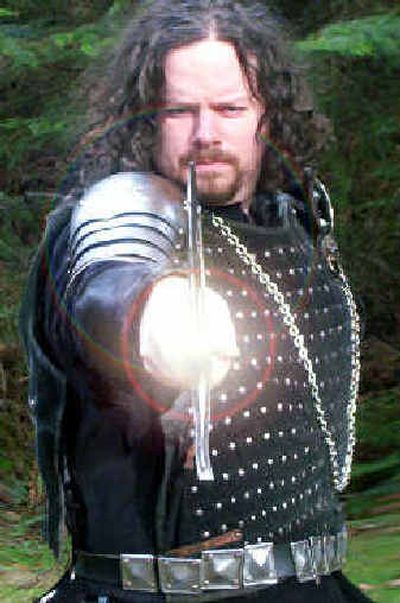
OLYMPIA – Voters, meet congressional candidate Glenn Coggeshell.
He’s the one dressed in medieval armor and brandishing a sword.
“The battle for Middle Earth has begun in Washington, D.C.,” Coggeshell’s Web site announces. “Good versus evil. Right versus wrong.”
Coggeshell’s running with virtually no money, campaign staff, or hope of winning a seat in Congress in November. Still, he felt strongly enough to plunk down the $1,581 filing fee. His “Lord of the Rings” political theatrics are meant as a joke, he says, but his campaign isn’t. He’s for tax cuts and gun rights and opposed to abortion.
“We’re going to have to get back to the way it used to be: normal citizens who give a crap, not professional politicians who pad their wallets and jump from one job to another,” he said, as Navy jets roared over his Camano Island home. “I’m not your everyday pansy politician. If they want to paint me as a wacko, then bring it on.”
Coggeshell’s long-shot candidacy is hardly unique. Scores of little-known Washingtonians have thrown their hats into the ring this year, running on platforms that span the ideological spectrum.
For those long-shot candidates who are serious, the first and biggest problem is simply to get the word out that they’re running. Political reporters tend to ignore them. TV or radio spots are out of the question; most long-shot candidates can’t even afford yard signs or bumper stickers. Instead, they tend to rely on Web sites or voters’ guides, and they go to every event that will have them: homeowners’ associations, church forums and small-town chambers of commerce.
“I feel I’ve got as good a chance as anybody,” said Bill Meyer, a retired longshoreman and honeybee pollinator running for governor. He recently gritted his teeth and bought 100 stamps to send out mailers. He’s still chafing about the $48 he had to spend to get some campaign photos taken at Sears. And his campaign manager’s compensation consists of a trip to the Ellensburg Rodeo.
Still, the campaign trail can be grueling, Meyer says. He recently agreed to speak at a Grange forum near Kettle Falls. He drove for hours, got lost repeatedly, and had his return route severed by highway mudslides. Arriving late, he got about eight minutes to pitch his anti-crime and anti-litter candidacy to the small crowd. By the time he got back home in Bellingham, he’d racked up 2,100 miles on his aging Chrysler.
“I want no contributions, I want no signatures,” said Meyer, a Republican. “But please vote for me.”
Retired Spanaway teacher Donald Hansler is also running for governor, but as a Democrat. Hansler’s spent three years preparing.
“I’ve been saving my clothing budget money, not buying any new clothes so I’d have the money for my campaign,” he said. His war chest totals about $8,000, most of it from him, his wife and his daughter. If he wins, he figures he’ll have spent about 3 cents per vote.
After three years of preparation, Hansler’s detailed campaign platform rivals those of the major candidates in the race. But nobody’s paying much attention. He’s calling for a state income tax, and a statewide referendum to determine how much state government should spend. If parents rate a teacher highly, that teacher should get a bonus, Hansler says. And every Washingtonian should get basic health insurance coverage.
“My best friend thinks I’m dreaming,” Hansler said. “But at each forum, I take a few votes away from the other candidates.”
And, yes, he too trekked out to that same Stevens County Grange hall for the recent forum. En route, he hit a deer.
“I’m considered a minor candidate,” Hansler said. “But I’m definitely at the top of the minor-candidate heap.”
In Tacoma, Democrat Scott Headland is also running for governor. His main plank: to ring the state with government-run casinos to siphon gamblers and their money from Idaho, Oregon and Canada. Headland concedes that Washingtonians seem reluctant to allow more gambling, but says Indian tribes will expand it regardless.
“We might as well go ahead and join the party,” he said.
Headland hasn’t gone to debates or knocked on doors. He’s counting on a groundswell of support once voters see his pitch on TVW, Washington’s dare-to-be-dull government TV network. He and the other candidates got to do a free 8-minute campaign spiel.
“I’ve got these people beat,” he said. “All I need is exposure.”