
Argentina rolls past overmatched U.S.
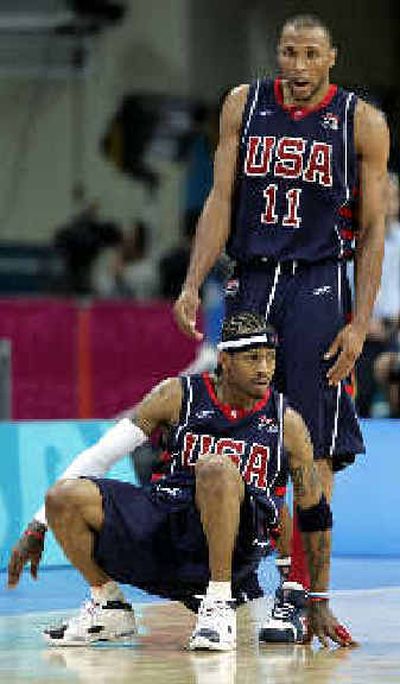
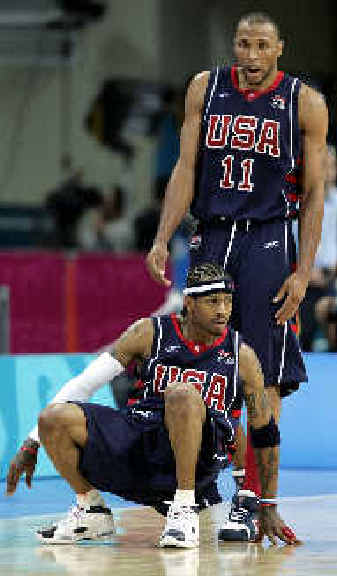
ATHENS — The assessments began long before Argentina’s players and fans celebrated their historic Olympic victory with a full-court fiesta.
The U.S. couldn’t shoot. The U.S. couldn’t defend.
My, how basketball has changed.
Once it was the rest of the world that had no shot.
Once it was the rest of the world that was defenseless.
The U.S. men’s basketball team, hurriedly assembled and seriously flawed, was beaten with surprising ease Friday night, 89-81, by the more-experienced, more cohesive Argentineans in a 2004 Olympics semifinal.
When, engulfed by the victors’ joyful postgame explosion, the Americans walked off the Olympic Indoor Arena court in a long, sad line, they were guaranteed an ignoble spot in U.S. Olympic history.
Diminished by pre-Games defections and defeated by a style of play unfamiliar to the NBA, the youthful U.S. team became only the third American men’s squad — along with those from 1972 and 1988 — to leave an Olympics without a gold medal.
They will play Lithuania tonight for a bronze medal just before Argentina and Italy meet in the gold-medal game.
The loss re-ignited speculation about the makeup of this Larry Brown-coached team and the Americans’ ability to adapt to an international style that rewards teamwork more than individual skills.
“Our game is more individual stuff,” said Brown. “And I think we’re moving further away from the game that they play here. … I’d just like to see one set of rules.”
Brown praised the Argentineans and, with star center Tim Duncan limited to less than 20 minutes by foul problems, criticized the officiating.
“They executed great and made shots,” he said of Argentina, which got 29 points from Duncan’s San Antonio teammate, Emanuel Ginobili. “But our best player, maybe the best player in the world, never got an opportunity to hurt Argentina. We’re not the same team without Tim Duncan.”
Duncan picked up two fouls in the first half. His final three came in a 1 minute, 11-second burst just as Argentina was extending its lead from 48-40 to 53-40.
“He never fouls out in our league,” said Brown.
The Argentines were built for these rules — a team filled with distance shooters, and big, quick bodies that can set perimeter picks and clog a zone defense.
The United States, without many pure shooters and natural centers, basically shot well from the outside in just one of its seven Olympic games — Thursday’s quarterfinal win over Spain.
Friday night they made only 3 of 11 three’s while Argentina hit 11 of 22. Stephon Marbury, who emerged from a shooting slump Thursday, re-entered, missing all three of his 3-pointers and collecting several of his team-high 18 points on meaningless hoops in the closing seconds.
After trailing, 43-38, at the half, the Americans fell out of the game at about the same time Duncan departed, eventually trailing by as many as 16.
The winners ripped off their sky-blue-and-white shirts and danced with their delirious fans. Several jumped up on the scorer’s table and became an arm-pumping conga-line.
The Americans, gathered at center court, soon gave up on waiting for the traditional postgame handshake. Fans, believing they were snubbing the winners, even though Argentina’s players were by then scattered all over the court and surrounding areas, booed the U.S. team’s exit.
And now the questions will begin: Did Brown and USA Basketball’s selectors assemble a team that couldn’t shoot, couldn’t defend inside and couldn’t win internationally? Should the NBA conform more to international form? Or should it be the other way around?
“A lot of fans in America think this is still 1992 and this was the Dream Team,” said U.S. assistant coach Greg Popovich, who coaches both Duncan and Ginobili with the San Antonio Spurs. “They think all we have to do is line up and we’ll beat foreign teams by 40 points.
“These guys are going to get criticized just because they didn’t win a gold medal. This isn’t the Dream Team. These guys volunteered to be on this team. They worked their (butts) off. And they just got beat by a better team.”
During an informal halftime news conference, NBA commissioner David Stern, one of the architects of the Dream Team concept that ignited basketball internationally, tried to ward off criticism of the team.
“I just don’t understand some of the wild press speculation that’s going on that helped fuel sentiment against this team,” he said. “This is a roster that 30 NBA teams would love to have. But the youngsters over here are beginning to dribble the ball instead of kick the ball now.”