
Athens came through in clutch
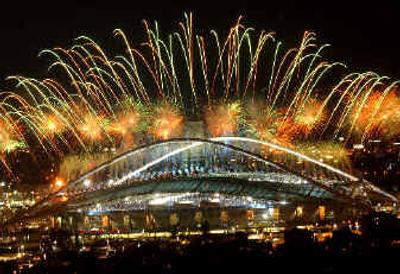
ATHENS — Under a brilliant full moon and the burning Olympic flame, the Greeks danced. They clapped, they sang, kicked up their legs and celebrated an Olympics that at one point was almost taken away, but in the end left them jumping with national pride.
After sponsoring 16 days of competition, and enduring years of ridicule and doubt about whether the Games deserved to return to their birthplace, the Greeks danced and danced in their modern Olympic Stadium. About 75,000 spectators clapped along as performers served up a giant Greek wedding feast of a closing ceremony, joyful that so much had gone right during the Games of the XXVIII Olympiad, and that so little had gone wrong.
Gone were the fears about terrorist attacks and smoggy traffic jams and unbuilt stadiums. The Athens Olympics had come to an end, and for the most part everything worked just fine.
Greece was the smallest nation in 52 years to host the Olympics, determined to recast Athens as a modern European city. In doing so, the country spent at least $7.2 billion on the Games, including $1.5 billion to provide security: an enormous sum that will take many years to pay off.
But complaints about costs were hard to find Sunday night, as Greece proudly handed off the Olympic flame to a nation 125 times its size — China, host of the 2008 Summer Games — secure that it had proved itself to the world.
“The Olympics came home and we showed the world the great things Greeks can do,” Gianna Angelopoulos-Daskalaki, president of the Athens Organizing Committee, told the crowd. “On this stage, the world discovered a new Greece.”
“Hellas! Hellas!” the crowd shouted, waving Greek flags and white hankies.
Organizers flooded the stadium with 250,000 balloons as thousands of fireworks lit up the sky. Under the dazzling light show, a succession of Greek singers and folk musicians kept the audience dancing. Toward the end, small groups of athletes from Brazil, Britain, France and elsewhere broke away from the security cordon and danced around the track.
Unlike the Opening Ceremonies, where fans loudly cheered the delegations from Iraq and Afghanistan and gave the silent treatment to U.S. athletes, politics were not on display Sunday night. Athletes from 202 nations entered the stadium at the same time, mixing together.
Earlier, Rogge cheered the Greeks in attendance by thanking them for their hospitality. “Dear Greek friends, you have won,” he said in their native language, before lapsing into French. “You have won by brilliantly meeting the tough challenge of holding the Games.”
Four years earlier, the IOC came close to yanking the Olympics from Athens. Construction and other preparations had barely progressed since the Games were awarded to Greece in 1997. Former IOC president Juan Antonio Samaranch revealed recently that Olympic overseers were about three months from making an emergency decision to move the Games to South Korea.
Spurred on by the threat, Greek officials worked feverishly. The challenges were substantial: Athens needed a new international airport, new highways, an expanded subway system and more than a dozen new athletic arenas.
As the deadline neared — the roof on the Olympic stadium slid into place just three months ago — there was little time for testing.
“At the end of the day, the biggest surprise to everybody is that there were no major issues,” Ioannis Spanudakis, managing director for the Athens 2004 organizing committee, said in an interview.
While the Athens committee met its attendance projections by selling more than 3.5 million tickets, many athletes performed in front of sparse crowds.
The closing ceremony, however, was a sellout. Even after the music died down, many Greeks lingered.