
Cure may be near for traffic headache
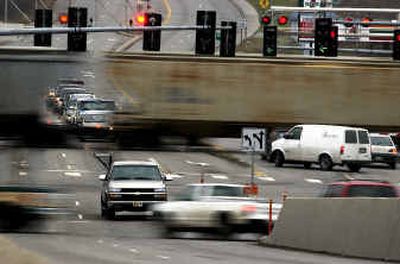
Jamal Dawud can see it out the windows of Wheelon Mobile Home Parts, a business where he works on Pines Road in Spokane Valley.
“If there’s a train, oh boy, it’ll back up a half-mile that way,” he said, pointing north.
Dawud was talking about the traffic that jams up at the two sets of stoplights and the railroad tracks that all sit within about one block of each other near the Interstate 90 interchange on Pines.
The messy intersection is just one problem complicating traffic and growth in that area. The city hopes to one day see Mansfield – an east-west street a block north of the railroad tracks – connected between the Pines area and Mirabeau Point area. That connection would improve the flow of traffic for the area. Currently, the route is blocked by some apartments and vacant land, and visitors to Mirabeau Point don’t have a direct route west out of the park area.
But the representative of one developer near there wants that plan abandoned in favor of a different route that would better serve the 360 to 400 apartment units the developer hopes to build there and other vehicles in the area, he said. Meanwhile, a Valley business’s plans to build a new office structure nearby are on hold until the intersection issues on Pines are worked out.
There is hope that at least some of the problems will be resolved soon. Last week, the Spokane Regional Transportation Council listed the improvements to the double intersection on Pines – which would involve consolidating the two sets of lights into one – as a top priority for $1.16 million in federal funding.
“There are two signals too close together,” said Steve Worley, a senior engineer for the city. “With the turning movements that are happening, there isn’t enough space between the two signals to allow the cars to queue up.”
Worley said the backup is causing air quality concerns.
The city is working on an arrangement where multiple parties would pay for the consolidation project. The Washington state Transportation Improvement Board has offered $2.2 million, the city would pay $55,000, the state Department of Transportation would pay $55,000 and private developers would give $500,000. Those figures, plus the $1.16 million from the federal government, bring the project total to almost $4 million.
Deputy City Attorney Cary Driskell said the public funding is confirmed, and the city is formalizing its agreement with the private developers now.
“My understanding is we’re very close to tying it all up,” he said.
Currently, one company’s hope for a new building a couple of thousand feet away from the double intersections is on hold.
InCyte Pathology, a business that does tissue and cell testing, had hoped to open a 26,000-square-foot office structure on Mansfield Avenue near Mirabeau Point Park by late next summer. The company leases a building on Indiana Avenue just west of Pines now, but planned to move its operations to the new offices by Sept. 1. InCyte spokeswoman Terri Montano said the company is just hoping now to get in by the end of the fourth quarter.
“We’ll have to come up with some contingency plans, but we’ll be all right,” she said.
The city said it didn’t stand on solid legal ground to allow the building to go up with what’s called a failing intersection – the double intersection on Pines – nearby. Intersections are deemed failing when there are either so many accidents or such a delay for motorists that the intersection doesn’t live up to state standards.
Once the funds to improve the intersection are secured, projects such as InCyte’s building can move forward, City Manager David Mercier said.
“You have to be able to say (the intersection consolidation) will be completed within six years,” he said.
InCyte was denied a building permit last month, Montano and Driskell said.
The company and the city came to an agreement, however, that InCyte could lay the foundation for the building with the understanding that there was no guarantee the double intersection would be fixed. The foundation work is under way now.
Details of the permitting process couldn’t be verified because the city hasn’t released the building and planning files related to the project to The Spokesman-Review. The newspaper submitted a public records request for the documents Dec. 6, but Driskell said he is reviewing whether there are statements in the documents that can be kept private under attorney-client privilege laws.
Meanwhile, on the same block where InCyte’s project is on hold, the Washington state Department of Fish and Wildlife is erecting a 14,500-square-foot structure.
Around the corner, work on the Centerplace community center is well under way.
Four city staffers couldn’t explain why the public projects were allowed while the private structure is delayed.
“We don’t know (why) at this point,” Driskell said. “… We are trying to wind through various documents to find out what was known at what time.”
InCyte’s project is at the west end of where Mansfield Avenue stops near Mirabeau Point Park.
The Fish and Wildlife building is at the corner of Mansfield and Discovery Place, to the east of InCyte’s, and Centerplace is north of there on Discovery.
To exit the area, vehicles can go south on Mirabeau Parkway and then east or west on Indiana, depending on which direction they’re headed. If they go west, they encounter the double intersection on Pines.
The only other way to get out of the Mirabeau area is to go north on Mirabeau Parkway to Euclid Avenue. Travelers needing to head either south or southwest still face the double intersection.
The city’s plans to connect Mansfield would require tearing down some apartments and building about 2,000 feet of road, but it would give people visiting the Mirabeau area a direct route west to Pines. The plan is currently in the city’s Arterial Road Plan, within the comprehensive land-use plan, but there are no immediate plans for starting the work.
Todd Whipple, a traffic engineer who represents developer Bill Lawson, wants the city to get the project out of its comprehensive plan. Although Whipple was part of a team that first suggested connecting Mansfield in the 1990s, he said there are better ways to improve traffic flow in the area.
Lawson hopes to build 360 to 400 apartment units in the area.
“Now, Mr. Lawson is coming forward and wants to move on his apartments,” Whipple said. “He’s got Mansfield showing up as an arterial that bisects his property.”
Whipple applied for an amendment to the city’s comprehensive plan in July that would eliminate the Mansfield connection project.
Spokane County is reviewing a traffic study related to the amendment now and the City Council is expected to consider it next month.