
Talented people get a boost
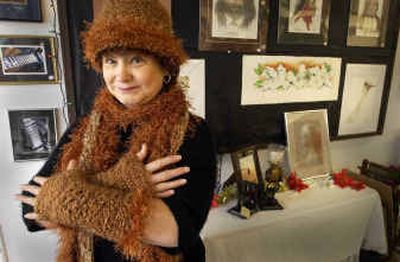
A woman’s order for $200 worth of custom knitting was more powerful than any medication Kathy Peterman has taken for depression.
The woman was shopping at The Associate’s Gallery, a new store Peterman manages in Coeur d’Alene. The gallery is stocked with attractive gifts – beaded jewelry, paintings, sand candles, woven boxes, knitted scarves – mostly handmade by people struggling with schizophrenia, bipolarity, depression and other stifling mental illnesses.
Depression has dogged Peterman. When her therapist in-laws, Dave and Liz Schmitz-Binnall, opened The Associate’s Gallery Dec. 1, Peterman bravely seized the opportunity to brighten her world. She not only produced flashy knitted scarves, wrist covers and hats to sell, she also volunteered to manage the store and work with customers.
Her decision was rewarded with the $200 order for her work within days of the gallery’s opening.
“I cried. I’ve really been blessed,” Peterman says, beaming. Tears spring to her eyes just remembering the order. “I’m so proud to be part of this.”
Her words are a Christmas gift for the Schmitz-Binnalls. The married social workers run D&L Associates, a private agency that offers people with mental illnesses job and life skills that can improve their existence.
The Schmitz-Binnalls have worked with people with developmental disabilities and substance abuse problems for years. But the mentally ill population grabbed their hearts. The Schmitz-Binnalls saw plenty of skills and talent in people who couldn’t handle traditional workplace demands.
“They have a lot of difficulty holding jobs,” Liz says. “It’s stressful. They need a lot of breaks. Employers can’t run a business if they can’t depend on their employees being there.”
Dave’s work in the field led him to believe his clients need meaning in their lives to move beyond their illnesses. Work supplies that meaning for most people, but the mentally ill usually don’t belong to the work force.
The Schmitz-Binnalls dreamed of designing a flexible workplace for their clients. Jo Sherman, a vocational rehabilitation counselor in Coeur d’Alene for the state Department of Health and Welfare, was their catalyst.
Sherman and the Schmitz-Binnalls work with the same people and had reached similar conclusions about how to help. Sherman started an arts and crafts group for her clients several years ago to show them they could create worthwhile products.
“It’s like art therapy,” she says.
Her clients created barrettes and earrings, wood carvings, stained-glass windows and more. Sherman was impressed. She arranged a weekend sale during Art on the Green a few years ago, then another at Christmastime. The sales were like medicine for her clients.
“They feel valuable to society,” Sherman says. “It increases self-esteem, self-worth.”
But transporting the crafts and managing two sales a year became overwhelming for Sherman after several years. Her clients had no skill at marketing themselves, so they wouldn’t continue the sales on their own. Sherman called the Schmitz-Binnalls.
“They’d said they’d open a store someday,” Sherman says. “That would be a permanent site for our clients’ work.”
Sherman’s call jolted the Schmitz-Binnalls into high gear. They decided to open a small, nonprofit gifts store and contract with mentally ill people to stock it. Contracted workers work as little or as much as they choose. When their crafts sell, they receive 90 percent of the price and 10 percent helps cover the store’s costs.
The store includes a workshop where clients can produce their crafts. They also can work from home if they choose. To fill out the store’s inventory, the Schmitz-Binnalls order factory-made gifts from a wholesale company. Twenty-five percent of those sales go toward the store’s costs.
About 15 people with mental illnesses supply the store now. Their work would stand on its own in any gift store. One craftsman is a disabled veteran in his 60s. He has schizophrenia. He creates sand candles – candles that sit in an artistic nest of rainbow-colored sand. They cost about $30 each. A bipolar woman paints lush scenes of the full moon over snowy fields. Another woman who fights anxiety sells her detailed drawings of Indian chiefs.
Prices range from $3 to $170. The Schmitz-Binnalls ask contributors to price their own products, but they often price low. Liz holds up a bright woven beaded bracelet as an example.
“The guy who made this wanted to price it at 50 cents,” she says. “I priced it at $3.”
Peterman knits high fashion scarves from fun fur and bubble yarn – stretchy, glitzy yarn – and creates memory wreathes – evergreen boughs decorated with family heirlooms. The Associate’s Gallery has added purpose and responsibility to her life.
“I’m so pleased things have sold,” she says as she finds a display spot for a handmade cradleboard a client just brought in to sell.
Peterman’s reaction tells the Schmitz-Binnalls they made the right move. They believe the store may offer some clients the confidence they need to go into business for themselves. Others will stick with the gallery, which will offer them enough satisfaction and motivation to improve their lives. Already the social workers have witnessed the store motivate some people with mental illness to try something they’d never thought possible: selling something they’d made.
“We all have creativity inside us,” Dave Schmitz-Binnall says. “They’re rediscovering their incredible talents. I tell them to show me what they made and what they show me blows me away.”