
Signatures forged, witness testifies
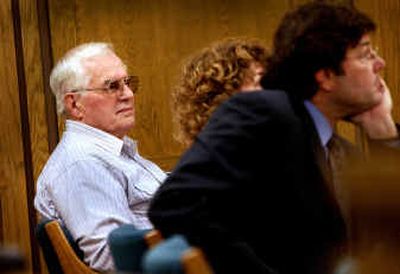

Orville Moe’s daughter regularly forged his signature on hand-numbered checks written at Spokane Raceway Park, a witness testified Monday at a hearing examining financial irregularities at the popular drag strip.
Former SRP employee James R. Tice of Spokane was called as the second witness for a group of 500 dissident “limited partner” shareholders whose civil suit accuses Moe of fraud and demands his ouster as general partner in Washington Motorsports.
Tice followed a forensic auditor, Norman Transeth, of Portland, who testified that Moe may have failed to report as much as $20 million in gate receipts at Spokane Raceway Park.
The judge is considering a request from the limited partners to appoint a receiver to take over all financial operations at the 30-year-old auto racing complex in Airway Heights. The hearing before Superior Court Judge Robert Austin is scheduled to resume at 9 this morning.
Orville Moe is expected to be called as a witness before the hearing concludes.
The 67-year-old millionaire, who lives modestly in a North Spokane home, could find himself invoking his 5th Amendment right against self-incrimination if asked questions on the witness stand about evading state and federal taxes and other alleged criminal conduct.
Tice, whose father started the American Hot Rod Association (AHRA) in 1956, briefly testified about his work as one of Moe’s employees at Spokane Raceway Park.
Tice said he was paid about $12,000 in 2003, including $1,000 for supervising the AHRA World Finals drag races in August of that year. He was paid $5,000 to $6,000 for similar work in 2002, he testified.
Under questioning by plaintiffs’ attorney John Giesa, Tice said he was not given a U.S. tax Form 1099 or a W-2 while employed at Spokane Raceway.
Tice testified the employee’s share of federal income taxes, Medicare withholding and state workers’ compensation were not withheld from his paychecks.
“Who signed those checks?” Giesa asked the witness.
“His daughter, Terry, signed the checks with Orville Moe’s name,” Tice responded.
“You saw her with your own eyes sign these checks with his name?” the attorney then asked.
“Yes, when she worked there, she would regularly sign his name on the checks,” Tice said. “Everybody used to joke that she could sign his name better than him.”
Tice testified that Moe’s daughter, Terry Graham, would routinely sign Orville Moe’s name to Washington Motorsports checks used to pay racers and employees.
The plaintiffs’ legal team, including Giesa and Portland attorney Mike Esler, apparently hope Tice’s testimony will help bolster their contention that Moe doesn’t follow regularly accepted bookkeeping practices in handling the racetrack’s finances.
Transeth testified that business records produced by Moe show he regularly paid employees in cash “under the table” and claimed a questionable $182,500 consulting fee on a 2003 federal income tax return.
Moe’s attorney, Carl Oreskovich, asked Transeth if that consulting fee could be the money Moe claims he’s owed, but has never been paid by Washington Motorsports.
“I can’t find out what that amount of money meant,” Transeth responded.
Under further questioning by Moe’s attorney, the accountant conceded that business records kept by Moe, including a check register and general ledger, showed who was paid money for prizes or work at the raceway.
But Transeth added that it was not acceptable to list only the person’s name, and not their Social Security number or home address.
Without those bookkeeping procedures, the witness said, it’s impossible to know when an employee has made more than $600, which is the annual wage limit before employers must fill out Form 1099s.
Oreskovich also asked the accountant about other records that showed U.S. Fast Foods, the concession company Moe owns, paid a 22 percent commission totaling $40,749 to Washington Motorsports in 2003. Transeth said those numbers were in the records produced by Moe.
But the same records also showed U.S. Fast Foods, which employed upwards of a dozen concession stand employees, only paid $1,472 for salary that same year, Transeth testified. He said that suggests employees were paid “under the table” to avoid state and federal taxes and withholding requirements.
U.S. Fast Foods has been cited by the state Department of Labor and Industries for violating state employee withholding laws.
“Were the records adequate?” Esler asked of the race track’s books and hand-numbered checks.
“No, I don’t believe they were,” Transeth responded, saying it was “highly unusual and unreliable” for a business not to use pre-printed, numbered bank checks.
“When you have unnumbered checks, it’s almost impossible to reconcile the bank account,” the witness said.