
Auto landscape continues to surprise
While none of us was paying attention, the first decade of the new millennium sped toward its midpoint.
Now we’re four years deep into the decade and the millennium and the automotive landscape continues to surprise. This will be remembered as the year gas-electric hybrid technology proved to be more than a fad, the Mercedes-Benz/Chrysler merger bore its first impressive fruits and exotic new braking systems worked their way into the mainstream.
The Rise of the Hybrids
Two Japanese rivals duke it out at technology’s leading edge – Toyota’s Hybrid Synergy Drive (HSD) versus Honda’s Integrated Motor Assist (IMA).
In each system, an electric motor supplements the efforts of a small gas engine. There are key operational differences, but both systems produce excellent fuel economy and greatly reduced emissions.
Neither system needs to be plugged in — their battery packs are recharged during operation — and neither imposes a comfort or convenience penalty; these cars are as easy to live with as any on the market.
Honda has taken the more aggressive stance by integrating IMA into its Civic and Accord lines, while Toyota has licensed its technology to Ford, for use in the small Escape SUV hybrid.
General Motors has dipped its toes into the hybrid pool, with a system that automatically shuts down and restarts the engine at idle, and GM and ChryslerDaimler have announced plans to co-develop a full-on hybrid technology.
Hybridization is generally regarded as a transitional strategy that will bridge the gulf between petroleum-thirsty internal-combustion engines and some future alternative-energy technology.
Honda is hoping it’s hydrogen. It’s developing hydrogen-based fuel-cell technology, and an accompanying solar-powered, home-based hydrogen-generation system that would produce enough power to warm the home and fuel the vehicles.
Meanwhile, Volkswagen sent us a half-dozen of its TDI turbo-diesel-powered models for testing. They are impressive — economical, spry and fun to drive — but are not yet ready for prime time, thanks to too-high emissions output. VW is confident it can clean up its act in time for the next round of clean-engine mandates and we hope so; their turbo-diesels are way too cool to bite the dust.
ChryslerDaimler Union Reaps Its First Fruit
Mercedes-Benz DNA made the trans-Atlantic leap into the heart of the Chrysler family this year, with the all-new Crossfire sports coupe, which is essentially a re-skinned M-B SLK.
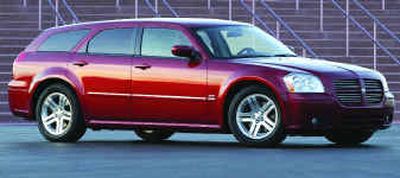
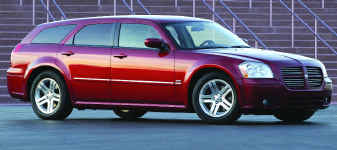
More critical to the marriage’s long-term success, however, are the Chrysler 300 and the Dodge Magnum. Both are the beneficiaries of German engineering — the Magnum even rides on MB’s E-series suspension — but also incorporate plenty of Chrysler, especially under the hood.
They’re exciting cars to look at and, whether you love them or hate them, they will make you turn your head. That alone isn’t enough to resuscitate the foundering Chrysler auto lineup, but it’s a great first step.
Safety Continues Its March
In the mid-‘90s, we were invited to Austin, Texas, to sample the latest from Mercedes-Benz and at that time encountered some exotic braking technologies, including Brake Assist and Brake Force Distribution.
The former stands ready to step in and apply the anti-lock system when it senses the driver has made a substantial stab at the brake pedal; the latter makes certain braking power is applied equally at all four corners, helping the car stop in a straight line.
In 2004, both technologies penetrated deeply into the industry. Engineering-centric German companies still pioneer these technologies, but these days even the most humble Korean manufacturer is not far behind.
Noteworthy Drives
An occasional benefit of this gig is getting the opportunity to drive vehicles that aren’t normally seen in these parts.
A mid-summer trip to Minneapolis put us behind the wheel of the new Mini convertible, which improves on the exuberant cheekiness of the original by subtracting the fixed roof. If there’s a better way to spell fun, I don’t know it.
Unfortunately, you still have to cross the mountains to get your hands on a Mini — and have it serviced.
The same is true for the most exotic car we drove this year, the Bentley Continental GT.
In honor of the opening of a new Bellevue dealership, Bentley made a handful of their rarely seen vehicles available for press drives.
Bentley is a storied British marque, the high-performance counterpart of Rolls Royce. Founded in the 1920s, it entered the 24 Hours of Le Mans seven times between 1924 and 1930, and won five times.
Bentley was purchased by Rolls-Royce in 1931 and by Volkswagen a few years ago. Its two-car lineup is still hand-built in England using nothing but the highest quality leathers and wood trim, but the powertrains and platforms are strictly Teutonic.
The $162,000 Continental GT shares platforms with Volkswagen’s Phaeton, and a VW-designed W12 makes 552 horsepower and 479 pound-feet of torque. Even at 5,247 pounds, the Continental hammers the 0-60 sprint in 4.7 seconds, and has a top speed of 198 mph.
A height-adjustable electronic suspension keeps the Bentley flat and stable during high-speed cornering and the twin turbochargers kick in with a mighty burst of acceleration.
The task for Volkswagen lay not in building a technologically superior car, but in building one that that would evoke the great Bentley spirit. Perhaps only VW, with its sensational interior design skills (witness any Audi cabin) could have pulled this off. The Continental GT is a brilliant, evocative blend of Olde-English form and modern functionality.
It was fun masquerading as a member of the landed gentry while tooling about the outskirts of Snoqualmie Falls. And, just imagine, all this gentility, power and prestige can be yours for the price of a drive to the coast and the paltry sum of $162,000.