
Toll may pass 100,000
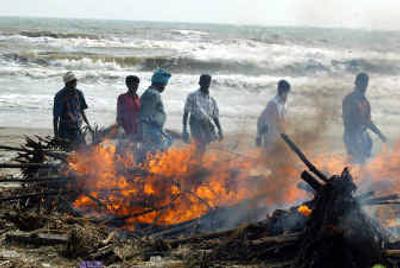
BANDA ACEH, Indonesia – Cargo planes carrying tons of relief supplies landed Wednesday in this wreck of a city, only to pile up at the airport for lack of trucks, gas and a distribution system. Half a world away, President Bush defended the U.S. response to the earthquake and tsunami that claimed at least 77,000 lives across 12 nations.
In his first public comments on the Sunday catastrophe, Bush said from his Texas ranch: “This has been a terrible disaster. I mean, it’s just beyond our comprehension to think about how many lives have been lost.” He pledged that the United States will “stand with the affected governments as they care for the victims.”
At the United Nations, a humanitarian coordinator said that the world must join together immediately to deal with one of the worst natural disasters in modern history. “Coordination is now vital,” Jan Egeland, of the United Nations, said. “The casualty number is rising by the hour.”
Egeland said his organization has asked for an immediate $130 million to help the areas hardest hit by the disaster, including Indonesia and Sri Lanka. He also said the United Nations would launch an appeal early next month to raise more than $1 billion in relief funds.
As the International Committee of the Red Cross warned Wednesday that the toll could exceed 100,000, the death toll continued to climb in Sri Lanka, but in fewer numbers, raising hopes that the worst of the carnage might be over in that country. The death toll in Sri Lanka now stands at more than 22,000.
Thousands of foreign tourists, many of whom had sought sunny beaches as a respite from dark northern European winters, are among the missing.
In the days after the disaster, Indonesia has emerged as the most devastated in terms of lives lost. A U.N. official estimated that the country’s death toll could reach 80,000 once authorities are able to get into areas cut off from outside assistance. Authorities said the cleanup effort was plagued by continuing fuel shortages and the unwillingness of residents to help collect bodies for fear of finding their family members.
The first Indonesian military teams reached the city of Meulaboh on Wednesday and found what was described as thousands of bodies. Michael Elmquist, head of the U.N. Office for the Coordination of Humanitarian Affairs in Indonesia, said that as many as 40,000 people might have died in Meulaboh, a city of about 100,000 people on Sumatra’s west coast south of Banda Aceh. Elmquist said he based his estimate on an aerial survey of the city.
And confirming the worst fears for the Sumatran coast, a helicopter flight by a military commander for the region Wednesday revealed village after village covered with sea water, flattened homes and only a handful of survivors in the rubble.
International aid and foreign doctors began trickling into the hard-hit Indonesian province of Aceh as the first two Australian military cargo planes landed in Banda Aceh, the provincial capital. But little food or medical assistance appeared to be reaching camps where thousands of survivors have taken refuge.
The government accelerated efforts to collect rotting corpses from the debris-strewn streets of Banda Aceh, dispatching 40 trucks to pick up bodies.
Aceh has been under strict military control for the past 18 months as the Indonesian army battles separatist rebels. Few outsiders have been allowed into the province, but that is changing. Dozens of foreign journalists have raced to the region. Medical teams from Singapore, Japan, Malaysia and Taiwan also have arrived.
When the first Australian flight landed in Banda Aceh, Australian Group Captain John Oddie was greeted by Gen. Bambang Darmono, who is scheduled to take command of the airport this week. The Australians plan five relief flights a day.
In an unusual exchange, Oddie offered to bring in a heavy forklift and crew to unload the aid planes as well as Indonesian aircraft arriving at the military airport. The Australian also offered to bring in a medical team today.
Bambang said he would consider the proposal but did not have the authority to accept the offer.
“Come back tomorrow,” he said.
At the airport, hundreds of boxes of rice, noodles and bottled water were piled up waiting to go to refugee camps, but no distribution system had been set up to deliver the goods. The officer in charge said he gives supplies to the camps that send a truck and ask for them.
At a camp set up on the grounds of television station TVRI, about 2,000 refugees were subsisting on the small amounts of food they were able to take from their homes and a meager supply of rice handed out by the Indonesian Red Cross. Student volunteers dispensed aspirin or amoxicillin to refugees who complained of illness. The camp has no latrines.
A mile up the road at Mata Ie, a camp set up by the Indonesian military, dozens of injured refugees lay on cots in the medical tent but there was no doctor to treat them. The smell of death hung over the hospital, where workers were starting to bury more than 500 bodies. Dozens of patients lay on cots and wooden benches in the corridors and the lobby. Bloody bandages lay on the dirty floor. Several patients moaned for help.
Mahmud Bakhtiar, 25, who lost 16 family members including his father and seven brothers, suffered a broken arm when he was caught by the tidal wave. Four days later, he still had not been treated by a doctor.
“I asked for one, but they promised nothing,” he said. “I have no idea where to go. I feel very sad. All my family, all my cousins, my nephews are dead. My arm hurts.”
Over the past two days, dozens of doctors have arrived from other parts of Indonesia and from abroad to staff the facility. The hospital’s biggest problem now is a shortage of fuel, said Aryono Pusponegoro, a doctor from Jakarta, the capital, who has become the hospital’s temporary administrator.
The desire to bury each body in a shroud, according to Muslim tradition, has caused shortages. “That’s why we don’t have any more sheets in this hospital,” a doctor said.
In Thailand, officials said Wednesday that as many as 3,000 people, many of them foreign tourists, might have died at Khao Lak on the country’s southern coast. More than 1,800 bodies have been recovered at the resort, which is popular with both Western and Asian tourists.
In India, officials estimate that about 12,500 people have died, although only 7,000 have been confirmed. Authorities fear as many as 7,000 might have died in a cluster of more than 550 islands, but have not yet reached all that are inhabited.
In Sri Lanka, the body count continued to rise Wednesday as rescue workers reported 743 more deaths, lifting the nation’s official toll to 22,493, according to the National Disaster Management Center in Colombo, the capital. But the increase was far less than previous days. The center also reported 8,600 people had been injured, with several thousand still missing.
Many continued to hold out hope their missing relatives might be located. “We went to look for him but didn’t find him,” said Ravindranath Thenuwara, a 32-year-old iron worker who lives just south of Colombo, speaking of a missing nephew. “We hope he turns up.”
There were reports that some trucks bearing supplies bound for Tamil areas had been hijacked with the aid diverted to other groups.
The separatist Tamil Tigers’ reclusive military leader made a rare appeal on the movement’s Web site for help. “I solicit the support and magnanimous assistance of the international community and the U.N. agencies to help our people in distress,” Velupillai Prabhakaran was quoted as saying on the TamilNet site. Prabhakaran has led the guerrillas during a protracted civil war.
Aid, meanwhile, has started to arrive in Sri Lanka in substantial quantities, government officials and aid workers said Wednesday, providing some faint hope to hundreds of thousands of Sri Lankans left homeless, injured or grieving for loved ones.
Civic groups have helped a great deal, said Rangith Mudalige, director general of the Sri Lankan Red Cross, as he juggled a host of phone calls and staff interruptions. Several teams of doctors are on the ground from countries around the world, as are more medicine, food and relief items.
Sri Lanka has now been able to truck 125 tons of supplies overland to different hard-hit communities. Russia and the United Arab Emirates delivered large shipments late Tuesday. And the United States has increased its cash contribution to $2.6 million in addition to “large amounts” of commodities aid, said Chris Long, a U.S. Embassy spokesman in Colombo.
In some cases, however, aid-laden trucks are having trouble returning to Colombo to fill up with another load, given gasoline shortages in many areas.
Another major concern is the scarcity of drinking water, which at this stage is a more urgent problem than food, the Red Cross’s Mudalige said. A key factor is that many areas have seen their wells inundated with seawater, a situation that can take months to rectify.
Around much of Sri Lanka, meanwhile, locals have set up collection points to help channel money, food and medicine to victims. The country has shown support in less tangible ways. A blizzard of white flags – white is worn to funerals and is the traditional color of mourning here and elsewhere in Asia – has sprouted on stores, lampposts and even flapping from motorized three-wheel rickshaws.
“We wish that all those who are dead will ascend to Nibbana,” or heaven, said a hand-lettered sheet tied to the gates of the University of Colombo.