
Neighbors pool funds to apply for zone change

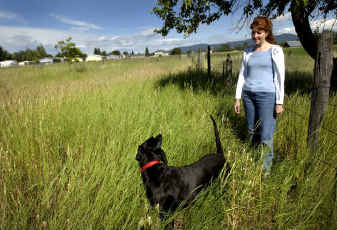
In Mary Pollard’s kitchen Monday, neighbor Diane Johnson stood at the sink gently washing strawberries they’d picked from the yard. Johnson keeps a key to Pollard’s house in case she ever needs a cup of sugar or an extra egg.
That’s how neighbors are in Pollard’s Greenacres neighborhood – they share sugar, watch each other’s children and walk house to house, enjoying the countrylike setting.
Pollard doesn’t want her lifestyle to change, so she and her neighbors raised $1,800 to apply for a zoning change from the city of Spokane Valley that would prohibit developers from building more than 3.5 houses per acre there. Currently, six houses are allowed per acre.
“We know which car is going down the street. We know who belongs here,” Pollard said. “That’s not going to happen if more houses go in.”
But the neighborhood’s bold and unusual move to preserve its lifestyle is only half the story.
Pollard is on a mission to educate citizens about the Growth Management Act, the state law that dictates how communities must plan for future growth. She organized a meeting for the public to learn about the law, which will be held at 6:30 p.m. Wednesday at the Central Valley School District Administration Building. State Rep. Lynn Schindler; Tim Harris, chief counsel for the Building Industry Association of Washington; and Marina Sukup, the city of Spokane Valley’s Community Development Director, will participate.
Pollard argues that Spokane Valley leaders oversimplified the law at a series of public meetings held this spring and that the comprehensive land-use plan, a 20-year blueprint for growth, is being written without serious consideration of citizens’ desires.
“Knowledge is powerful,” Pollard said. “We need an educated community, but people are afraid of conflict. Sometimes you need to rock the boat a bit.”
The meetings, in which citizens were asked to act as “mayors for the day” and brainstorm changes they’d like to occur in their neighborhoods and citywide, were conducted on an elementary level, she said.
“Serious things should be treated with the respect that serious things merit,” Pollard said. “We shouldn’t trivialize them.”
Sukup applauded Pollard’s efforts to educate herself and the public, but she said the meetings weren’t designed to provide in-depth examination of the law.
“To try to do that in a two-hour meeting with 40 to 70 people in the audience is very difficult,” she said. “No, it’s not difficult; it’s impossible.”
She said the city’s staff is integrating citizens’ concerns into a comprehensive plan draft now. In the fall, the public will view the draft during another series of meetings. At that point, the staff will ask citizens: “If we didn’t get it right, let’s fix it. If we didn’t go far enough, let’s go back and see what needs to be done,” Sukup said.
Pollard said she’s trying to ensure more people know how to preserve their neighborhoods and understand when the city makes the decisions it does. She compared city growth with the game of Monopoly, where developers with the most property have more power over the other players. Pollard wants the homeowners who bought into the rural lifestyle to have their say, too.
“Growth Management says you must grow, but there has to be an option to not grow,” she said.
In fact, the Growth Management Act reads that comprehensive plans must include “a housing element ensuring the vitality and character of established residential neighborhoods.”
Meanwhile, Sukup said the Planning Commission likely will hold a hearing over the proposed zoning change in late August.
The affected area encompasses more than 250 houses and sits between Barker Road to the east, the Spokane River to the west, Mission Avenue to the south and the Centennial Trail to the north.
Ideally, the neighbors would like to limit growth to one house per acre, but such a zone doesn’t exist yet. The Planning Commission is considering creating a one-house-per-acre zone for the Ponderosa neighborhood across town, and a public hearing will be held regarding that issue next Thursday.
The $1,800 zoning-change application cost includes a $1,500 application fee and a $300 charge to complete a State Environmental Policy Act checklist.
Sukup said she’s never known a neighborhood to pool its money to apply for a zoning change.
“It really is remarkable,” she said.