
Car bomb kills at least 10 Iraqis in Baghdad
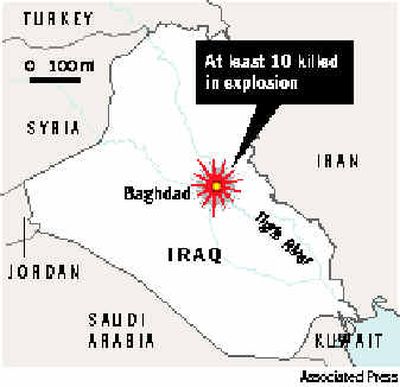

BAGHDAD, Iraq – A suicide bomber killed at least 10 people and injured 40 at a busy checkpoint in Baghdad on Wednesday, ending a quiet spell since the restoration of Iraqi sovereignty with a powerful blast outside the new government’s compound.
In a separate incident, guerrillas assassinated the governor of the northern city of Mosul in a targeted ambush on the road to the capital.
The insurgents apparently knew which car carried Gov. Youssef Kashmola when they attacked his convoy with a grenade and gunfire, said an official from the Interior Ministry. The governor, two bodyguards and two suspected assailants died in the incident.
Although insurgents’ attacks haven’t abated since the June 28 hand-over of limited authority, Wednesday’s blast was the worst since Prime Minister Iyad Allawi took office. With Americans in charge of clearing the scene, gathering evidence and counting casualties, the bombing also revealed how little control Iraq’s new leaders wield in tackling the nation’s No. 1 problem: security.
Flanked by American bodyguards, Allawi showed up to survey the damage: a deep black crater, smoldering cars whose drivers burned to death, crumbled concrete security walls and a carpet of jagged metal debris. The prime minister said the attack was retaliation for the arrests of suspected terrorists, though he declined to give details.
“This is a naked aggression against the Iraqi people,” Allawi said. “We will bring these criminals to justice.”
The bomber drove a green SUV packed with 700 pounds of explosives, according to a preliminary report by the Interior Ministry. He joined a line of cars waiting at a checkpoint and drew attention by refusing to show an ID badge, witnesses said. Seconds later, the bomb went off.
Among the dead were three Iraqi national guardsmen and seven civilians who reportedly were waiting to apply for jobs in the Green Zone, the fortified compound that houses the U.S. and Iraqi administrations. One American soldier was injured.
Several of the victims had gathered to mark an important historical event Wednesday, the anniversary of the 1958 overthrow of the Iraqi monarchy.
American forces had stepped up security early in the morning in anticipation of attacks on the national holiday, U.S. Army Col. Mike Murray said. That evening, a reception proceeded as scheduled to mark the day when King Faisal II was removed and Iraq became a republic.
Security was tight at the reception and several high-profile Iraqis attended, including embattled politician Ahmad Chalabi and tribesmen from the insurgent-run city of Fallujah.
Sharif Ali ibn al Hussein, a descendant of the royal family, blamed the overthrow of the monarchy for the rise of the dictatorship of Saddam Hussein.
“This is the day legitimacy and democracy died in Iraq, and we continue to pay the price,” he said. “Even today, there were bombings and the resort to violence to achieve political ends.”
The 9:15 a.m. blast was heard throughout Baghdad, shattering the windows of nearby shops and sending a ceiling fan crashing down on one family’s breakfast table.
Onlookers quickly flooded the streets as ambulances screamed down the road and American military helicopters hovered overhead. Residents said they knew living near a main route to the Green Zone was dangerous but that they’d hoped there would be no more bombings once Iraq returned to sovereignty.
“Why are they still doing these explosions?” wailed Abu Salman, whose wife swept rubble from their courtyard. “What more do they want?’
“We were just eating breakfast,” said Zahra Murad, a neighbor. “We have no more blood left to shed. Death is above us and underneath us.”
The bombing brought chaos to Yarmouk Hospital, where more than a dozen shrapnel-filled victims waited to be wheeled to the single X-ray machine. Distraught Iraqis barreled into the ward, shouting the names of relatives they hoped to find. Police outside fired guns in the air to clear a path for ambulances.
Salam Baqur and his wife, Zahra, were waiting for a cab when the bomb went off. The blast embedded shrapnel in Baqur’s back. His wife, a schoolteacher, was still missing.
“She was next to me before the explosion, and then I couldn’t find her,” Baqur said, his voice cracking.
At the bombing scene, Americans led the search for evidence. An explosives-sniffing dog dug through rubble as investigators painstakingly read scraps of paper and measured the crater. They worked under a massive Iraqi flag and next to a wall where a graffiti artist had scribbled, “Don’t make us thieves or terrorists.”
Iraqi police and guardsmen could only watch. They weren’t even in charge of crowd control; U.S. armored vehicles and soldiers kept bystanders behind razor wire.
Iraqi guards said they were humiliated by American troops who sidelined them and barked orders. Yet they conceded they were ill-equipped to prevent such bombings and lacked the forensics experience to lead an investigation.
For many, the bombing proved there were probably years ahead before Iraqis were truly in charge of protecting their country.
“This gives us more courage and, one day, we’ll have more power,” said Haider Abdul Redha, a 24-year-old member of the national guard. “This is a crime against the new government, intended to destroy Iraq and keep the Americans here. But we’ll fight the enemy until our last breath.”