
Patsy Clark’s looks like a million
The law firm that bought the Patsy Clark Mansion moved in last month, and lawyers are working amid $1 million worth of construction at the eclectic Spokane landmark.
A new roof’s been put on. All the rugs were removed, and the original hardwood floors were refinished. The electrical wiring, plumbing and irrigation systems were replaced. All the woodwork has been painstakingly refinished or replaced with historically accurate duplicates.
It’s a work in progress that was supposed to be done six months ago, said Richard Eymann, partner in Eymann, Allison, Fennessy, Hunter and Jones, P.S. A separate entity formed by the law firm’s partners, called Spokane Civic Group LLC, bought the building for $1.03 million in February 2003. It closed as an upscale restaurant in May 2002.
Eymann said the lawyers are learning firsthand how important the building is to the community.
“When we don’t mow the lawn here, all the elderly ladies let us know right away,” Eymann said. “This building has such a tradition.”
Designed by celebrated Spokane architect Kirtland Cutter, the 12,000-square-foot, three-story mansion at 2208 W. Second Ave. was completed in 1897. Built for Spokane mining millionaire Patsy Clark, Cutter designed the residence to be the “most luxurious mansion ever” after a directive from the owner, according to Spokane’s Historic Preservation Department. Cutter collected materials and furnishings for the house from around the world.
Patsy Clark lived in the mansion until he died in 1915, and his wife, Mary, lived there until 1926, the Historic Preservation Department’s Web site says. After being owned by investor Eugene Enloe, the house served as the Francis Lester Inn, a restaurant and event location, until 1982. At that time, the mansion was restored as Patsy Clark’s Restaurant.
The building is on the National Register of Historic Places, and consultants have been brought in to ensure historical accuracy in everything from paint color to lighting fixtures.
Individual heating and ventilation units were installed in each room. A new bathroom was built on the first floor, made to match the Irish Room, which will be remembered by diners as the principal dining room. All the kitchen equipment was removed and the formerly boarded-up windows were reopened and restored.
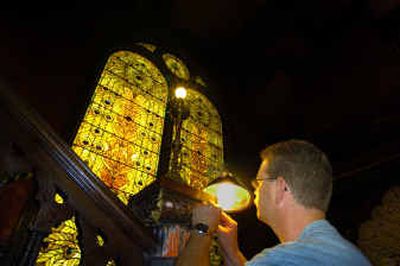
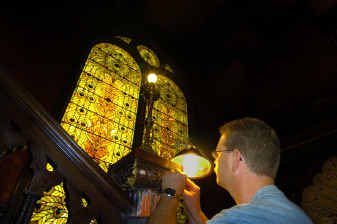
On Wednesday, the receptionist sat on the landing below majestic Tiffany stained-glass windows as a craftsman painstakingly restored the detail in the dark wood columns above her.
“The crews here have spent hundreds of hours fixing all the nicks and bruises from it being a restaurant,” Eymann said. “Everything has been trying to take it back to the original or make it look original.”
The patio on the building’s east side was reopened after being boarded up. A fountain is being built on the lawn below the patio. All the damage was repaired on the building’s decks and nine fireplaces. The Spokane lighting company Luminaria designed all the lighting for the second floor.
Wall coverings made in the mid-1800s in a German monastery were sent to a woman in Moscow for cleaning and will be reinstalled.
Not much is being done to the exterior, except painting and tearing out the driveway, which will be replaced with landscaping and a brick walkway. A handicap-accessible entrance is being installed to the front of the building, wrapping around on the west side.
The law firm plans to allow local organizations to hold meetings in its new first-floor conference room, also known as the French Room. It will include removable tables, a retractable projection screen and 20 computer hook-ups.
The firm also is planning to arrange for a tour schedule to allow the public access to the mansion, Eymann said.