
Security measures unleash protesters
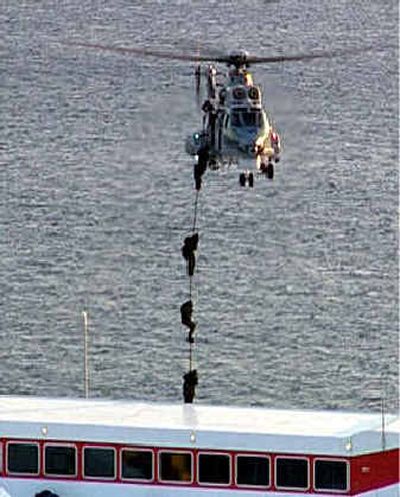
ATHENS, Greece — Athens’ main port was sealed for two hours Tuesday to allow divers to install an underwater monitoring system as part of an Olympic security network that protesters contend is a privacy invasion.
The fiber-optic cables are a key element of an electronic web of cameras, sensors and other intelligence-gathering devices designed to help safeguard the Aug. 13-29 Olympics. Greece is spending $1.24 billion on Olympic security.
Although the devices are considered necessary for security, several groups said they will demonstrate against their use. Anti-globalization groups said they would protest outside Greece’s parliament. Some political parties also have expressed concerns.
Police officials tried to reassure Athenians that the electronic monitoring system, which includes a blimp and thousands of infrared and high-resolution cameras, will not violate privacy.
The 200-foot blimp, which carries chemical “sniffers” and high resolution cameras, will start flying over the city this week, police said.
“The security measures are being implemented with complete respect for human rights and according to the guidelines set out by the agency responsible for privacy and data protection,” police spokesman Lefteris Ikonomou said.
Groups opposed to the security measures, including a group called Campaign Anti-2004, said at police headquarters that they would demonstrate in protest outside parliament.
“For us the Olympic Games are not welcome. The culture of the Olympic Games is not ours,” the group said in a statement.
A different kind of strike
Ambulance crews and other emergency service personnel threatened to strike during the Olympics unless they receive extra pay for work at the Games.
It was the latest warning by Greek unions seeking government bonuses for canceling vacations to be on full duty during the Aug. 13-29 Olympics.
“We have decided to strike during the Olympics if we do not get an Olympic bonus like the security forces,” said Ilias Ioannides, head of the country’s union of emergency service employees, which includes ambulance teams, paramedics and other medical rescue units.
Ioannides added that 2,600 emergency services workers have been specially trained to work during the Olympics, but he did not clarify what additional preparations were needed.
Labor groups throughout the country have held strikes and rallies to press for Olympic bonuses, which have been promised to police and other security forces in amounts up to $3,000. But the government has rejected more concessions because of skyrocketing Olympic costs projected to top $12 billion.
Female cyclist wins appeal
Mary McConneloug won her appeal to be nominated to the Olympic women’s mountain biking team, overturning USA Cycling’s selection of Sue Haywood and ending a bizarre process that will likely be remembered more for confusion than accomplishment.
The arbiter ruled that USA Cycling’s decision to add 15 points to Haywood’s international total — a decision that pushed her one point ahead of McConneloug in a yearlong battle for the lone women’s mountain start position allocated to the Americans for the Athens Games — wasn’t justified.
The ruling is binding, and McConneloug’s name will formally be added to the official Olympic roster today.
“The appeal was heard during a conference call Monday during which both riders were represented, as were USA Cycling officials.
McConneloug, the No. 2-ranked women’s rider in the world, filed the appeal because she believed USA Cycling, in nominating Haywood to the team, did not follow its own criteria — which states the top-ranked American rider in the International Cycling Union’s rankings will be chosen for the Olympics.
The UCI did not award Haywood with any points for a race held in Idaho nearly a year ago. Official results suggest Haywood would have earned 15 international points with her third-place finish in that event, but USA Cycling officials said those results were never forwarded to the international body’s offices.
When choosing which rider to nominate, USA Cycling included those 15 points in Haywood’s total — giving her 1,489 for the year ending July 12, or exactly one more point than McConneloug earned in that span.
Ethics classes for drivers?
Athens finally got its new tram. What it may need now is Olympic etiquette classes for notoriously erratic drivers.
The tram and the city’s wild traffic got acquainted after a train hit a motorcycle illegally crossing the tracks, police said. The two motorcycle passengers were slightly injured.
The motorcycle driver ignored a red light that gave the right of way to the tram, which began service Monday as part of upgraded public transportation for next month’s Olympics.
But it may take a while for drivers to become familiar with having to watch out for moving trams. The city’s old tram line closed in 1960 — to make room for more cars.
The initial response to the streetcars has been overwhelming. Hundreds of people waited at stops for a ride on the new line, linking the city center with the seaside.
Accused cyclist hits bottom
Sean Eadie, a cycling bronze medalist at the 2000 Sydney Games, said doping accusations that derailed his Olympic preparations had driven him to the verge of a breakdown.
Eadie said his coach visited him and recommended he see a doctor.
“I slept 30 out of 36 hours and vaguely remember it,” Eadie said in an interview broadcast on Australia’s Channel 7 network.
Eadie was cut from Australia’s Olympic squad last week after it became known the Australian Customs Service in 1999 intercepted a package that was addressed to him with 16 tablets containing a banned growth hormone.
A judge in the Court of Arbitration for Sport ruled Monday there wasn’t enough evidence to prove Eadie was guilty of trafficking a banned substance, clearing his probable return for next month’s Athens Olympics.