
Invasion of the aphids
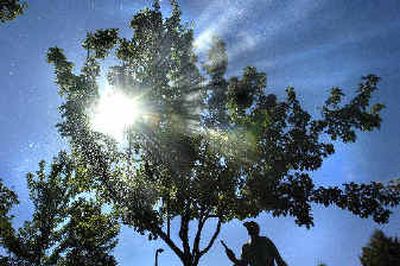
Sue Feulner first noticed the sticky problem on Monday. Drops of a sugary, sappy substance called honeydew covered her backyard concrete porch. The green leaves of the maple tree above glistened with honeydew in the sun.
“It was just all over the patio and we’ve lived here 25 years and we’ve never seen anything like that,” she said.
The problem?
Aphids – small, soft-bodied pests – were gorging on the underside of the leaves, sucking the sap out of them and producing honeydew, the aphids’ waste product.
It’s a nuisance area residents are calling about more than usual this summer, said Tonie Fitzgerald, an agent with Washington State University Extension Service in Spokane Valley. She suspects the “bazillions” of aphids all over Spokane and North Idaho simply comes down to food chain cycles.
“There’s a big aphid population for a year or two and as beneficial insects build up and feed on them, they knock off that aphid population,” she said.
She recommended do-it-yourselfers hose the problem leaves with a powerful spray of water to detach the pests from the leaves. Smaller perennial plants can be sprayed with a mild insecticidal soap, but she warned of overuse and the possibility of killing beneficial insects that eat aphids, such as ladybugs and the larval stages of hover flies and lacewings. Using insecticides during hot weather can even kill plant tissue, Fitzgerald said.
Professional landscaping companies also use soil injections to control aphid populations. The insecticide, injected four to five inches into the ground, can take up to two months to work because the trees need plenty of water to fully absorb it, said Dan Brunette, the North Idaho supervisor for Senske Lawn & Tree Care.
For more immediate results, Brunette said that Senske also sprays trees with a pesticide.
The sprayings usually last 10 to 14 days, and it may require two to three sprayings to eliminate the bugs, he said.
“The problem with the spray is that we’re going to control the insects that are there, but not the eggs,” he said.
“As soon as that application wears off, the new eggs are going to hatch and are going to come back up until those soil injections kick in.”
Brunette said the aphids in North Idaho have kept his company “plenty busy,” and he estimated that the pests account for a fifth of his business this summer. Senske’s receiving more calls than normal about aphids and seeing larger aphid populations when the technicians go out, he said.
Each spray on a full-grown maple tree, a popular pick with the aphids, costs about $40 to $50 at Senske, and the one-time injections cost $65 to $70, Brunette said.
Another solution is to capitalize on aphids’ natural predators, such as ladybugs.
“You go out right before dusk and you sprinkle ladybugs around the plants you want protected,” said Corey Epley, an employee at Northwest Seed & Pet’s North Division store.
The store sells ladybugs in a mesh bag of 1,500 for $5.99, and the insects can be kept dormant in the refrigerator for up to two weeks, he said.
Residents are snapping up the ladybugs quickly. The store sold out Tuesday, but received a new shipment of 64 bags Friday morning. Epley said he expects the latest shipment to last only four or five days, and he promptly ordered more.
“We go through them so fast,” he said. “This has just been an extremely bad year.”
But Fitzgerald, the WSU agent, said residents shouldn’t worry too much about aphids munching on their plants.
“Healthy trees can withstand this amount of feeding,” she said. “It’s not really harming the trees unless they’re really stressed.”
Yellow and wilting leaves as well as summer defoliation should tip off homeowners to these stressed trees, she said.
Watering the trees with a slow drip for several hours can help.
Annoyed residents can expect the aphids to die off in the fall, she said.
Anyone with questions about how to handle the aphid population explosion can contact the Washington State University master gardeners at (509) 477-2181.
Residents in North Idaho can call the University of Idaho master gardeners at (208) 446-1680.