
Armstrong makes it six
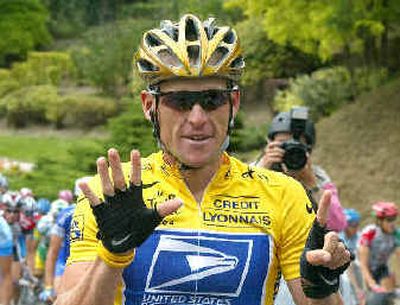

PARIS – The cobblestone-paved Avenue des Champs-Elysees became a yellow brick road Sunday, awash in the color of Lance Armstrong’s astonishing accomplishment.
Eight years ago this fall, the brash, stubborn Texan was battling for his life, undergoing surgery and chemotherapy for testicular cancer that had invaded other parts of his body like a hostile army.
As he celebrated his record-setting sixth Tour de France victory on the famous street where real armies once fought a literal war, Armstrong looked secure and relaxed, the new gold standard in his sport.
Sunday’s primary color was reflected everywhere – including the baseball cap he donned afterward.
The cap said LiveSTRONG, a slogan created by his cancer foundation that plays off Armstrong’s name and is emblematic of the way he has ruled the roads of France over more than 12,000 miles in the last half-dozen years.
“I wouldn’t be so bold as to say I dominated,” Armstrong said modestly of the 2004 race. He was restrained in Sunday’s formal ceremonies, doffing his cap to the masses and staying in steely control as “The Star-Spangled Banner” was played in his honor to respectful silence.
Later, Armstrong grinned happily as his U.S. Postal Service team did a slow-motion lap of the Champs-Elysees.
The Postal Service’s soundtrack for the parade was a hit song by Armstrong’s companion, rocker Sheryl Crow, who looked slightly abashed when “All I Wanna Do Is Have Some Fun” began blaring from the speakers along the course.
“He inspires me,” Crow said. “It’s easy to be there for him.”
Armstrong now has left the company of quintuple Tour winners that includes the late French gentleman-rider Jacques Anquetil; the intense and durable Belgian Eddy Merckx; hard-headed and hard-working Bernard Hinault, the last French champion; and gifted, introverted Spaniard Miguel Indurain.
“Winning in ‘99 was a complete shock and surprise for me,” Armstrong said. “Not that I’ve gotten used to winning the Tour de France, but I do know what it means.
“This one is very, very special. … I never thought I would win a second one or a third one. I’m humbled by the event. It’s always a challenge, it’s always different. A lot of people just one month ago thought it wouldn’t be possible for me to do it.”
There were doubts that Armstrong could prevail this year. At 32 he was at an age when many riders begin to slip, and his rivals in this edition of the race seemed more numerous and better prepared.
In Armstrong’s final pre-Tour tune-up race, Spain’s Iban Mayo obliterated the field in a time trial up Mount Ventoux, beating Armstrong by two minutes. Armstrong’s ex-teammate Tyler Hamilton outclimbed him too. Five-time runner-up Jan Ullrich of Germany appeared fit, as did ex-Postal rider Roberto Heras.
They all faded away, yielding to new riders who don’t yet have the moxie or legs to challenge Armstrong.
Hamilton injured his back in a mass pileup at the sprint finish of Stage 6 and was forced to withdraw a week later. Mayo abandoned after an early, inopportune crash and a miserable performance in front of his Pyrenees partisans. A demoralized Heras left the race quietly in the Alps.
Ullrich blew up on the first major climb and never recovered, finishing 8 minutes, 50 seconds behind Armstrong and off the Tour podium for the first time in his career.
The German’s T-Mobile team did have something to cheer about Sunday. Andreas Kloden finished second, 6:19 shy of Armstrong, and gave the champion a sweeping, hats-off bow on the podium. T-Mobile also won the team classification.
The Tour opened with Armstrong defending himself against doping allegations in a book released last month in France.
Proceedings turned bizarre Friday when, with the race decided, Armstrong took it upon himself to chase down a breakaway by Filippo Simeoni. The Italian rider has testified against his consultant, Dr. Michele Ferrari, in a doping case that does not involve Armstrong.
The race ended with Armstrong chiding fans who booed him and cheered Richard Virenque, the seven-time King of the Mountains and key figure in the 1998 Festina doping scandal.
“What kind of a champion do they want?” Armstrong asked rhetorically. “Do they want a champion that doesn’t work hard, that doesn’t love his sport?
“Don’t stand there and boo me and cheer for somebody that has been involved in the biggest doping scandal in the history of sport.”
Although Armstrong called fans who swore, spit and otherwise derided him “a vocal minority,” he did endure harsh heckling in the Pyrenees and rode the Alpe d’Huez time trial with special security personnel ahead and behind.
“If that’s the risk, to be loved you have to get second, I’ll take a few boos and hisses,” he said.
Surviving the rainy, windy, hazardous first 10 days of the Tour intact proved vital, as half the peloton took tumbles in the first week.
Armstrong finished second in the opening prologue mini-time trial and veteran one-day racers George Hincapie and Viatcheslav Ekimov led the way over the cobblestones in Belgium and northern France.
Postal won the Stage 4 team time trial, briefly putting Armstrong in the overall leader’s yellow jersey, but he made it clear he wasn’t interested in keeping it at that point.
Apple-cheeked, blunt-talking 25-year-old French rider Thomas Voeckler went out on a breakaway the next day and vaulted into the top slot.
He became the new darling of France by holding the yellow jersey until Stage 15. The developments played right into Armstrong’s tactical plan. To defend Voeckler’s lead, the Brioches la Boulangere team helped Postal control the race, easing the workload of Armstrong’s teammates.
Armstrong traded stage wins with Italian CSC rider Ivan Basso in the Pyrenees as the rest of the pack imploded. By the time the race entered the Alps, the defending champion was ready to assert himself.
He sprinted by Basso in the last yards of the uphill finish at Villard-de-Lans on his way to the first of three straight stage wins. The next day brought the Tour’s showcase, a time trial up the 21 switchbacks of L’Alpe d’Huez. Armstrong eviscerated the field, topping Ullrich by more than a minute.
Finally, and perhaps most tellingly, Armstrong rode in the lead pack throughout the Tour’s toughest climbing day, then sprinted to nip Kloden on the line at Le Grand Bornand. Armstrong’s subsequent time trial win on a flat course in Besancon was an anti-climax.
“It was a Tour where every day felt right,” said Jim Ochowicz, Armstrong’s team director at Motorola in the early 1990s.