
Arafat yields power over security forces
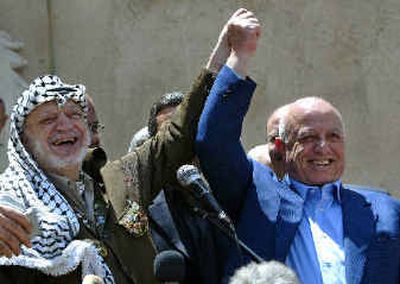
JERUSALEM – Palestinian Prime Minister Ahmed Qureia withdrew his resignation Tuesday after Yasser Arafat promised to give him limited power over Palestinian Authority security forces and to enact reforms. The agreement ended a two-week-long political rift that had threatened the Palestinian leadership.
“The president refused my resignation, and I will comply,” Qureia told reporters in the West Bank city of Ramallah after emerging from a closed-door meeting, kissing Arafat on the cheeks and holding his hand.
Qureia hailed Arafat’s agreement to yield some control over the security forces as a “new step toward reform and imposing the rule of law.”
The crisis broke out when Arafat named a cousin, Moussa Arafat, as chief of the Palestinian security forces. The appointment triggered an unprecedented display of street power in Gaza as members of Arafat’s Fatah movement, angered by official graft and the slow pace of democratic reforms, demonstrated, demanding Moussa’s firing and an end to cronyism in the security forces.
Gun battles erupted between young Fatah rebels and Arafat’s old loyalists. The battles were followed by a wave of kidnappings of foreigners and local officials, including the police chief of Gaza, which prompted Arafat to declare a state of emergency.
Then Qureia handed in his resignation, saying he couldn’t quell the violence because Arafat wouldn’t allow him to revamp the security forces. Arafat refused the resignation, but Qureia continued to insist he would step down.
Publicly, Palestinian officials were vague over how much control of the security forces Arafat had agreed to give up to defuse the crisis.
In private, they said the agreement gives Qureia control over the internal security units – the American equivalent of the police.
But Arafat would retain his grip on the bulk of the vast constellation of Palestinian intelligence services and military forces.
Arafat, the officials said, has also agreed to order investigations into corrupt officials within the Palestinian Authority, which controls the West Bank and Gaza.
In the past, Arafat hasn’t followed through on similar promises to hand over power. The previous prime minister, Mahmoud Abbas, quit last September after only four months on the job when Arafat kept control of the security services.
Qureia said he’s convinced that Arafat “is serious this time, that it is not just words, but that this time there will be action.”
But Arafat’s critics don’t believe him.
“This has been Arafat’s method for the past 35 years,” said Sattar Kassem, a political science professor at Najah University in Nablus who once ran against Arafat for the Palestinian presidency. “Each time he faces Palestinians who ask for reforms, he takes certain superficial steps, and he never carries out the demands of the Palestinian factions or the Palestinian people.
“What happened today, to me as a Palestinian, is meaningless.”