
Working for a better life
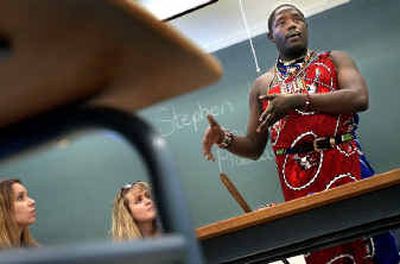
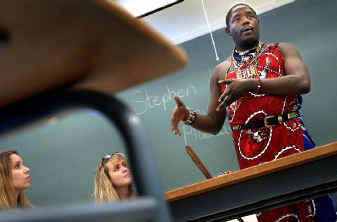
When Stephen Kaputa first came to Spokane five years ago, the Maasai warrior from Kenya discovered a new galaxy – a place where white flakes fall from the sky, where food could be ordered from a car window, where the doors to the grocery stores slide wide open.
Even more than the modern conveniences of America, Kaputa was awed by the women – by their independence, their jobs and the work they accomplished in the community.
“Women here have been given opportunities to have a better life,” said Kaputa, a member of the Maasai, a semi-nomadic tribe in southern Kenya and northern Tanzania. “In my country, girls don’t have that chance.”
Instead of going to school like the boys, Maasai girls often stay at home, said Kaputa. Some as young as 9 years old are forced to marry men who are often twice their age or older. Many also become the victims of female genital mutilation, a tribal custom practiced extensively among the Maasai. Considered a rite of passage, female circumcision – in which the clitoris is partly or completely removed to decrease sexual pleasure – is practiced because of an old belief that it reduces the chance of a woman having extramarital affairs. Its results, however, are painful and can sometimes lead to death.
“In our culture, educating a girl is a waste of time and money,” said Kaputa, who grew up in the village of Olooltoto. “This is wrong. If we do not educate our girls, we cannot eradicate poverty.”
His experience in Spokane, coupled with his dedication to the Maasai, compelled Kaputa to start a nonprofit organization to help these girls. Thanks to the sponsorship of about 400 people in Spokane and throughout the area, Precious Life International has helped about 500 Maasai girls pursue an education while escaping the fate of forced circumcision.
“Our main focus is to give girls the same opportunities as boys,” said Kaputa, 29.
Kaputa’s ties to Spokane began seven years ago, when Kim Bingle of Spokane met the young man during a missionary trip to Kenya. Fluent in six languages and raised in a Christian household, Kaputa served as an interpreter for the American missionaries.
“The sincerity of his heart and his desire to serve God impressed her,” said Kim Bingle’s husband, Lonny Bingle, pastor of Spokane Faith Center. When his wife returned from Kenya, she persuaded her husband to give Kaputa a scholarship to attend the Spokane Faith Center’s Destiny Ministry Training. The Bingles helped him obtain a visa to study in the United States while members of the nondenominational church provided Kaputa with room and board. In two years, Kaputa earned an associate’s degree in ministerial studies.
During his stay, Kaputa came to the realization that education is the key to alleviating poverty among the Maasai, a people whose average income is less than $10 a week.
More than half of the Maasai tribe cannot read and write, said Kaputa. Many also cannot afford to send their children to school past the eighth grade.
To raise money to help his people, Kaputa established Precious Life International, an organization that works with Christians and Maasai leaders to “eradicate the practice of female genital mutilation, early forced marriages and poverty among the Maasai tribe,” as well as to promote educational opportunities for girls. Now, Kaputa travels back and forth from Kenya to the United States several times a year.
In Kenya, he and a staff of six people talk to families and tribal leaders to persuade them to send their daughters to school. Unless the girls are enrolled in school, the government cannot keep track of them and protect them from the practice of female circumcision, Kaputa said.
In Spokane, he talks to classes, church groups and others about the Maasai and the injustices suffered by the girls.
Sponsors in the United States give $30 a month for each girl. According to Kaputa, about $4 of the $30 goes toward administration costs; the rest pays for school uniforms, shoes, books, school supplies, food and medical care. Since Precious Life became a nonprofit four years ago, the organization has raised a total of $50,000 for programs to help the Maasai.
Kaputa has encountered resistance from some members of his tribe, a group that has traditionally been wary of Western influences because of its struggle to hold on to its age-old traditions. Some parents fear that if their daughters are allowed to attend school, they might lose their cultural ties.
“Education will not destroy the culture,” Kaputa often tells them. “It will only strengthen the Maasai.”
When Bingle, along with associate pastor Scottie Branson, traveled to Olooltoto and other Maasai villages earlier this year, the pair was welcomed by Kaputa’s people. Although Bingle usually preaches about Christianity during his travels to the developing world, he and Branson chose instead to meet with tribal elders to assure them that they honored their traditions and had no intention of diluting the Maasai culture.
“We told them that Stephen came to us and we embraced him as one of our own,” said Bingle. “We asked them to embrace us as one of their own.”
During their five-day stay, Bingle and Branson met teenage girls who pleaded for the chance to go to school so their fathers would not marry them off. Those who already attended school through Precious Life offered words of gratitude to the people in the United States who have sponsored them.
Lives in Spokane have also been transformed as a result, said Bingle. Through Kaputa, people here have learned more about the Maasai culture, which until now seemed so foreign to some. They also have forged ties with girls and families who have benefited from their generosity, he said.
“People here have been touched with a sense of purpose,” Bingle said. “They have shown much compassion.”
Members of the Maasai rarely leave the arid lands of East Africa’s Rift Valley, Kaputa said. When they do travel overseas, the intent is always to gain knowledge but also to return and help their people.
Each time he meets with mothers and fathers, Kaputa tells them that cattle alone will not help their culture survive.
“Drought and famine will kill the cows,” he said. “But education cannot be destroyed. It is the tool we can use to fight poverty.”