
Softball’s Babe Ruth

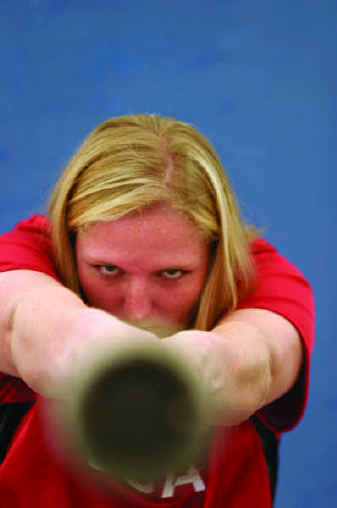
Olympian Stacey Nuveman did her interview by phone while sitting in a San Diego airport awaiting a flight to Northern California.
Her former coach, UCLA’s Sue Enquist, answered questions about the former Bruins star during an hour-long freeway commute home from work.
Such is life in the softball fast lane for two persons at the pinnacle of their increasingly popular women’s sport.
Nuveman, a catcher-first baseman and 2002 UCLA graduate, will be in Spokane on Saturday with her Olympic teammates for an exhibition double header against local all-stars as part of their five-month barn storming across the United States.
Enquist has been a part of ten Bruins national championships either as head or assistant coach.
Included are the last two and in 1999 when Nuveman led the nation in home runs with 31 and runs batted in with 91. She was a finalist that year for the Sullivan Award given the nation’s top amateur athlete.
“She comes from just a great family and talk about the consummate student-athlete,” said Enquist by phone from her car. “She absolutely did very well in school and could handle the ups and downs of sport. I think what made her so incredible was she was a prolific power hitter who also hit for average. It really separated her in the annals of UCLA softball.”
Nuveman became the NCAA all-time leader in home runs with 90 and slugging percentage at .945. She was a four-time first team All-American and only the second player to be named three times as Pac-10 player of the year. In all four of her seasons at UCLA the Bruins qualified for the college World Series and reached the finals twice.
Nuveman, who despite her busy team schedule handled broadcasting duties for ESPN during the Bruins’ run to the NCAA title, was highly regarded even before she played collegiately.
“She was,” said Enquist, “the top recruit in the country.”
Her sophomore year in high school she became a member of the USA national junior team that won the 1995 Junior Women’s World tournament gold medal.
“It was a big step knowing my name was in the loop,” Nuveman said. “It took off from there.”
And, at age 26 she still remains totally immersed in softball. It’s not so much sport as lifestyle, she said, what with the training, travel and time spent with the team to endorsement commitments and clinics. And players don’t get rich doing it.
“I’m very much in love with the game, you have to be to play at this level,” the newlywed explained. “Our life truly does revolve around it. Your talent won’t take you there, but that passion is what will.”
Like most athletes at the 6-foot Nuveman’s level, she grew up playing all manner of sports in La Verne, Calif., before softball became her main focus.
In 1997 she was on her first UCLA NCAA qualifier, and in 1999 made the United States team that won the Pan American Games and the 2000 Olympics.
Then it was back to UCLA to complete her career.
Since graduation it’s been a continuing process of preparation and obligation as an Olympian.
Nuveman explained that the selection of the U.S. Olympic softball team is an ongoing process of multiple tryout camps to evaluate the talent. This year’s final Olympic camp was in September where 46 players, including Spokane All-Stars and University of Washington pitcher Tia Bollinger, vied for 18 berths.
The team is a blend of experience and youth, from Lisa Fernandez, a pitcher in her 14th year on the world stage and one of four members of two previous Olympic Gold medal winners, to newcomers like 19-year-old Lauren Lappin who plays at Stanford.
It is a blend and trend, said Nuveman, one of two other 2000 Olympians, that will continue.
“Youth and experience makes the best all-around team,” she said. “I expect it to be similar in the future.”
Part of that is due to the growth in stature of college softball, which has become a USA softball proving ground. Part of it is because the game itself has evolved.
Although pitching still dominates, hitting has closed the gap and power hitting has become an increased emphasis in a sport that once relied heavily on the short game.
This year’s Olympic team has it all with four talented pitchers, strong defense and every facet of the offensive game, said Nuveman
“We have all the weapons,” said Nuveman. “We have power, tons of speed , slappers, just a well-rounded team. Different talents make you an Olympian. That’s what makes us so dangerous.”
She said her first Olympics, in Sydney, met and exceeded any expectations she had going in. The U.S. team had to come back from losses to win Gold, creating an atmosphere of high stress and excitement, she said.
“It really and truly was storybook,” she said “I don’t know how you could top it.”
When Nuveman and company hit Spokane, June 12 for the 5 p.m. doubleheader at Franklin Park, it will be her third visit. She played in a tournament here and conducted a clinic at Whitworth College.
She said that Spokane will witness the best softball has to offer. Toward that end, she said she hopes the local all-stars will be competitive and coach Fuzzy Buckenberger sent a message promising her his team was going to “whip up on them.”
“He’s been talking smack for the last month and a half,” said Nuveman. “He’s talking a big game and got our hopes up. Hopefully he’ll deliver.”
But is Nuveman truly worried?
“When I talked to him (Wednesday) I told him we haven’t lost yet,” she said. “I’ll just leave it at that.”