
New state law salutes Old Glory

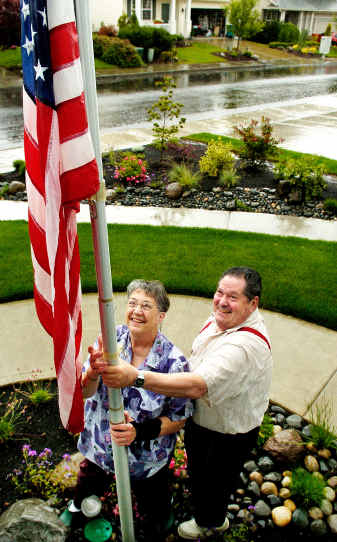
Starting Thursday, homeowners will be guaranteed the right to fly Old Glory even if neighborhood covenants ban flagpoles.
The new state law is among more than 200 that take effect this week.
The flag bill grew out of a Vancouver developer’s opposition to flagpoles in his upscale Westridge Place, which meant that Patsy McElroy had to take down her illuminated 16-foot flagpole and her 3-by-5-foot American flag or face a $100 fine that could escalate with each notice of infraction.
“I couldn’t afford a fine, so I took it down,” she told the Columbian newspaper. “I said, ‘This is not over. It will never be over until my flag is up.’ I suppose the bottom line is I didn’t like being told I couldn’t do that.”
Rep. Deb Wallace, D-Vancouver, whose husband is an Air Force Reserve lieutenant colonel deployed in Qatar, pushed House Bill 2934 through the Legislature with ease. It says homeowner associations may impose reasonable restrictions on the size and location of flagpoles, but not ban them outright.
Other new laws include:
• Driver’s license. Senate Bill 5428 allows license renewal via the Internet or by mail, rather than having to go to a Department of Licensing office. The agency will start the service this fall, with renewals good for five years. The driver must do an in-person renewal once a decade, though, so eyesight can be tested and a fresh picture taken.
• Crime-fighting. House Bill 2400 calls for tougher sentences and less chance of a treatment alternative for child rapists.
The Legislature also wrote new domestic violence legislation in the aftermath of the murder-suicide of the Tacoma police chief who had been accused of violence against his wife. Measures include Senate Bill 6384.
Senate Bill 5412 aims at combatting identity theft by authorizing voluntary use of thumbprints or other biometric identification on driver’s licenses.
Several bills, including Senate bills 6105 and 6560, crack down on animal cruelty.
• Cyberstalking. House Bill 2771 makes it a felony to use the Internet to stalk victims, through such things as repeated harassing and defamatory e-mails.
• Coaches who prey. Several measures, including Senate bills 5533, 6171 and 6220, are aimed against abuse of prep athletes by coaches. The bills require better screening, hiring and monitoring of coaches and better tracking of individuals as they move among districts.
• Oil spills. Senate Bill 6641, which Ecology Department Director Linda Hoffman calls the most important oil-spill legislation in a decade, aims to prevent and speed response to spills that occur during fuel transfers from shore to vessels.
• Power plants. House Bill 3141 enacts tough siting standards for new power plants, designed to combat global warming by reducing the effects of carbon dioxide emissions.
• Base closures. As part of the state’s effort to shield military bases from the next round of closures, Senate Bill 6401 directs local governments to use land-use plans to guard against developers encroaching on the bases.
• Hunger. Senate Bill 6411 broadens school feeding programs, including a new mandate for summer programs in some districts. It also removes the lifetime ban on drug offenders getting food stamps.
• Education. Lawmakers revamped the state’s remedial education program with Senate Bill 5877 and changed how districts may calculate their property tax levy base with Senate Bill 6211.
• Branch campuses. House Bill 2707 affirms the role of Washington State University campuses at Spokane, Tri-Cities and Vancouver and University of Washington campuses at Bothell and Tacoma.
The legislation calls for a study by each institution on how the campuses should develop. The bill also says the colleges will no longer be called “branch campuses.” Even though they continue affiliation with the flagship institutions, they are declared to have their own unique identity and mission. self end