
Dam resilient as tourist draw
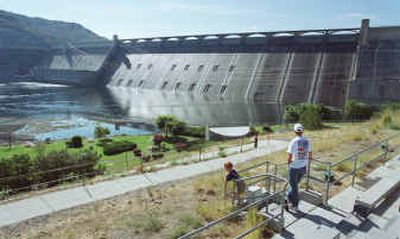
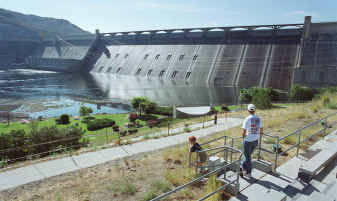
GRAND COULEE DAM, Wash. – It may be considered a fat target for terrorists, but the Grand Coulee Dam, one of the largest concrete structures in the world, is still a magnet for tourists.
Standing 550 feet tall and nearly a mile wide, the dam has the largest power-producing capacity in the United States.
It has been a tourist attraction in north-central Washington since it was built in the late 1930s, with more than 363,000 people touring the dam’s visitor center last year. Tourism industry officials expect as many or more this year.
“I think we’re more worried about if it’s going to rain this weekend than we are about terrorism,” Grand Coulee Dam Area Chamber of Commerce executive Susan Miller said.
Since Sept. 11, 2001, security has been increased at federal hydroelectric dams across the West. But despite warnings and restrictions at dams and other engineering marvels, tourists still come.
Interior Secretary Gale Norton recently announced that portions of the Statue of Liberty, closed since the 2001 attacks, would reopen to tourists this summer after safety and security upgrades.
Tourists are returning to Hoover Dam on the Colorado River between Arizona and Nevada. Paid visits dropped from 1.2 million to about 850,000 after 2001, spokesman Bob Walsh said. This year, more than 960,000 visitors are expected.
“It’s coming back,” Walsh said. “As the economy has picked up and tourists return to Las Vegas, ours has gone up accordingly.”
Visitors to San Francisco still put the Golden Gate Bridge atop their must-see lists.
The San Francisco Convention and Visitors Bureau estimates that three-fourths of visitors to San Francisco go to the Golden Gate Bridge.
Bridge spokeswoman Mary Currie said it is difficult to determine how many visit the Golden Gate because no admission is charged, but tourism appears to be gradually coming back after 9-11 and the area’s dot-com demise.
Traffic across the tops of larger dams – such as Grand Coulee and Hoover – has been restricted or banned. Boats patrol waters nearby, and formerly public areas have been reduced.
At Grand Coulee, vehicles are no longer allowed to drive across or park atop the dam, and armed security guards keep constant watch over an operation that provides electricity to 11 Western states.
Guided tours of the giant Third Powerhouse are still operating, although tourists can no longer wander through other areas of the dam. Backpacks and other packages are no longer allowed into the dam’s visitor center, spokesman Craig Sprankle said.
But despite the restrictions, people still flock to the structure dubbed “the eighth wonder of the world” when it was completed in the early days of World War II.
“Our goal is to make the facility safe for the workers and for the visitors,” Sprankle said of new security measures. “We worked to be able to accept visitors.”
Many come for the laser light show that plays across the face of the dam nightly from Memorial Day through the summer.
Others come to play on 130-mile-long Lake Roosevelt and on Banks Lake, a 30-mile-long reservoir pumped from Lake Roosevelt, which serves as the headwaters for the 500,000-acre Columbia Basin Irrigation Project.
Still others are attracted by the area’s spectacular geology, carved by massive Ice Age floods.
Gary Heit, owner of the Coulee House Motel in Grand Coulee, said bookings fell off after Sept. 11, 2001, but have been building steadily since.
Few guests ask about potential terrorism, but some have questions about parts of the dam that have been off-limits since the Sept. 11 terror attacks, he said.
“People realize what’s happening,” he said. “They get to go down to the powerhouse and see the dam, and that’s what they hoped to do.”
Tourist visits to the dam dropped 20 percent after September 2001, but have slowly climbed back to pre-attack levels, Sprankle said.
This year, tourism officials are most worried about high gasoline prices that could keep vacationers closer to home, he said.