
Signs installed to warn of foreign flora, fauna
IDAHO FALLS — How does a plant hop from a lake in Spokane to the Upper Snake River? Or a snail the size of a pinhead move miles upstream in a day?
They hitch a ride on felt-soled wading boots, on the side of a boat or hidden in a trailer wheel. Unless boaters and anglers take precautions, invasive exotic plants and animals, such as zebra mussels, New Zealand mud snails and Eurasian water milfoil may soon take hold in eastern Idaho’s pristine areas, a state panel says.
“Once they’re here, there’s no effective eradication method,” said Matt Miller, communications director for The Nature Conservancy in Idaho.
The Nature Conservancy, with other members of the Idaho Invasive Species Council, announced Friday they are installing 3,500 new signs across the state at boat launches and other water-access points to warn about invasive aquatic species.
The signs also encourage everyone to wash off gear before and after entering the water.
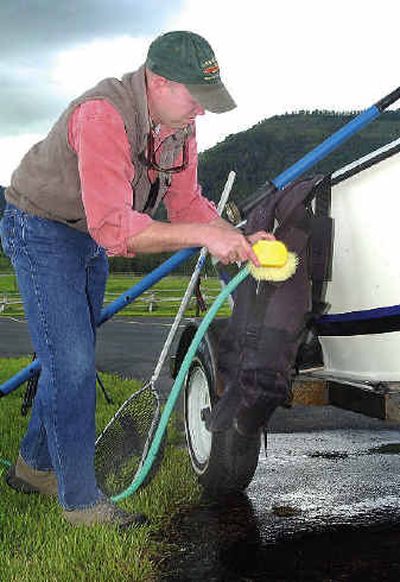
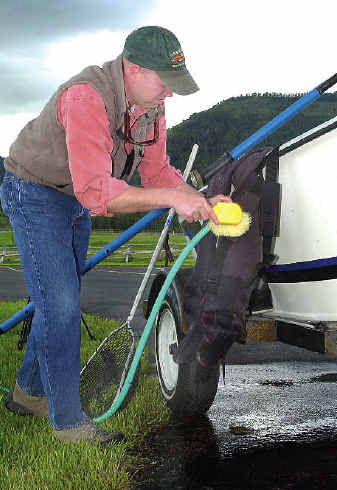
“It’s important to scrub vigorously, especially the feet,” said Alan May of The Nature Conservancy, demonstrating on a pair of waders and felt-soled boots.
You can’t count on seeing the plants or animals because tiny larvae or pieces of plants are almost invisible, he said.
Even pieces of plants like milfoil, which can attach to shoelaces, are enough to start a new plant.
Though they may look small and innocuous, these species can take over entire streams, lakes and canals because they have no natural predators here to keep them in check.
“There’s only a certain amount of life a lake can support,” Miller said, and only enough room for a certain number of plants on the banks.
If they aren’t stopped, they replace a naturally diverse range of plants or animals with a monoculture.
Everyone ends up paying the costs to control them once they gain a hold.
Bonneville County spends $250,000 each year to control invasive species, and they cost Idaho $300 million each year in habitat loss and species control, Miller said.
The Invasive Species Council is targeting species already known to be in Idaho. They’re also targeting species like zebra mussels that are known to be in water bodies nearby.
While the focus on aquatic species is new, efforts to stop invasive species are not.
Bonneville County’s noxious weed superintendent, Jeffery Pettingill, and his staff of 10 patrol the roads and stream sides every day to find and kill invasive noxious plants.
The office uses computer analysis of satellite images of flower colors to identify weed patches. They also rely on private land owner to alert them to new plants.
His office hands out calendars with the top 24 noxious weeds in eastern Idaho.
“If we can control it here, hopefully the impact down there will be less,” Pettingill said.