
Democratic voters still lukewarm about Kerry
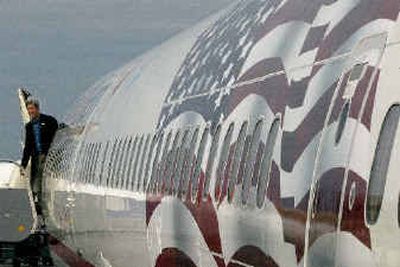
John F. Kerry has shattered fund-raising records, unified an oft-warring party and pushed past President Bush in some national polls. Yet many Democratic voters, officials and even members of Kerry’s staff express an ambivalence – or angst – about their presidential candidate that belies this strong public standing.
These Democrats say the enthusiasm for defeating Bush runs much stronger and deeper than the passion for electing Kerry. The chief reason: The Massachusetts senator, they say, has been unable to crisply articulate what a Kerry presidency would stand for beyond undoing much of the Bush agenda.
So far, these concerns have not slowed Kerry. But if Kerry is unable to change this perception coming out of next month’s Democratic convention in Boston, it could prove much harder for the Democrats to maximize turnout, win over Ralph Nader voters and keep independents from swinging to Bush, they say.
“There is a danger in that (ambivalence),” said John D. Podesta, White House chief of staff in the Clinton administration. “You can’t just be against something. (Voters) want a positive vision of where the country is going, and he has to provide that.”
Rep. Bart Gordon, D-Tenn., said for Kerry to win the presidency, “Bush has to lose the confidence of the public and the next thing that has to happen … (is) Kerry has to convince the public he’s an acceptable alternative. He has not passed that threshold, but he is making progress.”
When asked if he is excited about Kerry, Gordon said, “I am excited about a change of the administration. I think Kerry is a solid guy, he’s not an exciting guy.”
To be sure, Kerry heads into the summer stretch in far better shape than many Democrats – and Republicans – anticipated, and far better positioned than most challengers in recent history. He out-raised Bush, the most prolific fund-raiser in presidential history, in April and May, silenced most of his critics inside the party and jumped ahead of the president in polls, both nationally and in several key battleground states. Rep. Rahm Emanuel, D-Ill., said this proves most Democrats are fired up about Kerry. As for those who are not, “There were days when people had lukewarm feelings toward Bill Clinton, and now he’s revered,” he said. “Do you think they will do any less to help John Kerry?”
One standard barometer of voter enthusiasm is how strongly partisans support their presidential candidate. By this measure, Kerry is doing far worse than Bush, but markedly better than Al Gore at this point in 2000. In a recent Washington Post-ABC News poll, 68 percent of Democrats strongly support Kerry, while 89 percent of Republicans expressed strong support for Bush. In July 2000, 55 percent of Democrats expressed similarly strong feelings toward Al Gore.
It is not uncommon for a first-time presidential candidate to face questions at this point in the campaign about their ability to inspire and connect with voters. Tad Devine, a senior Kerry adviser, said John Kennedy did not really catch fire with voters until his debates with Richard Nixon late in the 1960 campaign. Devine said most successful candidates made their move – and mark – during or after their convention, when most voters tune into presidential campaigns, and the nominee has synthesized his message.
Taking a cue from Ronald Reagan, Clinton and Bush, all of whom succeeded in explaining to voters three or four easy-to-understand changes they had in store for the nation, Michael Donilon and other top Kerry advisers are crystallizing the Democratic nominee’s core initiatives for unveiling at the convention. Devine said the campaign is developing a positive message around the concept of “making America stronger at home and respected in the world. The challenge is to infuse meaning into this” in the months ahead with specific details.
Devine said there will be at least three opportune moments to do this: when Kerry names his running mate, which a top aide said will happen the first or second week in July, at the convention a few weeks later and, during debates with Bush this fall. For now, Kerry is content raising money to wage a forceful campaign and spending millions of dollars on ads introducing himself as a candidate with the stature to run the country during wartime. Polls show Kerry’s image has improved in many states where his campaign spent heavily on biographical ads.