
Team works to save rare squirrel breed
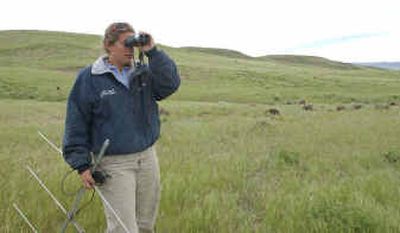
EMMETT, Idaho — A team of Boise State University researchers set up what looks like a miniature emergency room for squirrels on the tailgate of a truck parked on a dirt road near Squaw Butte.
The young biologists use an anesthetic to knock out their tiny subjects, southern Idaho ground squirrels, which are lined up in cages that serve as a makeshift waiting room.
Justin Barrett skillfully grabs a squirrel so it won’t bite him, puts it to sleep in a jar and places it in an electronic fat analyzer that looks like a mini-magnetic resonance imager.
Sometimes the researchers even give their squirrels mouth-to-mouth resuscitation to revive them.
These extraordinary efforts are being made because the southern Idaho ground squirrel is on the waiting list for protection under the federal Endangered Species Act.
Shooting, poisoning, habitat degradation and the invasion of alien weeds have shrunk its numbers from 40,000 to 4,000 since 1984. The only place in the world you can find these brown spotted burrowers is on 1 million acres of western Idaho range land from Emmett north to Cambridge.
They are larger and lighter in color than the endangered northern Idaho ground squirrel that lives north of their range.
The common Paiute ground squirrel, which lives south of the Payette River, has no spots and shorter ears.
The Boise State team, the U.S. Fish and Wildlife Service and a group of landowners are working cooperatively to save the squirrels, which play a key role in the shrub-steppe ecosystem where they live.
“There are no earthworms there,” said Eric Yensen, the Albertson College biology professor who discovered the squirrels were a separate species in the 1980s. “They increase the productivity of grasses and other plants by increasing soil fertility. They increase the rate of water infiltration and help prevent soil compaction.”
The three graduate students — Barrett, Karen Panek and Kristen Ross — are trying to learn what specifically has caused the squirrel populations to decline and what can be done to stabilize and increase its numbers.
They are examining their diet and how much fat they carry into hibernation, which begins now and lasts until late January or early February.
Their work comes as groups critical of grazing — The Center for Biological Diversity, Western Watersheds Project and Committee for the High Desert — have a lawsuit pending against the Bush administration for delaying placing the squirrels under the protection of the Endangered Species Act.
The squirrels, designated as a candidate species, are required to be protected by federal land managers. But private landowners, who own 85 percent of their habitat, are not required to take any action.
A group of landowners who control 100,000 acres of habitat have voluntarily worked with officials and researchers to help the squirrels. Joe Hinson, his wife, Margaret Soulen, and the Soulen family allowed biologists to try to move a squirrel colony from the Weiser Country Club to their ranch in 2001. The Soulens raise sheep and cattle.
The squirrels did not survive, but a conservation agreement between the federal government and the Soulens assured them that they would not be held responsible for the failure of the high-risk experiment.
A portion of the BSU research is devoted to studying how to move squirrel colonies that lie in the path of civilization.
Now, the U.S. Fish and Wildlife Service has written an expanded agreement for the squirrel’s entire range that allows landowners to negotiate similar site-specific conservation agreements. Landowners allow access to their land for research and agree to contact federal officials when they plan to excavate near squirrel habitat.
If more conservation measures are necessary later, the plans, which can be in effect for up to 20 years, include provisions for changing the rules, as long as funding is provided.
“There are strong adaptive management components to the agreement,” said Carmen Thomas, U.S. Fish and Wildlife Service conservation planning chief in Boise. “As we go along, everybody understands the lack of data we have for this species.”
Hinson, a natural resources consultant, is writing plans for four landowners with funds from the Idaho Office of Species Conservation and the Aldo Leopold Conservation Fund, administered by Environmental Defense and the Sand County Foundation.
He and his wife have spearheaded the private effort for a variety of motives — advancing private conservation, protecting themselves and other landowners from unwieldy restrictions to help the squirrels, and one more reason:
“I kinda like ‘em,” Hinson said.
With little known about the squirrels and so much of their habitat in private land, a traditional regulatory approach offers few benefits for management over a voluntary program, Thomas said.
“There’s no requirement for Joe or any of these landowners to come in and work with us, absolutely none,” Thomas said.
The squirrels’ fate lies in what the researchers can learn, what landowners will do and how they can be blended into a management plan. Since most of the large landowners are ranchers, they are closely watching the research effort to see how they and the squirrels will fare in the future.
“Maybe we will learn something about grazing and the effects on the little critters,” Hinson said. “If there is an effect, maybe Margaret and her family would change the way they do things.”