
Quality, gas prices sell Civic Hybrid
Wake up, Suburban, and hand Land Cruiser the news.
Gas prices are up and so are sales of fuel-efficient gas-electric hybrids.
That’s the word from Honda, whose Civic Hybrid has posted two consecutive record-breaking months, with April sales of 3,041 units.
Year-to-date sales are up 10.9 percent, to 9,023.
I suspect two factors are at work: 1) Hybrids from Honda and Toyota have been around long enough that buyers are growing comfortable with the technology and 2) there’s a genuine and growing desire to economize wherever possible.
Stories began appearing this past week that some consumers are compensating for higher fuel costs by changing their grocery-buying habits. If we can start saving at the gas pump, too, so much the better.
There’s also a third, perhaps less influential, component of increased hybrid sales – folks who care about the environment appreciate the fact that hybrids produce fewer unburned hydrocarbons than traditional internal-combustion vehicles.
Cleaner cars, cleaner air.
And the momentum is building. Ford has licensed Toyota’s hybrid technology for its Explorer SUV and next fall Lexus will introduce a hybrid-powered version of its RX 330 luxury sport-ute. The RX 400h will accelerate from zero-to-60 in less than 8 seconds with the fuel-efficiency of a four-cylinder compact sedan.
It’s a safe bet that as more of these larger, more luxurious vehicles make their way into the market, resistance to the new technologies will continue to fall.
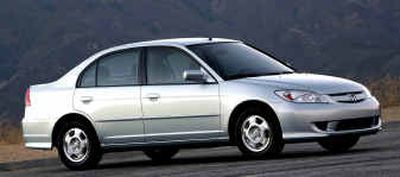
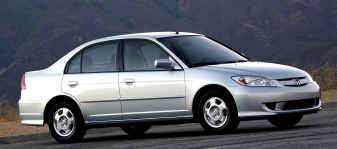
In fact, one of the great benefits of the Civic Hybrid is its utter ordinariness.
Unless you’re looking very closely, it’s impossible to discern between a stock Civic and the Hybrid. The Civic is available in one body style – it’s a compact four-door sedan – and the Hybrid and the base Civic share sheet metal. The only noticeable differences are a revised rear fascia, with a Hybrid badge, a thicker center bar in the grille, 14-inch wheels and slightly different rearview mirrors.
On the inside, Hybrid front headrests have a hole in them, while those in other Civics are solid, and the gauges glow a bright, cool blue. The trunk is slightly smaller in the Hybrid, to accommodate a battery pack, and the rear seats are fixed.
Otherwise, it’s the same, familiar Civic that is the only compact car to consistently rank among the country’s 10 best-selling cars.
It doesn’t hurt that J.D. Power recently named Honda the highest-quality non-luxury brand in the U.S., based on initial quality. In the overall rankings, Honda trails only Lexus, Cadillac and Infiniti.
But, bottom line, my guess is that performance is what sells the Civic Hybrid. Like my landlord, a car guy who recently cadged a ride in my Hybrid tester, most buyers believe that on some level the virtue of a hybrid will be offset by lousy performance.
Until they drive one.
Frank didn’t get to drive, but he learned all he needed to know from the passenger’s seat. The Hybrid is shod with 14-inch tires, which are designed with rigid sidewalls for low rolling resistance. They produce a ride that’s ever-so-slightly rougher than that of other Civics.
On the highway, the tires produce somewhat more noise than their softer counterparts but, once again, it’s such a small effect that it’s a non-issue.
The driver will notice some ambiguity in the steering, which is electrically assisted, unlike a normal Civic’s mechanical-assist operation.
Otherwise, the Civic performs like a regular Civic, with slightly less power.
Honda calls its hybrid system “Integrated Motor Assist” (IMA). The system’s 1.4-liter, 85-horsepower four-cylinder engine is mated with an electric motor that makes 10 kilowatts of power, or roughly the equivalent of 13 horsepower.
Unlike the Toyota system, in which the gas engine and electric motor may run independently of each other, both Honda power plants are always in operation, with the electric motor providing enough torque (remember that electric motors produce almost nothing but torque) to move the Civic along quite crisply. (Remember also that, in general terms, torque is what produces acceleration, while horsepower makes top speed).
Together, the power plants make 93 horsepower and 116 pound-feet of torque at just 1500 rpm.
The system is self-contained and the battery is constantly recharged, so it never needs to be plugged in. One gauge tracks the status of the charge and another shows the rate of recharge. Recharge is derived largely from a phenomenon called regenerative braking, in which the mechanical energy produced as the engine decelerates is transformed into electrical energy, as is the energy produced by braking.
It is possible, especially on long grades, with the air conditioning running, to deplete the battery, which leaves the gas engine to its own devices. It’s not a pretty picture, but neither is it a common occurrence.
The Hybrid can be equipped with a five-speed manual transmission or Honda’s continuously variable transmission (CVT).
Equipped with the CVT, the little gas engine builds quickly to peak torque, with a constant assist from the electric motor. The CVT’s belts and pulleys do their shiftless thing, keeping the system in the heart of its power band at all times.
Estimated EPA ratings are 47 city/48 highway, though real-world results tend to run closer in aggregate to the mid- to high-30s.
IMA is clean enough to qualify for California’s tough Super Ultra Low Emissions rating.
Uncertainty about the reliability of the system is a major impediment to increased sales, so Honda offers a 96-month/80,000 mile warranty on the battery pack. Local dealers tell me they’ve never yet had to replace a battery pack.
Hybrids are here for the duration — or at least until a true alternative to the internal combustion engine appears. What has begun as a low rumble on the horizon is about to explode into a full-blown phenomenon.
But Honda’s not resting on its laurels. Buried in those April sales figures are two Honda FCX fuel-cell vehicles, the world’s first commercial hydrogen-powered fuel cell car, which were purchased by the city of San Francisco.
Forward into the future.