
U.S. soldier could face court-martial
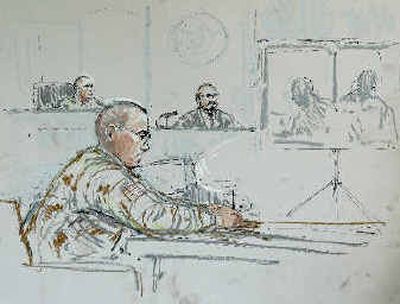
FORT LEWIS, Wash. — A U.S. soldier accused of trying to help al Qaeda should be court-martialed, the officer overseeing a hearing in his case said Thursday.
“These are serious criminal offenses that present a real and present danger to U.S. soldiers serving in Iraq,” Col. Patrick J. Reinert said.
Reinert’s recommendation will be passed on to the base commander at Fort Lewis, Lt. Gen. Edward Soriano, who ultimately will decide whether Spc. Ryan G. Anderson will face a court-martial and whether he might face the death penalty.
When Soriano’s decision is expected was not immediately known, said Capt. Jay H. Stephenson, of the Army’s Judge Advocate General Corps.
Courts-martial are typically held at the base where charges originated, Stephenson said.
Anderson, 26, a Muslim convert and Fort Lewis-based National Guardsman, was arrested in February and charged with five counts of trying to provide the terrorist network with information about U.S. troop strength and tactics as well as methods for killing American soldiers.
Reinert’s recommendation concluded an Article 32 hearing for Anderson — similar to a preliminary hearing in civilian court. During the hearing, prosecutors presented a secretly recorded video of Anderson meeting with two undercover military officials posing as members of al Qaeda.
In the video, Anderson offers information about weaknesses in the M1A1 Abrams, the military’s primary battle tank.
“I have no belief in what the American Army has asked me to do. They have sent me to die,” Anderson told the investigators. He was arrested just days after the meeting.
In closing arguments lasting about 30 minutes, Army prosecutors reviewed the evidence presented during the two-day hearing, saying it was “only appropriate” that Reinert recommend the case for court-martial.
“It is clear that Specialist Anderson believed he was dealing and communicating with an enemy of the United States,” said Maj. Chris Jenks. “He disclosed the means and methods to destroy U.S. Army equipment and vehicles and to kill U.S. Army soldiers.”
Anderson declined to make a statement and his attorney, Maj. Joseph Morse, kept his comments brief, asking that Reinert consider only the charges and the evidence presented during the hearing.