
MONSTER SUMMER
‘It’s time,” the fairy godmother cruelly informs “Shrek 2’s” green ogre, “you stop living in a fairy tale.”
Can the same now be said of DreamWorks?
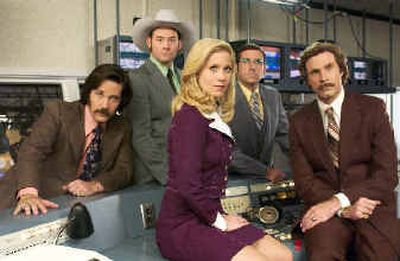
Founded 10 years ago, the studio is poised to enjoy a monster summer season, with each of its four films a potential blockbuster: the computer-animated sequel “Shrek 2,” which opens Wednesday; the Steven Spielberg-Tom Hanks immigration story “The Terminal” (June 18); Will Ferrell’s comedy “Anchorman: The Legend of Ron Burgundy” (July 9); and Michael Mann’s hit-man drama “Collateral” (Aug. 6).
It’s saying something when your biggest summer gamble, “Collateral,” stars no less than Tom Cruise.
But by the studio’s own admission, this summer represents a critical juncture in its history.
Like all once-upon-a-time stories, there have been many surprise turns for DreamWorks along the way. While “Shrek” has proved to be much more of a phenomenon than anyone possibly could have envisioned, DreamWorks itself has become much less of a studio than initially expected when it was founded in 1994 by Spielberg, music mogul David Geffen and former Disney studio chief Jeffrey Katzenberg.
Conceived as a fully integrated multimedia enterprise to include a record label, a publishing arm, a TV studio, interactive movies, live entertainment and a video game division — all housed in a state-of-the-art digital campus in west Los Angeles — DreamWorks now stands primarily with just two core businesses: animated and live-action movies.
And both divisions are coming off disastrous years. The studio’s live-action duds include “Biker Boyz,” “Anything Else,” “Win a Date With Tad Hamilton!” and the Ben Stiller-Jack Black disappointment “Envy.” In animation, the studio’s last film, 2003’s “Sinbad: Legend of the Seven Seas,” barely grossed $26 million.
“There have been huge disappointments along the way,” Katzenberg says. “It’s been hard, but it’s also been rewarding. I kind of feel like we are coming to another watershed moment for us.”
As evidenced by an advertising campaign that started last November, no single movie matters as much to DreamWorks as “Shrek 2.” The first film, released in April 2001, performed the miraculous double feat of generating a windfall of profits (an estimated $1 billion) and establishing the studio’s animated storytelling style.
Settling on a distinct DreamWorks filmmaking approach proved as elusive as earnings. “The Prince of Egypt” was a grown-up Old Testament tale, “Antz” was essentially a Woody Allen comedy, while “Sinbad” was an “Indiana Jones” swashbuckler.
Not until “Shrek” did DreamWorks hit upon a winning formula: Rather than make movies that appealed to the child in all of us, it found a way to reach the adult inside all children.
Even though it accelerated the studio’s exit from traditional, two-dimensional animation, “Shrek” stood apart from other animated movies not because it was drawn inside a computer but because it married an old-fashioned plot with a sophisticated sense of humor. Thanks to its irreverent comedy (including several jabs at Disney classics), teens flocked to the film as steadily as families, and it grossed more than $267 million in domestic theaters and sold countless videos.
The sequel, which was invited to this year’s Cannes Film Festival, might be even more accomplished than its predecessor.
The same principal characters are back, as Shrek (voiced by Mike Myers), Princess Fiona (Cameron Diaz) and Donkey (Eddie Murphy) travel to Far Far Away to meet Fiona’s disapproving parents (John Cleese and Julie Andrews). The most notable addition to the cast is the raffish but occasionally hairball-choking cat Puss-in-Boots (Antonio Banderas).
For all its contemporary gags and inversions of fairy tale conventions, “Shrek 2” tries to be heartfelt.
The first movie, says Andrew Adamson, who co-wrote and co-directed both films, “is about two characters who are losers who find each other and accept each other for who they are. To some degree, it’s about Shrek learning that he was lovable.
“This next story is about Shrek learning how to love. … These are two ogres, and they’ve gotten married. They have an idea of what happily ever after is going to look like. But everyone around them has expectations of what they think Shrek and Fiona’s happily-ever-after is meant to be. That’s the theme of the movie to me: You can make your own happily-ever-after regardless of parental or societal expectations.”
And as the country argues whether gay and lesbian couples can enjoy the same legal rights as straight couples, “Shrek 2” suggests ogre love isn’t totally unrelated to the debate.
“I wasn’t trying to make any kind of political statement so much as a personal statement,” Adamson says. “You should be able to love whomever you want to love.”