
Pellets yield lessons
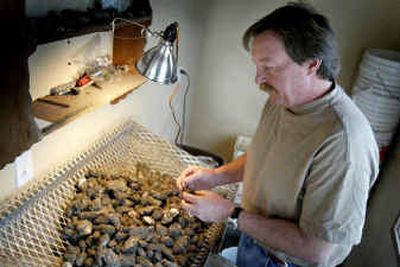

BELLINGHAM — Somewhere, as you read this, a long-legged, heart-faced barn owl is stretching out its neck and delicately upchucking.
Out drops a compact pellet of undigested lunch, which falls onto a dung-spattered pile below the owl’s shadowy perch.
That’s where Bret Gaussoin enters the food chain. With dozens of his collectors staking out barns throughout the West, Gaussoin has become the nation’s premier pellet impresario — helping turn owl leftovers into a staple of classroom instruction.
As owners of Pellets Inc., Gaussoin and his wife, Kim, sell to 15,000 schools, Scout troops, 4-H clubs and environmental centers in the United States and Canada.
Cheaper and more humane than frog dissection, the study of owl pellets has exploded since the mid- to late-1980s. Pellets, a trove of eco-diversity, yield lessons for all ages — from basic prey anatomy to food webs and complex ecological systems, said Anne Tweed, president-elect of the 55,000-member National Science Teachers Association.
Break one open and you’ll see why: Amid the fur, dried grass and indeterminate dust are tiny bones — skulls, tibias, femurs and the like. Sifted and compressed in the gizzard, they’re all that remains of the voles and mice that sustain a barn owl, that most nocturnal of raptors.
“I use them specifically to help with my human skeleton lessons,” said Ralph Hammersborg, a seventh-grade teacher at Seattle’s Eckstein Middle School, who gets his pellets through the school system. “We don’t usually think of it, but a mouse skeleton is virtually identical to a human skeleton.”
All of which makes owl puke a precious, if smelly, commodity.
“I would venture to say millions of owl pellets are dissected each year,” says Gaussoin, 45, as he sifts through one of the five-gallon buckets his collectors ship daily to his waterfront home office.
Before shipping them out, Gaussoin sterilizes the pellets by baking them — 8,000 at a time — on racks of cookie sheets.
Stinky, yes, but after 10 hours at 250 degrees they’re certified safe. And a good thing that is.
“Every other year a schoolkid will eat one on a dare, and we’ll get a call from the school nurse, all alarmed,” Gaussoin said. “It’s always boys, and I hate to say it, but it’s often Canadians.”