
Two men questioned about beheading
BAGHDAD, Iraq – The U.S.-led coalition is interrogating two men in connection with the beheading of an American businessman that was shown in a grisly video posted on the Internet nearly two weeks ago.
Based on tips from Iraqis, four men were arrested in a Baghdad raid earlier this week and two were quickly released, said Brig. Gen Mark Kimmitt, spokesman for U.S. military operations in Iraq. He refused to elaborate, saying only that the men were believed to have “knowledge, perhaps some culpability” in the death of 26-year-old Nicholas Berg.
Berg disappeared after checking out of a Baghdad hotel April 10. A videotape of his beheading by Islamic militants surfaced May 11 on a Web site linked to al Qaeda. CIA analysts concluded that the man who read a statement on the tape and then killed Berg is very likely Abu Musab al-Zarqawi, a Jordanian terrorist suspected in a series of bombings across Iraq.
Kimmitt wouldn’t say whether the men in custody are linked to al-Zarqawi or al Qaeda. Some news reports have suggested that the detainees are Iraqis loyal to Saddam Hussein’s former regime.
In other developments Friday:
Prisoner deaths
The Army has undertaken criminal investigations into the deaths of at least 32 Iraqis and five Afghans held by U.S. forces since August 2002, Pentagon officials revealed.
The deaths are from 33 separate cases, two of which involved more than one death. That is eight more cases than the Pentagon had publicly reported two weeks ago.
Nine are active cases, and eight of those are classified as homicides involving suspected assaults of detainees before or during interrogation sessions. Two have been resolved as homicide cases. Four are called justifiable homicides and 15 have been classified as deaths by natural or undetermined cause, the Pentagon said.
Of the total 33 cases, 30 involve detainees who died inside a U.S.-run detention facility. In the three other cases, two Iraqis and one Afghan died while under U.S. control outside a facility.
That statistical breakdown was provided by a senior military official, who spoke on condition he not be identified.
Bryan Whitman, a Pentagon spokesman, said members of Congress were given the same information Friday.
Najaf fighting
Explosions, gunfire and mortar rounds shook central Najaf Friday as militiamen loyal to anti-American cleric Muqtada al-Sadr battled with U.S.-led coalition troops in this holy city while 60 miles away in Karbala, coalition soldiers killed 18 pro-al-Sadr fighters.
Using AC-130 gunships, U.S.-led troops in Karbala struck al-Sadr militia positions near the shrines to Imam Abbas and Imam Hussein, whose golden domes in recent days have been wreathed with black smoke from nearby explosions. Many injuries were reported.
Protests surged throughout the Shiite world Friday as tens of thousands of religious Shiites in Lebanon and Bahrain took to the streets. Many wore white shrouds – indicating they were prepared to die – to express their distress that the shrines had become battlegrounds and that Americans were fighting near them.
In contrast to protests in Najaf and Karbala that have blamed al-Sadr and the Americans equally for violating the holiness of the cities with their presence, the protests in Lebanon and Bahrain as well as a small one in Iran blamed the United States almost entirely for the desecration of the holy places.
The cities of Najaf and Karbala and their respective shrines are among the most holy to the world’s Shiite Muslims.
Chalabi activities
The Defense Intelligence Agency has concluded that a U.S.-funded arm of Ahmad Chalabi’s Iraqi National Congress has been used for years by Iranian intelligence to pass disinformation to the United States and to collect highly sensitive American secrets, according to intelligence sources.
“Iranian intelligence has been manipulating the United States through Chalabi by furnishing through his Information Collection Program information to provoke the United Sates into getting rid of Saddam Hussein,” said an intelligence source who was briefed on the DIA’s conclusions, which were based on a review of thousands of internal documents.
The ICP also “kept the Iranians informed about what we were doing” by passing classified U.S. documents and other sensitive information, he said. The ICP has received millions of dollars from the U.S. government over several years.
An administration official confirmed that “highly classified information had been provided (to the Iranians) through that channel.”
The Defense Department this week halted payment of $340,000 a month to Chalabi’s program. Chalabi had long been the favorite of the Pentagon’s civilian leadership.
Patrick Lang, former director of the DIA’s Middle East branch, said he had been told by colleagues in the intelligence community that Chalabi’s U.S.-funded program to provide information about weapons of mass destruction and insurgents was effectively an Iranian intelligence operation. “They (the Iranians) knew exactly what we were up to,” he said.
He described it as “one of the most sophisticated and successful intelligence operations in history.”
“I’m a spook. I appreciate good work. This was good work,” he said.
Prisoners released
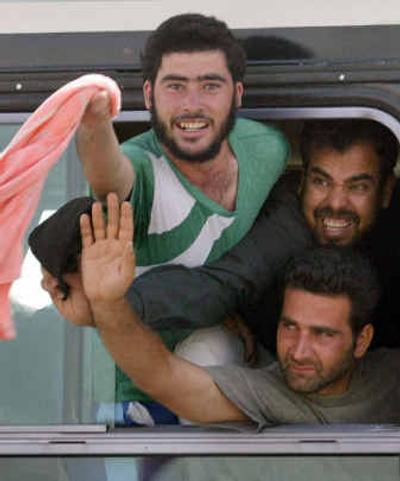
The U.S military on Friday released 454 detainees from the Abu Ghraib prison, the center of the abuse scandal, taking them out by bus at around 8 a.m. bound for Baghdad and other cities.
Brig. Gen. Mark Kimmitt, the senior military spokesman in Iraq, said an additional 394 prisoners would be freed May 28.
Early this month, shortly after the abuse of prisoners by U.S. soldiers became public, the U.S. general overseeing the prison system in Iraq said the population of the prison would be cut by more than half. The Friday release was announced earlier this week.
The prison has held up to 7,000 inmates at a time, according to a report by Army Maj. Antonio M. Taguba. The release came two days after Spec. Jeremy C. Sivits was sentenced to a year in prison for his role in abusing prisoners at Abu Ghraib. He was the first of seven charged members of the 372nd Military Police Company to be convicted for taking part in the abuse.
During Friday prayers at the Umm al Qurra mosque in Baghdad, Ahmed Abdul Ghafour Samarrae, a Sunni cleric, said the Islamic Party had called for a sit-in on Monday at the prison to protest the mistreatment of Iraqi detainees.
“All of the families of the prisoners and the people should come, and we will sit in until they release our prisoners,” he said. “For how long they are going to keep them behind bars? They must organize themselves and go there.”
Hamza Abdulla, 29, a former officer in the Republican Guard who attended the prayer service, said there was no reason for the guards to mistreat the detainees.
“They are only guards,” he said. “They are not investigators, and they are not questioning those prisoners. They are doing this for fun, and they should be punished. Whoever should punish them should put in his consideration the tradition of Iraq, because Americans will forget about these abuses after the U.S. elections. But those Iraqis will keep remembering for a long time.”