
Drained at the pump
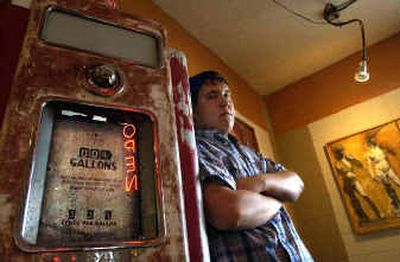

Ben Strength and Damon Borden are struggling to deal with the same problem: rising fuel prices that are eroding the bottom line.
Strength is a 19-year-old Spokane Falls Community College student who delivers pizza. He drives a 1993 Buick he’d love to trade in for a more fuel-efficient car.
Across town, 45-year-old Borden manages two Spokane-area Flying J Travel Plaza truck stops.
Like others in the region, both men are looking for relief at the pumps.
The average price of a gallon of regular unleaded gas in Spokane was $2.16 on Friday and $2.17 in Coeur d’Alene – both record prices that are more than 60 cents higher than a year ago. Diesel is even more expensive.
Heading into summer’s busy driving season, area motorists and business owners worry that prices will go even higher, forcing them to make drastic adjustments to their trips and their budgets.
“I love driving and delivering (pizza),” Strength said. “But if prices keep going up, I’ll have to ask my boss to move me inside, so I can work in the kitchen and save some money.”
Borden’s East Broadway truck stop usually sees 100 to 130 truckers a day filling up on diesel. This month, with prices climbing, many truckers are driving to stations in Idaho and Montana, where diesel is 5 cents to 10 cents a gallon cheaper.
The supervisor at the Broadway location, Jim Gagnon, says: “We’re selling at least a couple thousand gallons a day less than we used to. Drivers are making a lot more careful purchases.”
Fewer truckers means fewer purchases at the Flying J convenience stores, said Borden, who normally starts adding extra workers at his two locations this time of year.
“If it doesn’t get better,” he said, “we’ll have to actually think about cutting hours for workers.” Borden employs 75 people.
Consumers nationwide are dealing with spiraling fuel prices, caused by a 30 percent increase in the price of crude oil worldwide. U.S. fuel stocks are well below what they were a year ago, according to energy officials, prompting fears that prices haven’t peaked. Oil prices fell Friday after Saudi Arabia agreed to push the Organization of Petroleum Exporting Countries to raise its production quota, the Associated Press reported. Saturday, OPEC said it was “deeply concerned” about the recent rise in oil prices but deferred making a decision on increasing its output target until its members meet next month.
Meanwhile, some airlines have added fuel surcharges of $10 or more a ticket. Cab companies have started charging 10 percent to 20 percent more for rides. Trucking companies have tweaked drivers’ routes and schedules for greater efficiency.
Drivers like Strength keep watching for the best deals on gas and the shortest, quickest routes across town.
Strength started driving for David’s Pizza, a popular north Spokane business, about a year ago. He gets paid $7.75 an hour plus tips. He also gets paid a flat $2 a delivery, a fee he knows his boss can’t adjust. “We’re a small business. There’s only so much to go around,” he said.
As gas prices have risen, Strength has had to spend more of each paycheck covering his fuel costs. His Buick Custom Regal needs a tuneup. “But I can’t afford that right now. All I can do is keep changing the oil and hope that helps.”
He’s not complaining. Some pizza delivery drivers get paid a percentage of the total order. Other companies pay drivers 75 cents a delivery.
“I’m really feeling the pain,” said Jensen Eldenburg, a 20-year-old Pizza Pipeline driver in Coeur d’Alene. In addition to his hourly pay, Eldenburg gets 6 percent of each trip’s total bill. “I can go all the way to Post Falls and back on a $20 order, and I’ll get $1.20.”
John Bell, owner of Silver Eagle Charters, a tour operator based in Spokane, is also watching the pump.
“All I know is, it’s eating us up. And I don’t hear of any reductions coming soon,” Bell said.
A few months ago, Bell was one of five drivers taking a group of Clarkston High School students to Los Angeles. He booked the school tour – and set the price – nearly a year ago.
When he got to L.A., he found gas prices at $2.48 a gallon.
“You always look for trips like that, because they give you a pretty good return. But not this time. We just barely came out ahead,” he said.
With fuel prices at record highs, the impact will be felt when school districts start budgeting next year’s tours and charters, Bell said.
His chartered bus trips to Seattle Mariners games have to be repriced, too, and not because the team is playing poorly.
So far this year, he’s charged about $1,200 to take a charter group by bus to a Mariners game and back. He’ll add $125 to reflect higher fuel prices, he said.
People who fly instead of drive don’t have it any better. Last week, Continental Airlines joined several other carriers in announcing ticket surcharges. Flights of fewer than 1,000 miles will carry a $10 fuel surcharge, and longer flights will be assessed a $20 fee.
A Spokane cabbie says he’s started parking longer while on duty.
“I now sit still longer. I can’t cruise around parts of town as much,” said Tony Viola, who drives for Yellow Cab.
Regional truckers have dealt with rising fuel prices for the past three years by creating monthly adjustments that add surcharges based on the price of diesel. But those adjustments don’t cover all costs, said Don Piontek, a fuel manager for Systems Transport, which operates about 650 long-haul trucks out of its Cheney yards.
Systems Transport, which does business nationwide, often has to use a surcharge based on fuel costs for its Midwest or East Coast customers. “But if most of our miles are driven out West, where the cost of fuel is higher, the adjustment doesn’t really take care of all our impact,” Piontek said.
His company, like many large trucking firms, uses computer programs that identify the best routes and the best places to buy diesel.
“That’s why truckers now are just stopping for a little fuel in Washington state, then filling up farther east. It’s just the most practical way to manage costs,” he said.
Record fuel prices so far have not reduced operations or hours spent on the road by law enforcement agencies or government services.
But both the city of Spokane and Spokane County expect to see requests made for emergency fuel funds later this summer, unless gas and diesel prices drop.
Marshall Farnell, Spokane County’s director of administrative services, said he expects Sheriff Mark Sterk to make a request this summer for at least $100,000 more to keep patrol cars gassed up and ready to roll.
The city’s assistant director of vehicles, Gene Jakubczak, said his department will likely ask for emergency money later this year to ensure police patrols, garbage pickup and street repair trucks keep running. Jakubczak said the city, like other entities, buys gas and diesel on contract.
Last year the average price for gas was $1.30, and this year the city adjusted to $1.50. “You have to guess where it’s going to be, but it’s never perfect,” he said.
If the city has to take money from reserves for gas, it would be the first time in the 13 years he’s been with the city, Jakubczak said.