
‘New math’ takes lessons beyond book
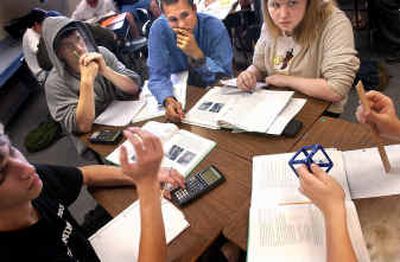
The same debate going on in Paul Huffman’s ninth-grade math class zings through classrooms coast to coast: Is a new, more collaborative and hands-on approach to learning math better for students, or should teachers stick with traditional, from-the-book problem solving?
The new math curriculum adopted by Nine Mile Falls School District this year prompted students to take sides.
Student Tim Rosenberry likes working in groups of four, with everyone learning from one another.
Lexi March is frustrated by having to work at the same pace as others in her group.
Tanya Crouse appreciates getting credit for showing her work, even if she gets the wrong answer.
And Kayla Sprint feels like she’s been duped.
“Algebra is gone. I don’t understand why they’ve taught it all these years and now it’s suddenly not needed,” she said. “I feel like we’ve been asked to forget everything we’ve learned.”
These are some of the arguments whizzing across the United States – among mathematicians, parents, students and teachers – for and against this “new math.”
At the crux of the debate are questions about what high school math should do – prepare students for work or college? And should all students be prepared the same way? The Washington state board for community and technical colleges reports that 55 percent of those who go to state community colleges have to take remedial math, leading many to believe that high school math needs to do much more than it’s doing now.
In traditional math classes, students move from algebra to geometry to trigonometry, year by year. Students learn formulas and algorithms and practice by solving dozens of problems – generally on their own. Problems have students finding 12 percent of 63 or “solving for X.”
New math teaches students little bits of algebra, geometry and trig together, and focuses on how math is used in the real world, outside of school. Teachers act more as guides, letting groups of students brainstorm ideas and talk things through, instead of telling them one way to work a problem.
New math problems often contain more words than numbers, like this problem from the National Education Association’s “Parent’s Guide to Helping Your Child with Today’s Math” (online at www.nea.org/parents/ math.html): “A farmer sends his daughter and son out into the barnyard to count the number of chickens and pigs. When they return, the son says he counted 200 legs and the daughter says she counted 70 heads. How many pigs and chickens does the father have?” (Answer: 40 chickens and 30 pigs.)
But instead of insisting everyone solves the problem algebraically with simultaneous equations, new math teachers let students tackle the problem individually. Some might draw pictures. Others might guess, then check their work and guess again.
Parents, such as Sandy Jordan, often start to worry when they sit down to help with their child’s math homework. Jordan has two children in Nine Mile Falls School District, which this year switched to a new-math curriculum called Core-Plus. Expecting to see familiar algebra problems, Jordan said she was shocked.
“There were so few numbers, and no drills,” she said. Her concern intensified when her daughter, a freshman, got her first D on a math assignment “for using poor sentence structure,” Jordan said.
She worries about her children learning the math they’ll need for later in life. “To me, it is blatantly WASL-driven. That’s OK if the kids are getting what they need,” she said, referring to the Washington Assessment of Student Learning, which is known for having new-math-style story problems. “I’m not saying that Core-Plus is horrible, but is it enough?”
Supporters say that’s exactly the reason for the switch – to make sure students get the math skills they need today, which are different from those needed by their parents. Today’s students, they say, need to be more comfortable with statistics, probability, reasoning and logical thinking, and be able to interpret data and communicate the results.
“We want kids to be able to do arithmetic, algebra and geometry, but at the same time, we’re developing a push for the understanding of what’s going on,” said Rick Biggerstaff, a math teacher at Lewis and Clark High School. “Somewhere in between is the happy medium.”
National debate
Spokane Public Schools has used a new-math approach for about six years. The change occurred after state education officials realized that schools prepared students for one thing, but the business community expected another.
“We were preparing kids for the community colleges and Yale and everything in between,” Biggerstaff said. “They were learning the quadratic formula and how to graph, but we had to ask if we were teaching them how to think and how to reason. The business community said, ‘We want kids to be able to think.’ ”
In particular, the business community wanted the kind of thinking that has students figuring out what type of problem they’re dealing with and the tools they need to solve it, in addition to doing the actual computation.
Similar questions were being asked around the country.
In 1989, the National Council of Teachers of Mathematics published a report on new standards for math. The U.S. Department of Education followed up with a list of 10 recommendations for exemplary math programs, which included a greater focus on estimation, connecting topics in and outside of math and justifying answers.
Soon after, a group of 200 mathematicians and scholars wrote an open letter to Education Secretary Richard Riley urging him to withdraw the recommendations, warning of “serious shortcomings” in the programs, including omissions of important topics – such as dividing fractions – and weak explanations.
The debate has been ongoing since, with mathematicians, teachers, parents and students lining up on both sides. Many who are unhappy with the curriculum in their district have taken matters into their own hands.
Dave Paulsen, a math teacher at Shaw Middle School, uses a 1992 pre-algebra book and worksheets with his basic math class instead of the prescribed book. That book, “Math Thematics,” has too few problems for students to work, he said. There’s no place to go back and see a sample of how to work the problems.
Parent groups in several states have succeeded in getting a new-math curriculum switched back to a traditional one. Others scour bookstores and online sources for used traditional-math textbooks, which they use at home to supplement their child’s math studies.
At the same time, districts continue to adopt new-math curricula and tout their successes.
Nine Mile Falls Superintendent Michael Green is proud of the new curriculum – chosen, he said, for the research supporting it. “Kids who were struggling with math before are getting it now,” he said. “Unapologetically, we are aligning it to the WASL. That’s what we’re accountable to. But it’s not the sole measure.”
Green admits that Core-Plus is not perfect, but he says teachers are supplementing the text with more traditional algebra practice. He’s convinced it’s what students need to succeed.
“People are used to seeing a formula at the top of the page with a set of problems to work,” Green said. “But in real life, you don’t have a sheet that says ‘Substitute this for this.’ We want to prepare (students) for the real world.”
Central Valley School District has been using Core-Plus for two years. Last year was a struggle, but now CV curriculum coordinator Tracey Franck likes what he’s seeing.
“Kids tend to understand it more,” he said. “They still have to put forth the effort to understand, but there are more ‘ahas.’ ”
At St. George’s School, teachers take a traditional approach to math, but because the school is small, the two math teachers and three science teachers often work together to integrate the subjects. Teachers also have the freedom to choose their own textbooks.
“We spend time building the foundations with addition, subtraction, multiplication and division, but that’s not what math is,” math department Chairman Judson Ford said. “It’s taking that and applying it to interesting questions. There’s a difference between knowing skills and being able to use them.”
The Mead School District currently teaches a new-math approach through seventh grade, then transitions students to traditional math to prepare them for college. But assessment coordinator Millie Hill said the district plans to review its math curriculum this summer and discuss the possibility of a more blended approach to math for the higher grades.
Those who think the new-math curriculum doesn’t prepare students for college point to the numbers of high school graduates who end up taking non-credit remedial math. In the fall of 2002, 85 percent of all the students enrolled in math classes at Spokane Community Colleges were in remedial math classes; at Spokane Falls Community Colleges, 77 percent were. At Eastern Washington University, 68 percent of entering students tested into developmental math courses.
Nitty-gritty math
Many argue that the time spent on math – rather than the type of math being taught – is the reason kids aren’t ready for college.
Julie Peck, coordinator for secondary mathematics for Spokane Public Schools, says the state’s two-year math requirement doesn’t cut it. Even if students excel in those two years, by the time they graduate two years later, their math skills are going to be rusty.
Several Spokane County districts have upped their math requirement to three years. But requiring kids to take more math is a huge hurdle to overcome, Peck said.
“There’s still a picture in the U.S. that math is only for some,” she said. “But everyone needs an understanding of numbers. It’s not as much about the nitty-gritty calculation stuff. Students have to be able to interpret and communicate. They need to be able to estimate, to understand numbers,” she said. But there are many who see the nitty-gritty calculations as essential. LC math teacher George Brown uses a basketball analogy when describing his approach to math to parents during open house.
The traditional approach to basketball teaches dribbling, then passing, then shooting. An integrated approach would be like teaching kids to play while they’re in the middle of a game. “No one does it that way,” said Brown, who’s been teaching math at LC for 16 or 17 years. The “faddish” integrated math stresses concepts over skills with a healthy dose of hands-on work, he said, while traditional math focuses on skills first.
“I know where those kids need to go, and it’s not in that book,” he said. “We don’t have time to bounce balls in class if they’re going to be studying calculus.”
Out of alignment
When the next step after high school is college, it’s often a step back – at least where math is concerned.
A former community college instructor, Biggerstaff acknowledged that what the high schools ask of seniors and what colleges ask of freshmen are two different things. After the introduction of the WASL, the high school math pendulum swung hard toward the new curriculum, while colleges remained stationed at the opposite end with traditional math.
In the 2003 report, “Mixed Messages: What state high school tests communicate about student readiness for college” published by the Center for Educational Policy at the University of Oregon, researchers picked apart assessment exams from 20 states, including Washington. They found that the tests “bear an inconsistent relationship to the knowledge and skills necessary for college success.”
That doesn’t surprise educators.
“The WASL . . . doesn’t signify a child is ready for college,” Peck said.
The purpose of the WASL, according to the state superintendent’s office, is to measure students’ knowledge of basic academic requirements. More students have been meeting the standard each year, but still, WASL results show that less than half of Spokane County students have mastered basic math skills, such as being able to solve simultaneous equations, apply formulas to calculate measurements and understand statistics.
On last year’s WASL the percentage of Spokane County sophomores meeting the standard in math ranged from 24 percent at Rogers and Liberty high schools to 59 percent at Mead High School.
Some question the validity and reliability of the test.
Biggerstaff is unconcerned about the lack of alignment between high schools and colleges because, he says, officials are starting to talk and find ways to improve.
“I’m excited about what we’re doing, compared to the math taught in the ‘60s and ‘70s,” he said. “Then, statistics and probability was de-emphasized. And that is the math the average adult probably uses the most. They need to know if that 2.9 percent at the bank is a good idea.”
Students are doing what their parents did, he said, but it’s not delivered in the same way. “We will not lose the important things parents learned. Teachers wouldn’t let that happen.”