
Warning catches security agency by surprise
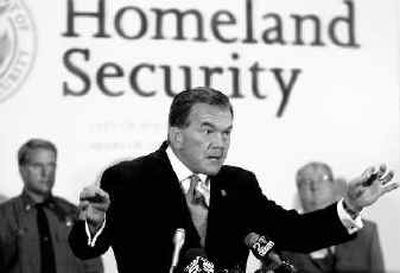
WASHINGTON – The Homeland Security Department was surprised by the announcement Wednesday from Attorney General John Ashcroft and FBI Director Robert Mueller that a terrorist attack was increasingly likely in coming months, officials said.
The department, created a year after the Sept. 11, 2001, attacks, is charged with issuing terrorism warnings to the public, and tension arose when Ashcroft and Mueller effectively took over that role at a news conference Wednesday when they said al Qaeda is preparing a powerful attack.
Officials said the Homeland Security Department knew in advance about the news conference but expected it to focus on seven suspects with ties to al Qaeda who were wanted for arrest or questioning. Department officials were caught off guard when Ashcroft went further and warned that al Qaeda “is ready to attack the United States.”
The news conference, which excluded Homeland Security Secretary Tom Ridge, raised concerns in Washington that his department was not coordinating the domestic fight against terrorism, which was confusing the message for the public and for local authorities.
Earlier on Wednesday, Ridge spoke on morning television shows and appeared to downplay the threat that Ashcroft would later trumpet, officials said. He told ABC’s “Good Morning America” that the threats are “not the most disturbing that I have personally seen during the past couple of years.”
Lawmakers who oversee the Homeland Security Department said the events Wednesday appeared to undermine the effort to unify the government’s response to terrorism threats.
“The reason that Congress created the Department of Homeland Security is that we need to merge the various parts of government responsible for pieces of the war on terrorism into one coordinated effort,” said Rep. Christopher Cox, R-Calif., chairman of the homeland security committee.
Cox said it was “regrettable” that Ridge did not appear with Ashcroft and Mueller “because their separate public appearances conveyed the impression that the broad and close interagency consultation we expect … may not have taken place in this case.” He noted that the 2002 law creating the department puts the secretary in charge of issuing “public advisories relating to threats to homeland security.”
Just one week ago, Ridge told the Sept. 11 commission at a hearing in Manhattan that his department “has made widespread information sharing the hallmark of our new approach to homeland security.” Ridge added that his department was sharing information with local authorities, private officials and the public through bulletins, alerts and a new Homeland Security Information Network.
White House press secretary Scott McClellan disputed suggestions that the administration sent mixed signals, saying, “What you’re seeing is that these officials are talking about it from their own positions of responsibility.”
Rep. Jim Turner of Texas, the committee’s senior Democrat, suggested the Homeland Security Department may not have known that the news conference would delve into threat conditions.
“If it is true that the FBI did not notify DHS of its intent to hold a press conference to advise the public of the current threat situation, we clearly have a lack of coordination between the two key agencies involved in homeland security,” Turner said. “Almost three years after Sept. 11, we have yet to see a full integration and coordination of efforts to make America safer.”
A similar issue arose two months ago when the FBI – not the DHS – warned that Texas oil refineries may be a target of attacks. In a letter to Ridge last month, Cox cited an “inconsistency,” noting that a week after the refinery alert, Homeland Security and the FBI jointly warned about a possible strike on mass transit systems.