
Tribute to a generation
WASHINGTON – Nearly 60 years after the defining event of the 20th century, the World War II memorial was dedicated in the capital Saturday in a tribute to the 16 million Americans who served in the armed forces during history’s greatest conflict.
Police estimated 140,000 people attended the ceremony at the new memorial between the Washington and Lincoln monuments. About 60 percent of the guests were men and women who lived through the war in which 400,000 Americans were killed.
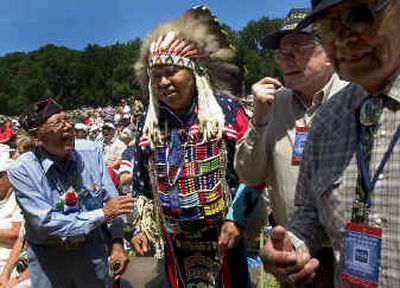
Among them Saturday was 77-year-old Glen Douglas of Spokane, one of the most highly decorated veterans in Washington state. He wore a war bonnet of eagle feathers for the dedication.
“When it mattered most, an entire generation showed the finest qualities of humanity,” President Bush told the crowd, most of them watching the ceremony on giant monitors in three seating areas throughout the National Mall. “Many of us are proud to call them ‘Dad.’ ”
The president’s own father, former President George H.W. Bush, was in attendance, as was former President Clinton.
“They are what I call the greatest generation,” said newsman and author Tom Brokaw, who spoke at the event. “They bet the future of this country on unconditional victory … but they understood the meaning of victory without revenge.”
Former Sen. Bob Dole, a disabled World War II veteran and chairman of the campaign that raised $195 million for the memorial, also paid tribute to the generation that sacrificed so much.
“They fought not for territory but for justice,” he said. “Not for plunder but for liberation around the world.”
But it was the veterans in the crowd, not the dignitaries on stage, who stole Saturday’s show. Through valor, or merely through capacity for survival, they etched such places as Iwo Jima, Bastogne, Bataan and El Alemein into the national consciousness.
“I was among the first to see those Japanese planes,” said Robert Allen, 81, of Dallas. He survived the attack at Pearl Harbor.
As an 18-year-old signalman, he was raising the colors on the roof of the administration building at the Ford Island Naval Air Station that December morning in 1941. The planes came in low and when they banked to strafe the U.S. fighters lined up on the runway, Allen saw the rising suns.
“Hey, those are Japanese planes,” he said before hell broke loose. “It was pitiful,” he said Saturday.
Of Saturday’s dedication he said, “It’s tearful, an odd combination of joy and exhilaration, yet somehow somber.”
John McKee, 79, of Albany, Ore., fought in the Battle of the Bulge in the 8th Infantry.
“It was an experience you wouldn’t want to go back and do,” he said. But after Germany fell, he was told he would have to fight again in Japan.
“I didn’t know what I was getting myself into the first time,” he said. “I told my wife, Lucy, I probably wouldn’t come home from Japan.”
The atomic weapons used on Hiroshima and Nagasaki almost certainly saved his life, Allen said. “I give (former President) Harry Truman a lot of credit.”
Back on stage, actor Tom Hanks spoke of the WWII generation’s sense of duty and sacrifice.
“Every day they asked themselves, ‘What can I do?’ and every day they provided their own answers,” he said.
Given a choice, Phillip W. Coon, a Creek Indian from Sapulpa, Okla., would have picked Hawaii for his tour of duty at the beginning of the war. He was given the Philippines instead, assigned to the 31st Infantry.
“We didn’t know what was coming,” Coon said. “Maybe the officers did.”
In December 1941, the Japanese caught the Americans unprepared.
“Everything fell apart,” Coon said. “We were outnumbered and outgunned. When the line fell, sergeant told me, ‘You’re on your own, Coony.’ ” He tried to make it to Corregidor, but the Japanese caught him outside the village of Marvales. As a prisoner, he watched them burn the village and massacre its residents.
Coon is one of the few survivors of both the Bataan Death March and a Japanese “hell ship,” one of the cargo vessels the Japanese used to get American POWs out of the Philippines in advance of Gen. Douglas MacArthur’s return.
Coon posed for photos Saturday with John C. Devores Sr., a Navajo “code talker” from Crownpoint, N.M., and Douglas, a Lakes-Okanagan Indian from Spokane.
Douglas saw combat in World War II, the Korean War and the Vietnam War. His way to the dedication of the World War II memorial was arranged by veterans service organizations in Colville, including the American Legion, Veterans of Foreign Wars and the Marine Corps League. The trip with his wife, Lesley, and a chaperone was financed largely through a promotion of the Statesman-Examiner in Colville.
Passers-by stopped to shake Douglas’ hand or take photographs. The eagle-feather war bonnet he wore caught their attention, but his service medals won their hearts. Many just wanted to say “thank you for your service” to the 77-year-old warrior with two Distinguished Service Crosses, four Silver Stars, four Bronze Stars and eight Purple Hearts.
“I wouldn’t take $10 million for the experiences I’ve had, but I don’t believe I’d do it again for $10 million,” Douglas said.
Don’t believe him. He tried to re-enlist on Sept. 12, 2001.
“Just dig me a foxhole and give me water and ammo,” he said he told the recruiter. “I’ll hold the hill.”