
Bush likely to move quickly against rebels
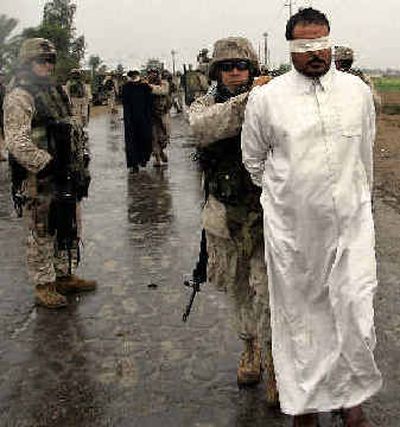

WASHINGTON – President Bush’s re-election gives him greater freedom of action in Iraq, and he’s expected to move quickly to try to stabilize the country, beginning with a major assault on Sunni Muslim insurgents.
The new approach is fraught with risks, and it could take Bush a large part – perhaps all – of his second term, billions more taxpayers’ dollars and more American lives to put Iraq on a path toward peace and begin a U.S. troop withdrawal.
“This is only the first stage of a very long process that will likely take years,” said Michael Eisenstadt, an analyst at the Washington Institute for Near East Policy. “We should lower our expectations for any rapid successes.”
But Bush no longer has to weigh the political risks of the Iraq war.
“We had to stop some operations until the (U.S.) elections were over,” said a senior Iraqi Defense Ministry official who requested anonymity because he’s not an authorized spokesman. “The Iraqi government requested support from the American side in the past, but the Americans were reluctant to launch military operations because they were worried about American public opinion. Now, their hands are free.”
In his victory speech on Wednesday, Bush was optimistic.
“We’ll help the emerging democracies of Iraq and Afghanistan so they can grow in strength and defend their freedom, and then our servicemen and women will come home with the honor they have earned,” he said.
“The president is in a stronger position,” Hoshyar Zebari, the foreign minister of the U.S.-backed interim Iraqi government, said in Baghdad. “What he’s doing here is right and just. We just need to complete the mission.”
The resistance is believed to involve up to 20,000 fighters and 100,000 supporters led by former Saddam Hussein regime officials, Islamic fundamentalists and Iraqi nationalists.
U.S. and Iraqi government forces have been building up for a drive to seize Fallujah, Ramadi and other insurgent-held towns and cities in the region northwest of Baghdad. The area is dominated by minority Sunni Muslims, who formed the bedrock of Saddam’s regime. Fallujah is run by guerrillas and dotted with safe houses of men associated with the al Qaeda terror network of Osama bin Laden.
“The election makes no difference for us in Fallujah,” said Abdullah Abdulkarim, 34, who said he was willing to fight to defend his city. “Both candidates will act the same towards Fallujah because they consider us terrorists.”
After the military secures Fallujah and the other towns, the strategy calls for holding elections for a national assembly by Jan. 31. The assembly would choose a transitional government and draft a new constitution.
The military operation needs to happen quickly to allow time for Sunni emotions to cool. Civilian casualties could be high, making it difficult for Iraqi leaders to persuade the Sunnis to participate in elections.
Sunnis make up about 20 percent of Iraq’s population of 26 million. Their participation in the election is essential to crippling the insurgency. If they don’t participate, they would view the transitional government – controlled by majority Shiite Muslims and minority Kurds – as illegitimate.
Sunnis will not abide by the presence of U.S. troops, experts said. And the Pentagon is anxious to limit the exposure of American soldiers to attacks.
But experts questioned whether inexperienced Iraqi security forces, which are believed to be penetrated by the resistance, can prevent insurgents from reasserting control of Sunni population centers. Guerrillas grabbed Fallujah in April after the Bush administration ordered a halt to a U.S. Marine offensive on the city.