
The breath of life
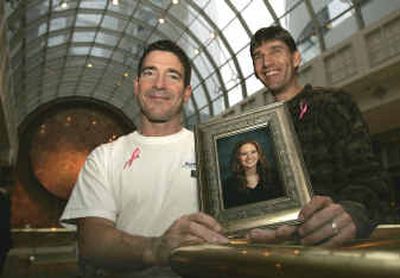
RICHMOND, Va. – Two years ago, Len Geiger was near death, suffering from a severe case of genetic emphysema.
On Saturday, Geiger participated in his first marathon, accompanied by the father of the 14-year-old girl whose lungs were used in a double-lung transplant to save his life.
Because of the extensive damage to his lower body, Geiger did a “race walk” instead of running the course while Kevin Shroyer slowly jogged alongside him. It took the pair more than six hours to finish, but Shroyer didn’t mind.
“When I’m running with him, it’s all about us and it’s all about Korinne and that’s as close as I will ever again come to running with my daughter,” Shroyer said before the race. “So I don’t mind savoring every minute I’m out there with him.”
The race helps benefit organ and tissue donation programs for the Donate Life Partnership of LifeNet and the United Network for Organ Sharing, the Richmond nonprofit organization that maintains the national list of those awaiting transplants. More than two dozen people affected by organ donation – including families of donors, recipients and living donors — will run as part of the Donate Life team.
“Most of our patients assume a better life than they have, but to achieve something as big as running a marathon is remarkable,” said Dr. Mark Robbins, medical director of the University of Virginia’s lung transplant program.
In 2002, Geiger’s lungs were barely functioning and his hip bones had deteriorated from his steroid medication, requiring a total hip replacement.
At the same time, Shroyer’s once-vivacious daughter, Korinne, lay in a hospital, about to die from what Shroyer said was a Paxil-induced suicide. The government has warned that the anti-depressant may be linked to an increased risk of suicide in children.
Shroyer and his wife Kristie, overwhelmed with grief, drew on their faith and decided to have Korinne’s organs donated. Her lungs went to Geiger, a 45-year-old from Gainesville, Ga.
A year went by while Shroyer, 44, of Lynchburg, grieved for the daughter who had also been his best friend. Meanwhile, Geiger’s health quickly improved and he got back to riding his bicycle.
Soon after, though, Geiger faced yet another setback. He took a hard fall off the bike, shattering his left thigh bone. After surgery, he went into respiratory failure and then slipped into a drug-induced coma. Three weeks later, he awoke only to be told he might never be able to use his leg again.
But Geiger pushed his body and by the summer of 2003 was able to complete a 10K race in Atlanta.
During this time, the Shroyers had started thinking about who received Korinne’s organs. As they were contemplating how they should go about contacting the recipients, they received a letter from Geiger through LifeNet, the organ and tissue donation agency in Virginia.
“I wrote that letter I can’t tell you how many times,” Geiger said. “I couldn’t ever quite get it the way I wanted it to be until finally, somebody very smart said, ‘Just say thank you.”’
The letter started a flow of correspondence between the two parties and last fall they arranged to meet in Charlottesville at a LifeNet office.
“We all hugged and we sat down, and I sighed. And Kevin leaned over and said, ‘Do that again,”’ Geiger said. “Because he could hear his daughter’s lungs and hear my voice and my voice is powered by his daughter’s lungs.”
The emotional meeting sparked a close bond, and the two soon realized they shared a love of fitness. They began participating in races together, and on Saturday completed their first marathon, with a time of 6:25:17.
Shroyer, who wears a necklace that belonged to his daughter and a photo of her around his neck when he runs, said he can feel Korinne breathing through Geiger when they race together.
“I believe Korinne is there with us – she’s a part of Len now,” he said.
Geiger, who always keeps a photo of Korinne close by, said he feels the same way.
“It’s kind of a confusing issue, because I’m not really sure if I’m carrying Korinne with me, or if she’s carrying me with her,” he said.
And though their relationship was born out of tragedy, Shroyer said Geiger’s chance at a new life was the most positive thing to come out of his daughter’s death.
“As a result of losing our daughter, I feel like I’ve kind of adopted a brother,” Shroyer said. “And he’s part of our family, whether he wants to be or not.”