
WASL a challenge for English learners
KENNEWICK – Jose Ballardo’s Spanish accent colors his English but doesn’t mask his creativity.
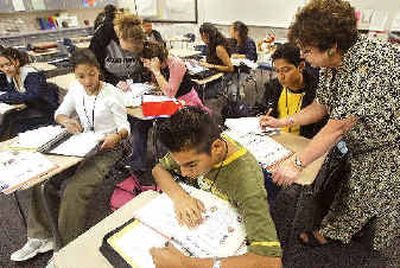
The 14-year-old, whose family moved from Mexico to the Columbia Basin three years ago, recently drafted a creative tale in his English as a Second Language class at Othello High School. The plot involved a futuristic spaceman who touches down on Earth, then takes precious information about humans back to his planet.
Schools with large numbers of English learners like Ballardo have turned to writing exercises in recent years because of the federal No Child Left Behind Act of 2001. The law requires all students, even those whose native language isn’t English, to meet minimum academic standards in reading and math on the Washington Assessment of Student Learning.
A Tri-City Herald computer analysis of results from 70 schools in nine area school districts on this year’s WASL tests confirmed that children whose first language isn’t English failed to meet the standards more than any other student group. The annual test is given to fourth-, seventh- and 10th-graders to measure their reading, writing and math skills.
The majority of children learning English speak Spanish, but some speak Russian or other foreign languages, officials said.
There are dozens of languages spoken by students in the region, ranging from Vietnamese and Korean to Portuguese and Arabic.
Meeting the standards can be daunting for teachers and students like Jose. While he has no problem stretching his imagination to the far reaches of the galaxy, imagining he’ll pass the WASL is a stretch.
“I’m scared,” said Jose, who will take the test as a sophomore next year. “You don’t know what questions will be on it.”
What’s unfortunate, at least in Othello High’s case, is that students and teachers are working to close the achievement gap – if No Child Left Behind doesn’t recognize it – said Principal Bill Duncanson.
“It’s not that these kids are ignorant,” he said. “That’s not the issue at all. It’s just they know Spanish. That’s what’s spoken at home.”
To raise this year’s scores, Othello High educators are trying to stress the importance of knowing English for the WASL. Not only are reading comprehension and writing sections of the test given to students, but the math section also includes story problems that require a basic understanding of English.
Graciela Pruneda, who teaches English language learning at Othello High, likened the experience of some of her non-English speakers to that of a lifelong U.S. resident who goes overseas and must pass a test in a foreign language.
“Nobody would like to go to China and be tested in Chinese,” she said. “Dealing with the cultural aspect of trying to fit in … it kind of puts them at a disadvantage from the get-go.”
A model that some states use to get a more accurate picture of their English learners’ academic skills involves giving them a portion of the standardized test in their native language.
An example is Oregon, where Spanish and Russian speakers take a test that provides math and science questions in English and their native language.
“The skills we’re trying to measure in math and science theoretically don’t require a proficiency in the English language,” said Steve Slater, assessment coordinator for the Oregon Department of Education.
Oregon hires a company to translate the test, he said.
But states need to be careful when providing tests in languages other than English, said Jamal Abedi, a professor with the National Center for Research on Evaluation, Standards and Student Testing at the University of California at Los Angeles.
He said the biggest potential pitfall is translating test items into questions with different meanings than those the exam writers intended. For example, a complicated math question has the potential to take on several meanings if the words mean something different in a foreign language.
“Language reliability affects the viability of tests,” said Abedi, who has researched different state tests for 12 years. “There is a lot of discussion about alternate tests. There are major issues involved.”
Instead, states should try to reduce unnecessary and complicated language on test questions, he said.
The WASL is given to students only in English, mainly because providing another test would cost the state millions more dollars a year, said Kim Schmanke, spokeswoman for the state superintendent’s office.
Students not fluent in English also take an annual language proficiency test, but it only measures whether the student can speak and comprehend English, Schmanke said.
Pasco and Sunnyside schools are among the schools that lobbied the Legislature this year to use a test other than the WASL to gauge the academic skills of students learning English.
“Are we testing their skills or are we testing their language?” asked Elizabeth Padilla Flynn, Pasco School District director of instruction and achievement.