
Picture perfect
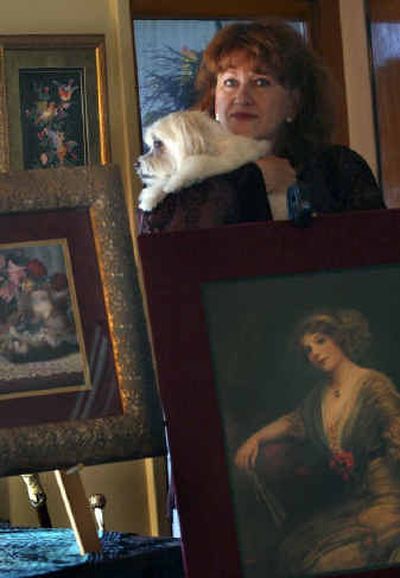
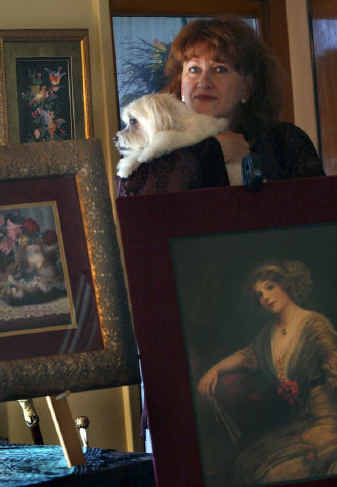
COEUR d’ALENE — Judy Henry’s artwork looks like something that might have graced your great-grandmother’s parlor.
Wistful maidens sigh over marriage proposals. Fairies lounge in the center of roses. Even the nudes have a certain blushing innocence.
These are copies of Victorian prints, salvaged by from old magazines, calendars and advertisements. Henry works with a local printer to reproduce them, and frames them for resale.
It’s her own little niche in the competitive world of art.
“There’s a ton of art out there for sale, and a ton of artists. So if you’re going to sell, you’ve got to look for something different,” Henry says.
Her firm is called “Painted Ladies — Women with a Past.” Many of the prints feature women.
Henry started the company last year. She and her mom, Janelle Heatley, wanted a business they could run together from their homes. In a previous joint venture, the mother-daughter team used their knowledge of collectibles to prepare items for estate sales.
Henry devoted a year to research. She consulted an attorney about copyright laws and spent thousands of dollars on trial print runs. Her greatest challenge was finding a company that made high-quality reproductions at affordable prices.
Keeping costs down was critical. Painted Ladies’ framed prints start at $50. If materials or labor went too high, Henry lost her profit margin. She eventually found companies to work with in Coeur d’Alene. Imagination Graphics does her printing and design work; Blackwell Studios does her framing.
To finance Painted Ladies, Henry sold off part of a cherished Victorian glass collection. The era – named for England’s Queen Victoria, who ruled from 1837 to 1901 – has always intrigued her.
“It was absolutely a more romantic time,” she says. “It was a time when gentlemen were gentlemen. Of course, the rules of society were pretty tough.”
The Victorian era was also a time of “obsessive extravagance,” Henry notes. Women in corsets sat down to 10-course meals. Popular art was flowery and sentimental.
“Here are portraits of seven women. You’ll notice that five of them have roses,” she says.
Henry’s best-selling print, “The Five Seasons,” shows five kittens frolicking on a lace-covered vanity. One kitten is looking into the mirror; others are licking cold cream; listening to a clock, smelling roses and playing with a pair of gloves.
“It’s just sweet,” she says.
Elaborate details and rich colors also drew Henry to Victorian prints. Some still glow like oil paintings. Through a process called “chromolithography,” layers of pigment were applied to the prints, one color at a time. It was the first, true multi-color printing method, Henry says. Before that, illustrations were hand colored.
Searching out old prints is Henry’s favorite part of the job. EBay is one of her best resources. She recently received a line of hat prints from a contact in France. Henry tweaks some of the prints, changing background colors or adding borders to give them her own flair.
In addition to kittens and nosegays, Henry’s portfolio contains a “hunting lodge” series framed in leather.
“I’d like it if people knew that not everything I sell is fluffy, puffy,” she says.
Henry’s goal for Painted Ladies is to gross $30,000 to $50,000 in sales during its first full year in operation. She was a little too late to get her prints into stores for the Christmas season this year. In January, however, she’ll start cold-calling retailers for Valentine’s Day and Mothers Day.
The company also has a Web site. Locally, Elegant Expression in Stateline stocks a few of Painted Ladies’ prints.
With flowing red hair and a gauzy black blouse, Henry looks the part of a romantic Victorian lady. Her living room contains no less than three bouquets of roses. If she scooped up her fluffy white mutt, Mozart, Henry could pose for a print on her brocade couch.
Other women tell her that they wish they could work from home, too. It isn’t as easy as it sounds, Henry says. Starting a business requires six- and seven-day work weeks. When your office is in your basement, you never quite get away.
“It has to be a passion,” she says. “You have to adore it enough that you don’t resent it.”