
Chirac advocates expanded council
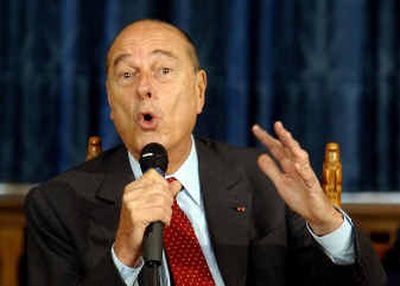

OXFORD, England – French President Jacques Chirac said Friday that the United Nations Security Council does not represent today’s world and should be expanded to include Germany, Japan and developing nations such as Brazil and India as permanent members.
Speaking to about 200 students and faculty at Oxford University, Chirac laid out his vision of a “multipolar” world, balanced among various blocs and alliances rather than dominated by the United States.
Chirac, at the end of a two-day visit to Britain designed in part to heal the two countries’ rift over Iraq, said his worldview was shared by Prime Minister Tony Blair.
“When it comes to multilateralism, we share the same vision,” the French president said. “When it comes to new rules of law or U.N. reform, we are speaking with one voice.”
Chirac said the decision-making U.N. Security Council “is no longer truly representative of the world as it is today. So it needs to be modernized.”
Britain has also backed expansion of the Security Council. Britain, France, China, the United States and Russia are all permanent members.
Chirac suggested the body’s membership should rise from 15 permanent and rotating nations to 20 or 25 to reflect how the world had changed since the United Nations was founded in 1945.
“You cannot simply take a snapshot of 1945 and apply it to 2004,” Chirac said.
A relaxed and voluble Chirac acknowledged differences over the U.S.-led Iraq war, which Britain strongly supported and France vociferously opposed. But he said the two governments were united on other key issues: fighting poverty, increasing international tolerance and salvaging the endangered environment.
“France and Britain have a shared vision of what the great challenges of today are,” Chirac said. Chirac’s visit marks the 100th anniversary of the Entente Cordiale, the pact that ended centuries of warring and hostility between the two countries.
Meeting with reporters after talks Thursday, Blair and Chirac put aside their long-simmering differences over Iraq and pledged to work together on reviving the Middle East peace process, alleviating poverty in Africa, slowing global warming and a host of other issues.
Speaking Friday to an audience that included international Rhodes scholars – in a room hung with a portrait of the scholarship’s founder, British imperialist Cecil Rhodes – Chirac said Iraq was “froth in a reality which is one of deep and cordial entente between France and the United Kingdom.”