
Congress stalls intelligence, acts on abortion
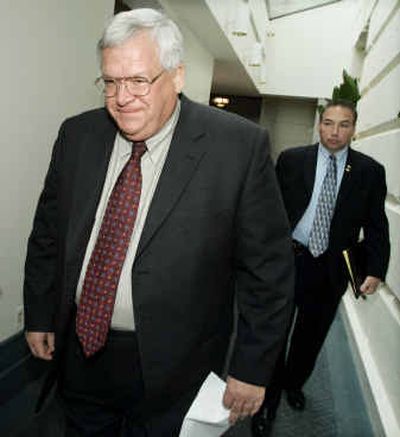
WASHINGTON – Defying their leadership and direct appeals from President Bush and Vice President Cheney, two powerful House Republicans on Saturday blocked intelligence reform legislation that would put a single director in charge of the nation’s spy agencies.
Passage of the legislation that would have implemented recommendations from the Sept. 11 commission had appeared likely earlier in the day. Commission members and families of the victims of the terrorist attacks reacted with frustration and outrage at the reversal.
The prospects of reviving the bill appeared uncertain late Saturday.
Hours after House and Senate negotiators said they had a deal, House Speaker Dennis Hastert, R-Ill., said he was unable to persuade Armed Services Committee Chairman Duncan Hunter, R-Calif., and some other Republicans to support the compromise. James Sensenbrenner Jr., R-Wis., chairman of the House Judiciary Committee, also opposed elements of the bill.
The two chairmen stood firm even after the president urged Sensenbrenner to compromise in a phone call placed from Santiago, Chile, where Bush was attending a summit of Asian and Pacific leaders, and after Cheney called Hunter asking him to do the same.
Hunter said the bill would undermine the Pentagon’s ability to obtain real-time intelligence during warfare. Sensenbrenner objected to stripping out controversial law enforcement and immigration provisions that had been included in the House’s intelligence bill.
“We’re just doing our jobs,” Hunter said in an interview.
Family members of Sept. 11 victims reacted with outrage to the developments, and blamed Hunter, Sensenbrenner and Hastert for the impasse.
“It is inconceivable to us that two House members can hold this bill hostage and keep America in peril,” the Family Steering Committee for the 9/11 Commission said in a statement. “They remain unapologetic as they pursue an agenda that is contrary to the express wishes of President Bush and Vice President Cheney.”
Gov. James Kean, the former New Jersey governor who served as chairman of the Sept. 11 commission, said Saturday’s developments were an emotional roller coaster for commission members.
“It is very frustrating to know that you’ve got the support of the American people, the support of the president, of the Speaker of the House, of the Senate and you can’t get a bill,” Kean said in a telephone interview. “I’m obviously disappointed.”
Hunter and Sensenbrenner were able to block the intelligence measure because they were backed by members of their committees and other House Republicans opposed to the compromise measure. House leaders did not want to risk a floor fight in which a substantial number of Republicans appeared likely to vote against the bill.
The failure to complete the bill embarrassed the congressional Republican leadership, coming just weeks after election victories on Nov. 2 handed them stronger majorities in the House and Senate and gave Bush a second term. The leadership wanted to present a united front as it prepares to push forward Bush’s ambitious legislative agenda in January.
It was a particularly embarrassing setback for Hastert, who had vowed to finish the legislation during the post-election lame-duck session, and had spent many hours in negotiations with the Senate to produce a compromise.
After marathon negotiations, House and Senate negotiators thought they had a deal Saturday morning. But when Hastert took it to the Republican Conference in the afternoon, he realized he could not overcome the objections of Hunter and Sensenbrenner.
Hunter “made the most compelling argument,” Hastert told reporters. “Duncan was concerned that the proposed reform could endanger our troops in the field who use real-time intelligence to fight the war in Iraq and Afghanistan. I have asked our conferees to go back to the negotiating table to make absolutely certain whatever we do, we protect our war-fighters.”
Hastert insisted there was still a chance of completing the legislation before the end of the year. Although Congress was heading home for the Thanksgiving holiday, it was not formally adjourning, he said, and House and Senate negotiators would continue to meet on the intelligence bill.
If they reached agreement, Hastert said, the leadership would call Congress back for a day in early December to cast final votes. In the meantime, he said “we will ask the president to get personally involved.”
Kean, the Sept. 11 commission chairman, said members of the panel would continue to lobby for the bill’s passage before year’s end. “We know that there are special interests and the Pentagon that never wanted to relinquish power,” Kean said, “But God forbid Congress should go on vacation and leave the American people unprotected.”
The bill would have shifted control over the budgets for many of the nation’s spy agencies from the Pentagon to the new national intelligence director. Currently, the Pentagon controls about 80 percent of the $40 billion intelligence budget.
In an interview Saturday evening, Hunter insisted the House-Senate compromise would have left the chain of command between the intelligence agencies and combat fighters ambiguous, and would have put U.S. troops at risk.
“We have 138,000 people in uniform in Iraq whose accomplishments and security depend on maintaining this lifeline between themselves and the intelligence apparatus,” Hunter said.
He said the compromise removed language intended to reinforce that chain of command.
“I owed to my colleagues my best judgment,” Hunter said. “Was it good for people who wear the uniform of the United States? My answer was no.”
Sen. Susan Collins, R-Maine, who co-authored the Senate bill, dismissed Hunter’s concerns, saying both she and Sen. Joseph Lieberman, D-Conn., who helped her write the Senate legislation, were members of the Armed Services Committee and would never approve legislation that endangered troops.
“There is a very strong bipartisan recognition that we need this reform,” Collins said. “We need one person to be accountable, to marshal the resources” of the 15 spy agencies. The argument that the bill would be harmful to troops, Collins said, “is utterly without merit.”