
Habitat decision prompts lawsuit
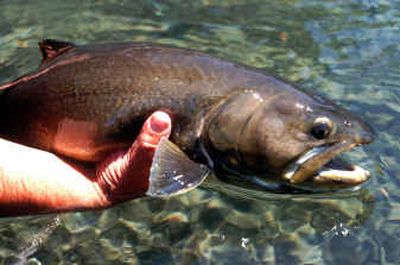
Environmental groups say they will sue the federal government over its decision Wednesday to remove critical habitat designation for the threatened bull trout in 90 percent of the Columbia and Klamath river basins.
The Alliance for the Wild Rockies and Friends of the Wild Swan contend the U.S. Fish & Wildlife Service bowed to political pressures in making the decision, which covers areas of Washington, Oregon, Idaho and Montana.
“We can’t allow this to stand,” said Michael Garrity, executive director of the Alliance for the Wild Rockies. “Failing to protect bull trout habitat will jeopardize clean water supplies throughout the Northwest.”
Mitch Snow, a spokesman for the agency in Washington, D.C., said the lawsuit was expected.
“There’s not a single action we do take where we don’t expect a lawsuit,” Snow said. “We’ve been sued so many times in so many ways that suit notices are the same thing as occupant mail.”
The critical habitat decision, required under the Endangered Species Act, was published in the Federal Register on Wednesday, but had been expected for some time.
The environmental groups waited until publication before serving 60-day notice that they intended to sue in federal court in Portland, said Arlene Montgomery of Friends of the Wild Swan, which along with the Wild Rockies group sued the government to get the bull trout listed.
Critical habitat refers to geographic areas that are essential for the conservation of a threatened or endangered species and which may require special management considerations.
The original critical habitat proposal for the Columbia and Klamath basins in 2002 contained approximately 18,500 miles of rivers and streams, and over 500,000 acres of lakes. The final contains just 1,750 miles of streams and 61,000 acres of lakes.
Of that, Oregon had 706 miles of streams and 33,939 acres of lakes and marshes. Washington had 737 miles of streams. Idaho had 306 miles of streams and 27,296 acres of lakes. All of Montana’s proposed critical habitat was eliminated.
“The Fish and Wildlife Service chose political expedience rather than good science, bull trout habitat and clean water,” Montgomery said.
But the agency contended the size of the critical habitat was greatly reduced to reflect existing conservation efforts in the region.
Those efforts included the state of Washington’s Forest Practices Act; the federal Columbia River Power System’s spending of $3.3 billion to restore salmon habitat over the past 20 years, which benefited bull trout; and conservation efforts by 11 federal agencies that manage portions of the river basin.
Montana also has a conservation plan to recover bull trout. Idaho already had an agreement with the Department of the Interior to protect habitat in the Snake River Basin.
The two environmental groups had sued the Fish and Wildlife Service for not designating critical habitat when it listed bull trout in 1998 as threatened in the lower 48 states. The agency is conducting a review of bull trout to determine whether a change in status is warranted. That review is expected to be finished next year.
The agency has said that in 30 years of implementing the Endangered Species Act, it has found that the designation of critical habitat provides little additional protection to most listed species.
In a separate action in June, Fish and Wildlife designated 2,290 miles of streams and 52,540 acres of lakes and reservoirs in Western Washington as critical habitat for the trout.
Bull trout have been reduced to about 45 percent of their native range in the past 150 years because of human encroachment, mining, grazing, logging, overfishing and introduction of non-native fish.