
Afghanistan’s myriad problems cloud elections
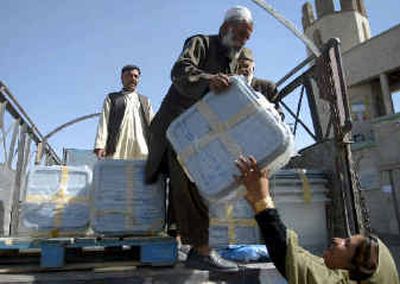
WASHINGTON – Millions of Afghans will vote in the country’s first presidential election Saturday, offering the rest of the world one of the most hopeful images from a land struggling to emerge from decades of war and privation.
Yet, voters will be surrounded by scenes that cast the new Afghanistan in a different light: Buildings flattened in insurgent attacks and factional fighting; mountain valleys carpeted with opium poppies; newly opened schools filled with children who are eager to learn, yet undersized from the malnourishment that continues everywhere.
Three years after U.S. troops ousted the repressive Taliban regime, Afghanistan has made progress. Despite claims by President Bush, Afghanistan’s bright future – or even basic stability – remains a distant hope. In many ways, security threats are more serious now than a year ago, posing a continuing concern in what remains a key front in the U.S. war on terrorism.
The Afghan elections “are a relative bright spot,” said James Dobbins, who was Bush’s envoy to Afghanistan. “But they have to be understood in a picture that has some very serious dark sides,” Dobbins said. “The security situation is not getting better. And I don’t know if it can be reversed.”
While Afghanistan has taken steps toward democracy and has improved public health and education, the new government remains weak and violence is rising. Some of the regional military leaders who have challenged the government have grown stronger, enriched by cash from the swelling opium economy. Taliban and al Qaeda remnants have regrouped and stepped up their attacks on relief and reconstruction workers and public officials.
Afghanistan’s deepening difficulties have raised questions about U.S. policy toward the country since the war’s end in 2001. Although President Bush has proclaimed his “iron-clad commitment” to the country, many experts, including former U.S. officials, believe the administration allowed Afghanistan’s security problems to take hold by failing to move earlier to see that order was imposed.
These critics contend the administration should have pushed to mobilize an international force of peacekeepers throughout the country, rather than focusing solely on the effort to root out al Qaeda and Taliban remnants.
“Afghanistan is not on the kind of fast track to stability and democracy that it could have been, and it’s because of policy failures,” said Mark Schneider, senior vice president of International Crisis Group, an international conflict prevention group based in Brussels, Belgium.
Some observers have called the U.S. investment too low. The 15,000-troop U.S. contingent in Afghanistan is far less than the 138,000 in Iraq. The U.S. government is spending $2.2 billion on peacekeeping this year, up from about $1 billion in 2003. That puts Afghanistan near the top of the list of foreign aid recipients, but the amount is dwarfed by the $18.4 billion appropriated for the reconstruction of Iraq, a country with roughly as many people.
Former U.S. envoy Dobbins said he believes that the United States has devoted far less than needed and will continue a “low input, low output” approach.
“If you invest low, you get low levels of security and low levels of economic growth,” he said. “It’s as simple as that.”
The differing views of Afghanistan have cropped up in the U.S. presidential campaign. In describing Afghanistan as a success story, Bush cites the 4.3 million children who now attend schools, compared to about 300,000 under the Taliban. He has said millions of children have been immunized against disease, and that 10 million adults, including 4 million women, have been registered to vote.
Democratic challenger Sen. John Kerry points to faltering security and resurgent drug industry in arguing that Bush’s invasion of Iraq detracted from the war on terror, which he argued is centered in Afghanistan.
While the number of Afghan voters is probably inflated by multiple registrations, opinion polls show that average Afghans are enthusiastic about their new democratic choices. Large majorities believe the country is on the right track, and Karzai has wide support.
Even so, it is easy to exaggerate improvements in the lives of Afghans. Afghan women still suffer the highest rate of pregnancy-related deaths in the world, according to the World Bank. Less than 20 percent of Afghans have access to safe drinking water, only 6 percent have electricity, and half suffer from chronic malnutrition.
By one measure of prosperity, gross domestic product per person, Afghans are doing twice as well as they were when the U.S. invasion took place. But that $246 per person compares to $1,600 in economically depressed Iraq. And most of the economic growth, is due to the opium industry that accounts for 75 percent of world consumption, and is set to break all records. Robert B. Charles, assistant U.S. secretary of state for international narcotics and law enforcement, recently called the drug threat “a dark shadow” over the country. Officials are most alarmed by the drug boom because it threatens to strengthen warlords, terrorists and ordinary criminals in ways that will quickly undermine the halting effort to build a new state.