
Lines form for flu shots

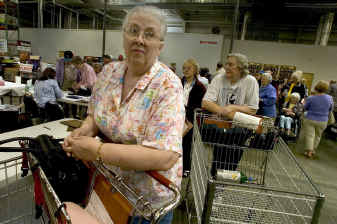
A flu shot clinic Thursday at Costco attracted hundreds of people who waited over an hour and formed lines that snaked between several check stands, past the shampoos and vitamins to the fresh flower display.
“I have to get one. I usually try to get it the first day out,” said Don O’Neal, a Spokane resident who has asthma and suffers from a seizure disorder.
With a nationwide vaccine shortage looming, people in high-risk groups scrambled to make sure they would get their shots. The Spokane Regional Health District called on employers that have scheduled flu shot clinics to restrict vaccinations to high-risk groups.
The Spokane health agency announced Thursday that it will hold its scheduled flu shot clinics today and Monday but will cancel other clinics until it learns whether it will receive the rest of the vaccine it ordered.
That depends on how the U.S. Centers for Disease Control and Prevention will manage supply of the vaccine.
“We’re imploring healthy people who may have the opportunity to go to a grocery store flu clinic or workplace flu clinic to forgo getting a flu shot until and unless this is cleared up and vaccine becomes more available,” health district spokeswoman Julie Graham said.
The Panhandle Health District in Coeur d’Alene announced earlier this week that most of its flu shot clinics would be canceled.
In Pullman, the Washington State University Health and Wellness Services announced Thursday that it has no flu vaccine available.
O’Neal, who gets a flu shot every year, happened upon the clinic when he stopped by Costco’s Valley store to pick up light bulbs.
The crowd included seniors, people with disabilities and a few middle-aged men and women. Some were there because their employers or their physicians aren’t providing shots this year – the unfortunate side effect of a nationwide flu vaccine shortage.
Nearly half the expected supply of flu vaccine for the United States was suspended when British regulators yanked the license of manufacturer Chiron Corp.’s Liverpool plant. Chiron, the second leading manufacturer of flu vaccine, had a problem with bacterial contamination in some of its product.
At Costco on Thursday, four nurses from Maxim Healthcare Services arrived with 500 doses of flu vaccine and 60 doses of pneumonia vaccine.
“We’ve probably had 250 to 300 people so far,” said Robb Long, a Costco employee who helped direct crowds and distribute paperwork.
Last year, crowds weren’t quite so big and Costco was able to hold more clinics, said Long. This year, the shortage caused four of the six scheduled clinics to be canceled.
Some people are finding that their family physicians aren’t providing vaccinations this year. Carl Mount and his mother, Winifred Jagler, came from Cheney for shots because their regular clinic didn’t have a backup supply and was forced to cancel when its order of vaccine didn’t arrive.
“The only time I didn’t take a flu shot, I almost died,” Mount said. “I’m just thankful they had it.”
Children ages 6 months to 23 months are one of the high-risk groups. Vaccine should be available to those children because the Spokane Regional Health District is distributing 2,330 doses to Spokane-area pediatricians and family doctors.
One alternative for people who aren’t in a high-risk group is FluMist, the new nasal spray flu vaccine introduced last year. It is safe only for healthy people, ages 5 through 49. About 1 million doses are expected to be distributed nationally.
High-risk groups include:
•Children, ages 6 months to 23 months.
•Adults, ages 65 and older.
•People ages 2 to 64 with chronic medical conditions.
•Women who will be pregnant during flu season.
•Residents of nursing homes and long-term care facilities.
•Children ages 6 months to 18 years on chronic aspirin therapy.
•Health care workers involved in direct patient care.
•Out-of-home caregivers and household contacts of children younger than 6 months.
Richard Imbler, of Spokane, wanted to avoid a repeat of a flu that nearly killed him last year. He was visiting family in Salt Lake City for Thanksgiving and ended up being admitted to the emergency room with a 105.6 degree temperature.
In addition to needing oxygen, he spent a delirious week in an out-of-town hospital.
Imbler said his brush with death exemplifies the harsh realities of an illness that some mistakenly equate with a simple stomach bug or cough.
“To have the real influenza – the kind that kills people – is a different experience.”
As someone who comes into contact with the public through his job, Imbler also wanted to avoid the chance of passing germs along to his 1-year-old grandson. The little boy is undergoing treatment for a brain tumor at Sacred Heart Medical Center.
“I have two very good reasons for not wanting to get the flu this year.”