
She finds painting helps ease pain

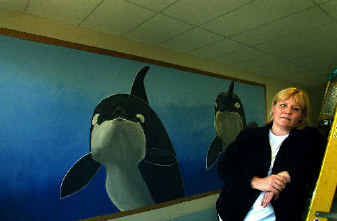
Joy Waters’ salvation is pastel and addicting.
Its hold on Joy is complete. It drives her past exhaustion and pain, sorrow and hopelessness. Her violent childhood and young husband’s death, her alcoholism, spinal cord surgeries and absent daughters fade in Joy’s consciousness while she draws with pastels, then fine-tunes her artwork with her fingers.
“Drawing helps me focus, like I’m in an altered state,” Joy says, resting her eyes on a human-faced moth in flight she drew and hung, framed, on her kitchen wall. “It’s very soothing, and touch is so important. I wouldn’t be here today without it.”
Joy is 38 and looks like a fresh-faced soccer mom most concerned with which cookies to bake for her four daughters. She’s a perfect example of how looks deceive.
“She’s amazing,” says Joy’s mother, Joy LaFern. “She’s never let anything stop her.”
Joy’s mother lives in Taos, N.M., but she’s in Hayden this month to help her daughter paint a mural for Idaho Outpatient Rehabilitation. The younger Joy has painted murals for several North Idaho businesses since she discovered the powerful medicinal effects of art and her skill with pastels. She works for a maximum of three hours at one time because that’s all her body will allow her. But even three hours with her fingers smearing blues and greens and her pinky cutting in details like eyelashes and lip creases feeds her soul enough to encourage her to rise from bed another day.
“Painting is my life. I have such support from family, my pets, prayers. But painting lifts me,” Joy says. “It’s still where I go when I’m angry or hurt or brokenhearted.”
She turned to alcohol first. Joy was 25 when her husband died in 1991. She knew his heart problems were serious when she married him, but she believed she could save him. She even trained as an emergency medical technician. It didn’t help. Alcohol masked her pain.
She drank for seven years, somehow raising two daughters and remarrying. Joy drove drunk. She sneaked alcohol into her house. She tore up her house during anxiety attacks.
In a lucid moment in 1998, Joy realized she was risking her marriage to Larry Waters and her job as a parent. She made an appointment with a counselor and joined Alcoholics Anonymous.
Her counselor identified reasons for her behavior. She was bipolar and suffered from post-traumatic stress disorder, most likely from her first husband’s death. Her childhood probably also contributed to the PTSD. Joy doesn’t say much about her childhood except that it was violent.
Her counselor changed Joy’s life, but not with his expertise alone. A picture he’d painted of a mouth hung on his office wall. Joy saw it and grabbed a pencil. She doodled as she had when she was a kid. Drawing captivated her. When artists gathered at the Resort Plaza Shops to paint in public, Joy went to watch. She was particularly intrigued with artist Dave Clemons’ work.
“I remember her saying she wanted to learn,” Dave says.
Dave was an art instructor at North Idaho College. Joy asked him to look at her work. He noted her keen observation skills. She wanted lessons but couldn’t afford them. Dave told her about artists who gathered weekly at a Coeur d’Alene studio to paint or sculpt from live models. He offered to meet her there and work next to her.
“It wasn’t formal tutelage, just let me share what I do and how I do it,” he says.
Joy went for a month, then signed up for a daylong portrait workshop Dave was teaching. He taught her centuries-old traditional skills, which gave her a foundation from which to develop her own style. At the workshop’s start, Joy was certain she was out of her league. By the end, she knew she was where she belonged.
“She has more talent than a hobbyist,” Dave says. “That’s why she made such a connection.”
Drawings Joy worked on during A.A. meetings captured the attention of a priest in St. Maries. He asked her to paint a mural for his church. She painted the Madonna in a flowing gown with her arms spread toward the heavens. She was standing in a cupped hand. As Joy painted a background of sun-drenched storm clouds, she was overwhelmed with sadness. For years, alcohol had blunted her emotions. Sober, she was staggered by their strength.
“I heard a voice say, ‘It’ll be OK. Keep painting.’ It was clear as day,” Joy says. “I couldn’t paint anymore. I wept, a total meltdown. I’d just been told I was on the right track.”
Art was no longer just satisfying, it was a spiritual experience that provided Joy the strength to heal herself. She needed it more than she imagined.
Headaches and muscle spasms in her shoulders and back had nagged her since childhood. Joy lifted weights, swam and hiked to alleviate the pain, but nothing worked. She sought help from doctors, chiropractors and acupuncturists. No one could pinpoint the problem.
She was preparing with her daughters for a karate competition four years ago when her life took another drastic turn. They took karate as a family activity and to boost self-confidence. Joy, a purple belt, visited her chiropractor for an adjustment to reduce her pain before competing. He took X-rays and discovered the top two vertebrae of her spinal column were broken. The top vertebra connects the head to the spinal column. It’s the bone “Superman” actor Christopher Reeve broke in a horse-riding accident, leaving him paralyzed.
Joy’s vertebrae were unstable but nerve damage wasn’t evident. She decided the bones had weakened either during her alcoholic period or when she was violently shaken as a child. Doctors warned her the slightest fall could kill her. She quit karate.
A neurosurgeon put her in a collar and suggested she make out a will. Joy was 34. She wrote farewell letters to her daughters, then underwent surgery to stabilize her vertebrae with screws and a bone graft. The surgery didn’t work. Her headaches and muscle spasms intensified. She trembled.
A second surgery nine months later didn’t work either. Joy told her doctor she felt pops in her head, then lightning down her arms and legs. She cried when he told her he couldn’t help. She called Johns Hopkins University in Baltimore. The school had helped her first husband with his weak heart. Doctors there referred Joy to a neurosurgeon in Missoula.
Her third surgery in January left her in a halo – a stabilizing device from her waist to the top of her head. Screws in her skull held it in place for 14 weeks. She couldn’t shower or brush her teeth. Joy’s daughters washed her hair with a toothbrush. A collar followed the halo for three months.
The strain tore her family apart. Joy’s two oldest daughters moved out this year, her 18-year-old into her own apartment and her 15-year-old in with her grandparents. Medical expenses threw Joy so deep into debt, despite her Medicaid coverage, that she trades artwork for physical therapy and other care whenever she can.
Her last surgery was successful. Her vertebrae are stabilized, but damage to the area is permanent. Her hands and feet go numb periodically. She still has headaches. She can paint or draw for a few hours at the most, which is why her mother came to help with the latest mural. Joy works in pain but is addicted to the euphoria her art stirs in her.
So the walls of Joy’s house are covered with her artwork – smooth faces with full, red lips or Miss Volatile with her red face, green lips and white wispy hair or dark faces with spaced teeth and searching eyes.
Dave Clemons likes knowing he helped Joy find her salvation.
“When you find those students who really want the thing you’re able to give them, it makes teaching a truly miraculous, marvelous, wonderful thing,” he says. “You feel like you’re opening doors to people.”