
Learning a lesson in community

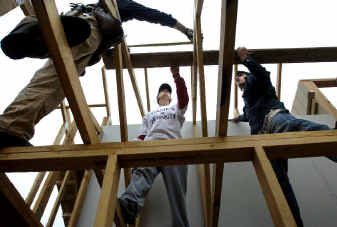
They spent six days hammering nails, drilling holes, handling tools they had never touched before.
Despite their lack of experience, the construction crew made up of students, staff and alumni from Gonzaga University was able to erect walls, lay pipe and contribute to the building of three duplexes — six dwellings for families in need of a new home.
“It’s humbling to be a part of this,” said Trevor Werttemberger, a ‘94 graduate and now the university’s assistant alumni director. “It’s meaningful to know that we’re helping them build not only a home, but a life.”
A transformation often takes place whenever people build a house together for Habitat for Humanity. Many talk about the rewards of volunteer work, of laboring alongside the future homeowners, of giving back to the community. In this case, the Gonzaga crew also spoke of fellowship.
The construction at the corner of Boone Avenue and Madelia Street in north Spokane was the first time that staff members along with students and alumni were able to work together on a tangible project.
While community service has always been part of Gonzaga’s mission, only students and faculty were encouraged to do volunteer work. Two years ago, the staff decided to get on board.
Now, all full-time employees of the university take a half-day away from work each year to volunteer at a school, soup kitchen or local charity. This year, the Staff Assembly’s Community Outreach Committee decided to team with the alumni office and Gonzaga’s Center for Community Action and Service-Learning for the Habitat house. More than 120 people took part in the weeklong project.
“You can’t instill community service and a thirst for justice in students without instilling it in the staff,” said Mike Renes, a member of the Staff Assembly and the community outreach coordinator for CCASL. In order for an institution to live out its mission, everyone – from custodians and secretaries to students, faculty and administrators – has to be involved, he said.
Working together on the Habitat house gave people a chance to get to know each other and work for a common cause, said Marcia Bertholf, an administrative assistant and member of the Community Outreach Committee.
For the past decade, service learning has been a significant part of the education at Gonzaga, a Jesuit school of about 5,400 students. Dozens of faculty members make academic-based service projects a requirement to pass their courses.
Last year, students at Gonzaga contributed about 100,000 hours of community service to projects in the Spokane area, Renes said. Many GU students also join the Jesuit Volunteer Corps, the Peace Corps and other volunteer groups after graduation. In fact, Gonzaga has been ranked in the top 20 among small universities in the country for producing the greatest number of Peace Corps volunteers.
Regardless of the careers they pursue, students at Gonzaga say they have benefited from the community service work they were involved with as students, Renes said.
Bertholf, who’s 5 feet 10 inches tall, spent three shifts in a 4-foot crawl space drilling holes in order to run pipes for radiant heat under the floors.
“It has been a very positive experience,” she said. The staff is “really trying to shine in our own light as far as making a difference at Gonzaga. It helps us realize the mission as a group and as a part of the whole university.”