
Six-gun bolsters notoriety

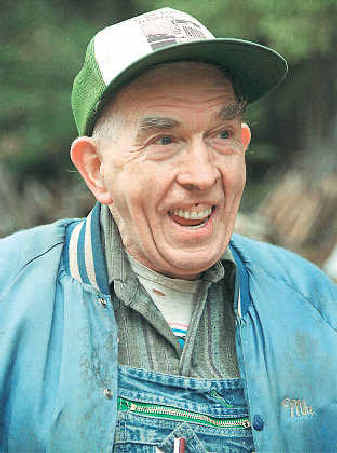
ELGIN, Ore. – Sam Horrell’s childhood was spent in a little log shack, cutting firewood with a crosscut saw and poaching wild meat for the dinner table.
Now he’s master of all he surveys as the unofficial governor of “Sammyville,” an imagined city that’s actually little more than a jumble of beat-up trailers, rusted tin homes and even a house of straw about six miles from the nearest real town, Elgin.
But while it may not hold a place on modern maps, the 100-acre property boasts legendary status in the wilds of the Blue Mountains. Don’t go there, other area residents warn newcomers. Sammy doesn’t like strangers, and you might never come back.
Though Horrell’s perpetually strapped-on six-shooter may scare some visitors away, his wide smile more often welcomes them in. His money – much of it buried underground in coffee cans – has helped build a church and feed the hungry.
It’s all led to a small measure of fame for the once-reclusive 73-year-old. Reporters ignore the warnings and chase him for interviews. He’s even inspired a B-rate fiction movie.
“I don’t know why some are scared of me. The sheriff department, city police, they all know I always got my gun and if they need somebody I’m here to help,” Horrell said.
“Sam’s always had this reputation as being kind of ornery or whatnot, but when you know him he’s a wonderful man and would give you the shirt off his back,” said Vicki Weaver, Elgin’s city clerk. “I don’t know how that reputation got started.”
Some blame his ancestors.
Gunmen and rustlers
In a region where blood runs deep, Horrell’s predecessors in the late 1800s were gunmen and accused rustlers in Texas, accounting for half of the historic Horrell-Higgins feud there. They also lived for a time in New Mexico, where the clan engaged in a bloody battle known as “The Horrell War.”
Many of the brothers died in the fighting. A few of the surviving ones – including Sam’s grandfather, John Horrell – brought the family’s outlaw spirit to Oregon.
“When Pa was a kid he wanted to ride with Jesse James’ gang,” Horrell said, though Jesse James was dead and his brother Frank James was pushing 60. “But they wouldn’t let Pa ride with them. Said he was too young.”
His father grew up, got married and in 1930, Sam was born. He was one of three sons.
The family’s only income came from firewood sold for about $6 a month. The paltry salary was enough to buy coffee, sugar, salt. Nearly everything else came from the land.
The living might have been easier in town, but that didn’t fit his father’s reclusive nature, Horrell said.
“He was a loner and that was the way he wanted it. Weren’t nobody living above us, nobody around,” he said.
As soon as Horrell was old enough, he took a job with the local lumber mill. He used the money to begin buying property, picking up parcels of land at tax auctions and foreclosures.
“I only ever had one debt at a time. Whenever any property come up and I had enough saved up for a payment, I’d buy it,” he said.
His first purchase was 20 acres of land for $21, on what is now the corner of Sammyville. It was where he built the family a new home.
The few folks who wandered onto the property were generally frightened when they found out where they were, Horrell said.
“That rumor has always been around: If you go out to Sammyville you don’t come back. Don’t go out to the Horrell place. Not sure how it got started,” he said.
Locals would be wiser to be wary of Horrell’s shrewd business sense, said Union County Sheriff Stephen Oliver.
“He’s probably got 29 rentals in Elgin alone, not counting the ones in Sammyville,” Oliver said. “I know he’s got more money than anyone around there, but I’ve seen him and his wife driving around to pick up beer cans and bottles for the deposit.”
Much of that money is hidden away in coffee cans, buried under rich mountain soil: Horrell’s savings accounts.
“Have I ever lost one? Well, I tell people if they can find them I’ll split with them,” he said.
The money isn’t left to rot, however. Sam and Annabelle became charter members of the Elgin Historical Society, underlining their support with a hefty donation. They ran the Elgin Food Bank for years, Oliver said. Sam Horrell donated the time, labor and money to lay the foundation for the local Seventh-day Adventist church, of which he and his wife are members. Annabelle Horrell spends her time volunteering to help senior citizens with their taxes.
Horrell has maintained his thrifty-living ways, most often wearing beat-up overalls and a ragged jacket. His cleft palate and eternally loose dentures can make it tough for visitors to understand every word. But Horrell’s most distinctive feature hangs on his hip — a long-barreled six-shot Ruger pistol.
Shot the movie screen
Shooting practice started young. Horrell was sitting at the Elgin Opera House watching his first movie when the excitement got the best of him, according to local lore. He pulled out the gun, yelled a warning for John Wayne and shot the image of an actor sneaking up behind the film’s hero.
Today, the entrance to Horrell’s kingdom is marked with a kelly green sign reading “SAMMYVILLE.” Horrell’s own home is known as the village’s chapel, a move which Oliver claims allowed Horrell to avoid residential building codes.
The house, like the town, is modest at best. A plywood ceiling tops Horrell’s living room. The walls are decorated with clippings of newspaper articles that mention Sam or Annabelle. The furniture is worn, and a dog named Rusty releases a low growl whenever a strange-sounding truck drives by.
Rentals in Sammyville top out at $300, said Annabelle Horrell, and that gets a resident a three-bedroom home of sorts. Prices drop depending on the rental – a beat-up trailer or a home made of tin or straw may go for less.
Residents regularly stop by Horrell’s house to drop off rent money or to ask permission to throw a mattress on his burn pile. Piles of rusted metal and rows of old cars fill the spaces between homes.
It’s no surprise the setting inspired a movie, also named “Sammyville.” The 1999 low-budget flick never made it to most screens, but Horrell didn’t mind. He simply enjoyed the attention while it lasted.
The crew was apprehensive, Oliver said. They checked in with the sheriff’s office before venturing into Horrell’s territory to make sure it was safe.
Still, Oliver said, residents’ fear of Sammyville has eased in recent years, along with the frequency of law enforcement stops.
“When I was a patrol deputy, a lot of the people he rented to at that time were criminal types,” Oliver said. “Now once in a while he’ll rent to somebody who’s involved in drugs, and he’s really good about letting us in when we need to be there.”
After the movie’s limited run, some Grande Ronde Valley residents wandered up to the village for a look. Reporters from papers around the nation began calling.
But with the notoriety, the mystique of Sammyville may be fading.
“There isn’t as much interest as there used to be,” the sheriff said. “We’re still out there a lot for domestic violence calls, and sometimes somebody just wants to go out there to meet Sam so we’ll take them out and introduce them. But it’s pretty tame these days.”
That’s just the way Horrell likes it – he doesn’t want visitors or potential renters scared away.