
More homeless people in Valley

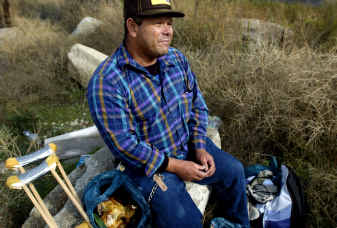
Spokane Valley residents see the face of homelessness every day as they pass street corners where panhandlers beg.
But Spokane Valley police Chief Cal Walker gets a closer look when he visits the growing number of campsites where many transients live. The areas are littered with human waste, food wrappers and empty alcohol bottles, he said.
“You go visit the homeless site and see what they’re spending their money on,” Walker said.
“It’s drugs, alcohol and food. It’s not on shelter; it’s not on sanitation.”
He said that since the city of Spokane, which abuts Spokane Valley’s west end, enacted a law last summer that prohibits most types of camping on public land, the down and out have simply moved east across the border. Now, the homeless population in suburban Spokane Valley is on the rise, he said.
“It’s like squeezing a tube of toothpaste,” Walker told the City Council on Tuesday. “The city of Spokane squeezed the tube over there, and now it’s coming out over here.”
To combat homelessness in Spokane Valley, Walker recently assigned Cpl. Bob Christilaw to work closely with transients and the social agencies that help them. Jailing transients for minor crimes only drives up incarceration costs and doesn’t treat the root of the problems, Walker said.
Many homeless people are battling mental health problems and would be better served in halfway houses than jail cells, he said.
The Spokane Valley Police Department earned praise Tuesday from the council and from mental health workers for its approach.
Paul Nutting, of Spokane Mental Health, doesn’t have figures that show a homelessness increase in Spokane Valley but said the agency’s Homeless Outreach Team is spending more time there because the police are helping them identify the people in need.
“If we can get a location and a solid referral, we’re out there in a minute,” Nutting said.
Still, crime often accompanies homelessness. Walker said a popular campsite in Spokane Valley is on Sullivan Road, near the Mirabeau Park Hotel.
Police have dealt with more vehicle prowlings, thefts, disorderly conduct and harassment there in recent months and in turn have stepped up patrols.
“There’s some real public health issues, some real public safety issues,” Walker said.
The Spokane Valley City Council has studied its legal options for curbing panhandling, which is just one piece of homelessness, but hasn’t addressed whether it should ban camping on public land, as Spokane did.
Spokane Valley doesn’t have a law that bans aggressive panhandling, and nonaggressive panhandling is usually protected by the First Amendment. Currently, panhandling becomes illegal only when it disrupts traffic.
While sitting on a rock in a vacant lot near the Mirabeau Park Hotel on Tuesday, Steve Esjairos predicted Spokane Valley will ban homeless camping, too.
He spends most nights at a downtown Spokane homeless shelter, but rode the bus to Spokane Valley to buy cold medicine and food at Wal-Mart.
“It’s a political fight,” Esjairos said. “All these business people don’t want any poor people around.”
He agreed that homeless people are leaving Spokane, but he said most of those he knows don’t stay in Spokane Valley because there are no shelters or soup kitchens.
The director of the Spokane Valley Community Center, however, has noticed more demand for clothes, food, shelter, blankets and sleeping bags. Molly Dalpae said Spokane’s new law pushes people out.
“The homeless are going to go where there are other services, and that’s the Valley,” Dalpae said.
Spokane Valley also is densely populated, so panhandlers can make money begging, Walker said.
Dalpae advised citizens not to give cash to panhandlers.
The homeless problem won’t be as visible soon. Most transients will find indoor shelter when temperatures drop, but Walker expects the number of transients in Spokane Valley next year to grow significantly.
“The first spring after city of Spokane has put teeth to their camping ban, we are going to be the recipient,” he said.