
escape to the Dead Sea

AMMAN, Jordan – My American hips weren’t cooperating. Iyad, the hunky Jordanian taking pity on me, could see this. My Iraqi translator could see this.
In fact, I was certain that everyone in the downtown Amman disco could see that I was a dancing disaster, as Iyad tried to guide me in rhythm to the pumping beat of Arabic pop filling the dark, smoky nightclub.
Everyone else was swaying in graceful circles, shoulders and waists swinging melodically like wind chimes in a gentle breeze. See, like this, my translator instructed, her body moving in a sensual blur of tight blue jeans and sleeveless black top.
She placed my hands on her hips so I could feel the motion. No go. I was still somewhere between Michael Jackson and Doris Day.
My translator, Luma (whose last name is being withheld for her safety), had come with me to Jordan from Baghdad on a quintessential coming-of-age road trip.
It was the kind of trip I had taken many times in the United States as a young adult. A friend in the passenger seat. A Big Gulp from 7-Eleven propped up against the gearshift. A bag of peanuts and a six-pack of beer in the back seat.
I was 19 when I tasted freedom for the first time, riding off to college without a parent on a southern Illinois highway in my beat-up Honda Civic hatchback.
Luma had to wait until she was 28 to find her freedom in a rented Nissan on Wadi Araba Road to the Dead Sea.
Until last year, Luma, a vivacious, hopeless romantic with an innocent smile, had known life only under deposed dictator Saddam Hussein, who restricted travel outside the country.
She had never been on a trip without her mother or a male relative. She had never worn a bathing suit at a beach with both men and women. She had never been to a disco that served alcohol, never swapped telephone numbers with a dance partner, never cranked up the tunes in the car and wasted the cool air-conditioned air with the sunroof open, just because.
And she had never had a hotel minibar beer.
The first night we were in the Jordanian capital of Amman, she opened the refrigerator of our 10th-floor room at the Four Seasons hotel and discovered a shelf full of beer. We should have one, she declared. No, no, no, I objected. Minibars are really expensive, and the accounting department will see this, and really, we just worked out in the gym.
I looked at her eager face, a face that said, “But we’re on vacation without our mothers!” We each grabbed a cold one, turned off the lights and sat on the floor to watch the moon rise over the twinkling city.
In spite of post-9/11 fears about traveling in the Middle East, Jordan is still a welcoming place for Americans. Most young Jordanians speak excellent English, and cab drivers know enough to get you where you want to go.
If you get lost in your rental car, however, and your Arabic-speaking translator is pretending she is from Spain and will not let you pull the car over to ask directions because there are religious-looking men on the sidewalk and she is wearing a revealing top, you might end up driving around for two hours in maddening, disorderly traffic unwittingly teaching your translator your best road-rage swear words.
The only option for civilians to fly out of Baghdad when we traveled last month was the expensive ($1,100 round trip), twice-daily Royal Jordanian flight to Amman, 90 minutes away. (Iraqi Airways just began daily service to Amman for about $750 round trip.)
A week before we left, a plane was fired on by a surface-to-air missile, and the airline temporarily suspended flights. We were on the second flight out since the ban had been lifted.
A passenger moving through the security screening banged a piece of luggage against a fiberglass panel. I immediately ducked, as did about five beefy contract workers. Luma didn’t miss a beat in the story she was telling. “Don’t worry; it wasn’t a mortar,” she assured me before picking up where she left off.
This was Luma’s first airplane ride, her first exposure to the indignities of the war-on-terrorism airport search. A week earlier she had bribed the woman at the checkpoint to our Baghdad hotel with diet pills to stop touching her “in a bad way.” (She also asked her to “stop touching the little one, my friend, the one they call Jackie.”)
At the airport, Luma set off a walk-through detector. When a security worker asked her to take off her shoes, Luma wouldn’t budge.
“I know how it is,” she told him. “First you ask for the shoes, then the pants! I will not.”
They waved her through.
•
Our main destination in Jordan was the Dead Sea, a place where we could relax and forget about life in Baghdad: the violence, the kidnappings, the car bombs, the translators who have been targeted because they work for Americans. In Iraq, Luma is scared every time there is a knock at the door.
One night when we were hanging out in the swimming pool at our Dead Sea resort, Luma turned to me beaming and asked if I felt happy.
“Happy? No, better than happy,” I told her. “I feel safe.”
She nodded, and we leaned our heads back against the tiled pool wall and watched the sun drop behind the mountains in Israel.
There are really only three main resorts on the Jordan side of the Dead Sea: the high-end Jordan Valley Marriott Resort and Spa, the Movenpick Resort and Spa, and the Dead Sea Resort. I chose the Movenpick, part of a Swiss chain, for its moderate price and faux rustic charm. Besides, I figured, it couldn’t hurt to stay neutral.
We bade goodbye each night to the setting sun from the outdoor pool, which was constructed partially above ground, with water spilling over a back bowl, creating the illusion that you could swim right into the Dead Sea.
It’s a 45-minute drive from Amman, a quick trip by taxi that costs about $35 one way. We opted against hiring a taxi or a driver because we wanted to make it a true road trip, just two chicks and the open highway.
Luma had arranged to borrow a car from an uncle living in Jordan, but the uncle ultimately decided against this because Luma did not have an international driver’s license. Not to worry, Luma told me. Her Iraqi friend, Jamal, an engineer living in Jordan for three months, would find us a vehicle.
Jamal had a contact at the Avis rental car agency, where we headed to get our wheels, no questions asked. I couldn’t understand exactly what was being negotiated at the Avis counter – the conversation was in Arabic – but whatever it was it took two hours, and I ultimately signed the contract and handed over my D.C. driver’s license and credit card. I had no idea how much it would cost.
Luma plunged the Nissan into the chaotic traffic and we were off, weaving and dodging and honking through the streets of Amman. I crouched in the passenger seat while Luma piloted our great adventure in a vehicle I was responsible for, in a vehicle only I was licensed to drive. As the road opened, revealing the wide brown vista of the Jordan Valley on each side, I opened my eyes and saw that we were now barreling down a hill, straddling the center lane.
“Luma,” I said quietly, pleading. “You know I never ask anything of you. You know this. But please, I don’t care how long it takes us to get to the Dead Sea. Please, please drive the speed limit. … Do you know you’re driving on the shoulder?”
“What’s a shoulder?” she replied.
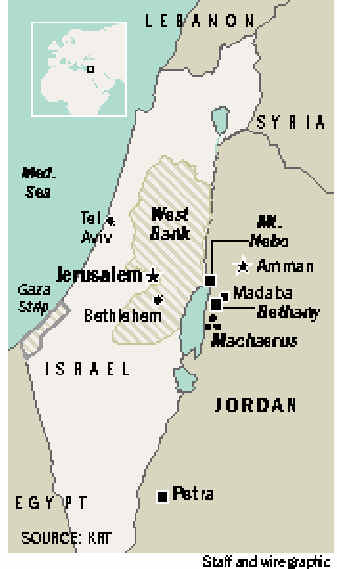
She eventually slowed down, cranked up the radio, and I sat upright again to watch our descent through the valley toward the Dead Sea. The sea is a remarkable place because of its geography and place in biblical history. We were within half a day of the ruins of King Herod’s fortress in Machaerus as well as Mount Nebo, where, according to the biblical account, Moses climbed to see the Promised Land before his death.
Luma and I also made the 15-minute trip to Bethany, which claims to be where Jesus was baptized. (Israel says he was baptized on the west bank of the Jordan River, within its territory.)
The site, which opened in 2000 after Jordan began excavations six years earlier, is tucked along a narrow two-lane road that passes camel ranches and sheep farms. Our English-speaking guide spent a considerable amount of time putting forth the defense for why Jesus was baptized there and not in Israel, even citing passages from the Bible to back it up.
The baptism spot itself is now a dried-up riverbed with ancient steps leading to it. The Jordan River, a meandering body of water, is a few hundred yards away, reached by a shaded gravel footpath.
My Muslim translator seemed as excited as her Catholic reporter to reach the river water, where we dunked our feet in the murky green liquid and looked out at a short tree line that marked the boundary with Israel.
“Can’t you just imagine Him walking to this very spot?” she said eagerly.
We both filled bottles of water to take to our mothers.
•
I was sun-kissed and rested when we touched down again in Baghdad five days later. I could never have imagined such a journey, this trip with Luma. I had seen the most beautiful sunsets, written in my travel diary by candlelight on a balcony where I could see the flickering lights of Jerusalem across the sea.
I climbed Mount Nebo with my Muslim translator to one of the holiest places in Christendom, a place where both sought peace. I had watched Luma live.
“Welcome to Baghdad,” the flight attendant chirped.
Luma scowled. “Don’t welcome me home,” she said.
An hour later we climbed into the armored car that would take us back to our drab hotel. I sat in the back and watched the grim postwar landscape pass us by – the wreckage, the dusty terrain, the garbage piled up against barbed wire. In the passenger seat, Luma blinked back tears.
“I hate this country,” she said. “Look at the tanks. Look at the guard rails,” which were mangled by roadside bombs.
“I just want to close my eyes and someone will wake me up in the morning and say, ‘Come on, here is your flight.’ I don’t want to be here. I just want to live normal.”
On our last night in Amman, I had discovered Luma dancing in our hotel room, the curtains open, the sounds of the city filtering through the cracked window, the sound of a life she wanted. She looked so happy, so free, dancing in her jeans and baby blue T-shirt.
This had been a vacation for me, something altogether different for Luma. We had traveled the same road but we had not had the same journey.
Sometimes you go away and you disappear into a place until you feel so much a part of it that you don’t want to come home. But sometimes you have no choice.
I thought of this as I listened to her cry. There was nothing I could say.