
Nissan Quest reinvents minivan form
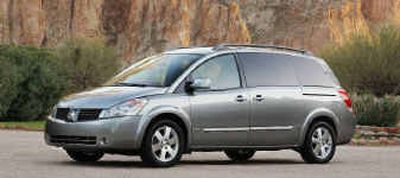

It may not be possible to make a silk purse out of a sow’s ear, but one could presumably create a good-looking sow’s ear that performs beyond expectations.
Similarly, Nissan has produced a minivan that will appeal to those who want a van that’s more than a box on wheels — a good-looking one that performs beyond expectations.
Flush with success from the redesigned Altima and Maxima sedans and the recent release of the lovely 350Z, Nissan designers took a clean-sheet approach when they began developing the Quest.
And though it’s tough to make a minivan look like anything else, they did a nice job of reinventing the form, both inside and out.
Check out that arching roofline and its echo in the curved window line below, the sloping hood, the large expanse of windshield and structured wheel wells — yes, this is a minivan out to make style points, and succeeding.
The fun continues inside. Control central is a round panel that contains not only the audio and climate controls, but also the gauges and shift lever. The arrangement reflects a refreshing approach to dashboard design and opens up a large expanse of real estate in front of the driver, which Nissan fills with a large, covered storage bin ideal for sunglasses and other miscellany.
The dash and cowl are mounted low, producing that massive expanse of front glass as well as terrific vistas for front-seat occupants.
But the new Quest isn’t just about making fashion statements. Nissan expects 80 percent of Quest buyers will be women hauling precious cargo and possessing heightened expectations regarding safety. So even the base Quest S (from $24,900, including destination) is fitted with side-curtain airbags, which drop from the roof to protect the heads and necks of outboard occupants.
Antilock brakes, brake assist and brake-force distribution, all designed to help a driver stop the vehicle quickly and in a straight line, are standard, as well.
Some manufacturers have begun bundling such features into options packages that include unrelated convenience options, and it’s refreshing to see Nissan deliver a van with safety built in.
Flexibility is another hallmark of a successful minivan, and Nissan scores with three rows of seats, all of which fold flat to create a level cargo floor. In the second row, only captains’ chairs are available, limiting total seating capacity to seven.
Order the optional, $350 seating package, and the third-row bench disappears into a well.
The sliding side doors are larger than those of any other van, which helps with ingress and egress and makes easy work of side-loading large objects. The second-row buckets spring up and forward to allow passengers into the third-row area.
To further ease ingress and egress, Nissan eliminated side bolsters from the front seats. At least one diminutive reviewer credits the bolster-less seats and low floor height for allowing her to slip directly into the driver’s seat from curb level. Still, she writes, the seating position was high enough to allow her to see over the tops of surrounding vehicles.
Third-row occupants are treated to a surprising amount of legroom; even with the second-row chairs in their rearmost position, there’s plenty of room for adults of average size.
In a neat trick and an industry first, Nissan provides an optional overhead console with two dropdown video screens, so even the tykes in back get a good view of the featured attraction.
Meanwhile, up in the business end of the Quest, the driver will enjoy one of the better driving vans on the market. The same 240-horsepower V-6 engine that’s found in several Nissan and Infiniti products powers the Quest. It makes 242 pound-feet of torque across a wide power band, so acceleration is instant and effortless. No worries about freeway merging or two-lane passing.
On the base S, the engine is mated to a four-speed automatic. Uplevel SL ($27,300) and SE ($32,800) models get a five-speed automatic. I drove the S and the lack of a fifth gear never seemed a handicap.
Ride and handling are outstanding, with Nissan’s traditional emphasis on taut steering and body-motion control. Some may find the steering a little heavier at parking-lot speeds than what they’re used to, but that pays big dividends on the highway where the steering is direct and responsive and not the least bit jittery or vague.
Downsides? As always, there are a few. That neat windowsill curve? It prevented designers from hiding the side-door slider tracks in the sill; those who find exposed tracks offensive will be offended.
That cool, circular control panel? It forces a hair too much multi-functionality, leaving some of the knobs and buttons hard to decipher and operate (this is one of those auto-writer complaints; anyone who spends more than a day in the Quest will have no problem working the air conditioning).
And, finally, my recurring complaint about center-mounted speedometers: Counting the Quest, there are now three vehicles sold in the United States so equipped and I continue to think it’s a mistake to force the driver’s eye away from the road and to the center of the dash.
Be that as it may, the Quest does a nice job of advancing minivan design. After all, just because you spend most of your drive time toting kids, pets and friends of kids and pets, it doesn’t mean you want to be stuck in a rig your mother would have found fashionable.