
‘Storm’ of blood, bombs, tragedy
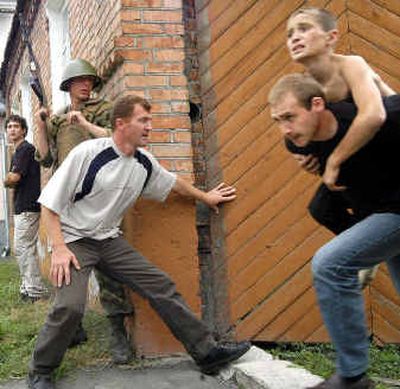
BESLAN, Russia – When “the storm” finally came as the adults feared it would, the bullets started flying, the bombs were exploding, and most of the children didn’t know what to do.
Hundreds of hostages, sweaty, hungry and scared, had been packed into the school gymnasium for three days. They had been told they would die if soldiers tried to rescue them. And suddenly a full-scale war erupted around them – the soldiers were coming.
Sosik Parastayev, who had just begun the fourth grade, noticed a man in uniform at the gym window, beckoning him to jump out. Sosik and his brother Atik, a year younger, scampered to the window along with their mother, Alyona Kokoyeva, who had been caught with them in the three-day siege of School No. 1. But as she tried to clear out the broken glass from the window so the boys could leap out, Sosik said, a bullet sliced through the air and ripped into her body.
“I was nearly shot” too, Sosik said. “I jumped out the window … Some soldiers grabbed me as soon as I jumped out. Everyone wet their pants.”
His mother survived, but he lost contact with his younger brother.
The army commando attack on the captured school in this town in southern Russia dragged on for hours after the assault Friday. But for the vast majority of the children held prisoner by Chechen guerrillas, “the storm,” as the survivors described the military onslaught, took place in a few chaotic and decisive minutes. Those who made it out of the gym right away were survivors. Those who did not mostly died.
Explosives which the guerrillas had wired around the gym blew up in a devastating cascade shortly after the first shots were fired, bringing the ceiling down from two floors above on top of hundreds of schoolchildren who never had a chance.
Hours later, the demolished gym still smoldered, its shattered carcass blackened and crumbled. By nightfall, most of the crushed bodies of students remained pinned under the rubble, while soldiers searched for lingering guerrillas and detonated the remaining booby trap bombs left behind.
Officials estimated the death toll at more than 200. Early today, 531 people remained hospitalized, including 283 children – 92 of the youngsters in “very grave” condition, health officials said.
For those who survived, there were broken bones, charred skin, mangled flesh, and memories that don’t fade away fast for young children. The words they spoke in the hours afterward seemed disconnected from their innocent faces, as they summoned forth images of mayhem and pandemonium.
“When they were storming, there was a lot of shooting,” said Aslan Isayev, dirty and scratched and seemingly hardened to the violence even though he was 9 years old. “Our soldiers came in and killed at least one of them, and maybe more,” he said, referring to the guerrillas.
“I saw the bullets flying right at us from the second floor and the first floor,” offered Arkady Zangiyev, also 9. “I fell on the ground. They were shooting. Then I started running. One guy from our class had a problem with his foot and I helped him run. I managed to run to the back exit and there was one of our policemen there. He grabbed a wounded boy and carried him. They were shooting a lot, but I ran very fast.”
The survivors were transported in ambulances and by volunteers in private cars to the Beslan hospital, which was so overloaded it set up giant tents to handle overflow patients and left others to lie on stretchers outside on the grass. Arkady wandered around the grass still dressed in his first-day-of-school gray pinstripe vest and pants, though he had long since discarded the shirt and jacket.
He and his classmates at School No. 1 had arrived on Wednesday morning for the opening of a new year, a festive day in the Russian calendar. Chechens and other guerrillas charged into the school at 9 a.m., armed with rocket launchers and explosive belts, demonstrating a cold willingness to use children to advance their cause.
“The terrorists were hiding behind trees,” Arkady remembered. “They jumped out and started shooting in the air. Some boys fell down in the street.”
Several men were killed in the first onslaught on Wednesday morning, among security guards, neighbors and fathers who happened to be at the school for the opening. Their bodies were left where they fell, baking in the late summer heat, while the guerrillas turned the school into a fortress. Hundreds, perhaps thousands of Russian troops encircled the school.
Inside, the students and their mothers were herded into the gymnasium and all the men were taken elsewhere. Some of the children spoke about rumors that they heard that the men had been killed – shot at point-blank range, according to some versions – or blown up by female suicide bombers, according to others.
The guerrillas began wiring the gym for a showdown. They placed a box of explosives at the center of the room, connected to a pedal which one of the militants held down with a foot. If he lifted his foot, the children were told, the bomb would go off. After that, according to the surviving children, the guerrillas set another 16 to 18 smaller, cylindrical bombs around the room, some on windowsills, even one in a basketball net.
The children said the guerrillas terrorized them, but did not hurt them physically. When some of the children cried too loudly, the guerrillas fired their weapons into the air or out a window to silence them. “They intimidated us,” Sosik said. “They pointed their guns at us. But they didn’t beat us.”
But survivors said the guerrillas were harsh with some of the adult hostages. Chermen Bugulov, 8, said one man was killed the first day of the siege. “One guy was screaming and they shot him in the stomach,” Chermen said. “His insides fell out. Then they pulled him away and got covered in his blood.”
Conditions in the gym grew increasingly grim. On the first day, the children were allowed to drink tap water, some were given chocolate candy bars from the school supply. The guerrillas broke the bars into pieces and distributed them, because there were not enough to go around.
But the guerrillas refused government offers to bring in food, and the candy bars were gone by the second day. On the third day, water was also running short. The children were allowed a sip at a time when they went to the bathroom, and some resorted to drinking urine.
“This morning we didn’t get anything to eat,” said Arkady. “We got piss instead of water.”
Most of the children had stripped off as much clothing as they could, often down to underwear for the boys, as they tried to survive the stultifying heat. Outside, the temperature reached a high of 86 degrees, but the conditions inside grew more hot and stuffy.
Arkady was so drained by the heat that he was falling asleep Friday afternoon when the commando raid began. “I laid down ready to sleep a bit,” he said, “and then all of a sudden the big bomb blew up.”
The children described the main explosion in conflicting ways. Aslan said the guerrilla with his foot on the pedal attempted to flee the shooting. “He let go of the pedal and tried to run away but it blew up and killed him,” the boy said.
Chermen, however, said the bomb was set off by gunfire from the Russian commandos. “Our guys accidentally hit the bomb and it exploded,” he said, still having trouble hearing after the blast. “The other bombs detonated at the same time. In some places the ceiling collapsed. It fell down on people.”
Those nearest the windows and walls had the best chance of surviving. “Me and my mom were blown up against the wall and something heavy fell on my head,” said Aslan.
Arkady ran to a window. “The bomb blew up and they blew out the windows and everyone started jumping out,” he said. “I wanted to run with my grandmother but the old people couldn’t run as fast as we could.” In the space of a few minutes, his youth seemed over. “I saw two dead people. One was shot in the chin.”
Sosik could see that neither was his mother. Sosik saw that she had been shot but he then jumped out the window, not knowing what would happen to her.
His mother, it turned out, was taken to the hospital. But Sosik’s bother, Atik, did not follow him out the window. As of late Friday afternoon, Atik had not been found.