
Lawyer goes to soldiers’ defense
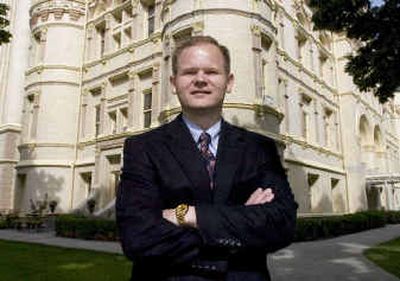

After spending several dormant years in the Army Reserve, a Spokane attorney is heading back into active duty.
But instead of diving into the trenches, Spokane County Deputy Prosecutor Patrick Johnson will plunge into the courtrooms to defend American soldiers facing charges that potentially range from murder and rape to theft and desertion.
While many of the details regarding his mobilization orders are up in the air until he reports Oct. 6 to Fort Bragg, N.C., Johnson, a member of the 22nd Legal Support Organization of the Judge Advocate General’s Corps, says resuming active duty as a 36-year-old captain diverges from his initial military experience as a 20-year-old private.
“With lawyers, we don’t really anticipate being in street combat,” he said of his role as a JAG reservist. “We go over with guns and flak jackets like other soldiers but don’t usually get involved in the fighting.”
Johnson didn’t deploy overseas when he served during the first Gulf War as a U.S. Army Psychological Operations Specialist from 1989 to 1992 He followed that with five years in the Army Reserve. His upcoming station is unknown.
Since 2002, he has prosecuted cases for the county’s special assault unit and has completed more than 50 trials, including murder, rape and drug charges. He joined Spokane’s JAG team of defense attorneys three years ago, a move that he says will require a change in mindset from his job as a county prosecutor.
“As a prosecutor, your client is the state of Washington. There isn’t face-to-face contact with an individual,” he said. “It’s frightening to know that when you have an individual client, you are responsible for their future. Their personal liberty is at interest.”
In addition, Johnson will hone his legal skills arguing the opposite side of cases, some of which may be similar to those he regularly prosecutes for the county.
“It will give him a good look at the other side,” said Spokane County Prosecutor Steve Tucker. “It should make him an even better lawyer.”
Military trials operate differently than civilian cases in the United States, according to Johnson. Although the same constitutional rights apply and many of the “court mechanics” are the same, courts-martial don’t require a unanimous jury – only two-thirds are required to agree to reach a verdict, Johnson said.
The jurors are drawn from the military and have the opportunity to ask questions during trials, which Johnson credited as an improvement in trial efficiency. In addition, he said it’s easier for attorneys to meet with their clients when they’re both anchored to the armed forces. His clients will likely be U.S. soldiers facing criminal charges, frequently with their jobs at stake, he said.
Until Johnson deploys in October, he is wrapping up cases, contacting clients whose trials will be transferred to another county prosecutor and spending time with his wife and children. His call to duty came as no surprise to his family, he said.
“Any time you get 140,000 or so soldiers together, some are going to misbehave and face charges of some sort,” he said, noting it was his turn to serve in their defense.
In recent years, only one other prosecutor, a bomber pilot, has left the county office for military service, Tucker said. He said the county has rearranged attorneys to cover their cases, and Johnson works in a unit they especially “can’t run too short on.”
“We hate to see him go,” Tucker said. “He’s got a lot of experience and is a great trial attorney.”
Johnson’s wife, 5-year-old son and 2-year-old twin sons will remain in Spokane during his service, which he admits could extend longer than the one year cited in his orders. And although he says he will likely serve within the United States, his family has supported his initial preference to go overseas.
“I would rather go to Iraq,” he said. “If the Army is going to send me away from my family for a year, I want it to be for something important. It seems like it would be more worthy of my separation from my family to be in Iraq.”