
Patience pays off in orchard
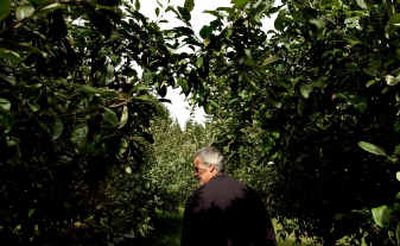
SAGLE, IDAHO – THE road to the orchard is rugged. It twists and turns, catapulting adventurous drivers straight to the heavens.
Words of encouragement are posted along the way, but they matter little. There’s no room for backing down now. A sign reminds, “All good things are hard to obtain.”
A quote from Thoreau and an emerald field await at the top. They pave the way to a rustic, wooden shack that bears the name “Talache Apple Co.”
Carver Kearney cleared a space in the woods south of Sagle more than 20 years ago. He had never farmed before, but a neighbor had. The retired orchardist told Kearney that his place would do just fine in bearing fruit.
Kearney had spent eight years as a captain in the Army. After serving in Vietnam, he returned to visit his parents, who had retired to Hayden Lake. The veteran fell in love with the area and found solace in the forest. He put his faith in his neighbor’s wisdom and planted 750 trees.
Kearney set out to learn all that he could about organic gardening, fighting fungus and trimming limbs. Wearing snowshoes, he began his solitary work of pruning boughs each January. He coaxed new growth by following an old adage: You can prune when your knife is sharp.
Then Kearney did what all good farmers learn to do. He waited.
Six years later he had enough fruit to establish relationships with wholesale markets in Oregon and Washington. He started a “U-pick” business as well. He gave up his trucking business, which had sustained him while the trees matured.
“A million miles was enough,” he said.
The West Virginia native likes inviting others to his lake view sanctuary to pick their own apples.
“I thought it would be a good way to share all this beauty,” he said.
Rows of Gravensteins offer gifts in shades of green and rose. Jonamacs and Galas slant to face the shores of Lake Pend Oreille. Rippling waters dance in synchrony with Bach and Vivaldi as Kearney pipes in music to put both visitors and trees at ease.
Mostly he shares his bounty with humans, who weigh their baskets of fruit on a dependable Toledo scale. Often, the orchard visitors are nonpaying guests who creep in from the woods and help themselves to the harvest. Kearney built a fence, which keeps out the deer, but does nothing to discourage a flock of turkeys. They fly over it and are welcome to graze in the grass.
Bears are persistent, so Kearney leaves a gate for them, an open hole at the bottom of the fence.
“We share the crop,” he said.
As many as four at a time may stop by and are usually polite. They don’t do much tree damage, Kearney said. They gorge on leftovers from the ground and swipe fruit from the branches only when the aroma is at its peak.
Growing apples in North Idaho isn’t like growing in the arid valley of Wenatchee. Cooler nights create a dense, slow-growing apple, Kearney said. The volume of fruit will never be as great and some years are harder than others. A cold winter in the mid-1990s killed quite a few of his Golden Delicious trees. He replaced them with hardier varieties. When Red Delicious apples started falling out of favor, he removed half of those trees and replaced them with Honeycrisps and Gingergolds.
Kearney is philosophical about the crop that has occupied his time and mind since 1980.
“I took this journey and I grew with the apples and the apples grew with me,” he said.
As more people move into the area, Kearney finds that the U-pick business has become a more important part of his operation. He ships fewer apples away. In the future, he dreams of setting up more picnic benches and building a gazebo. He imagines he could rent his orchard for gatherings and weddings. Bride and groom could stand with Eden at their backs and Lake Pend Oreille as their witness.
But all in time. Kearney has yielded more than fruit from his labor.
“Extreme patience,” he said, is the lesson he’s gained. “And to accept not what I want, but what nature gives me.”