
Poll shows voters want change in primary election
Robert Hitchcock of Five Mile thinks it’s a waste to be given four ballots and throw away three, as he was earlier this month in the state primary.
He also doesn’t like the new law that for the first time in nearly 70 years forced primary voters to pick just one party’s candidates.
“I honestly believe we should be able to go in and vote for whoever we want,” said Hitchcock, one of more than 400 voters contacted recently in a statewide poll.
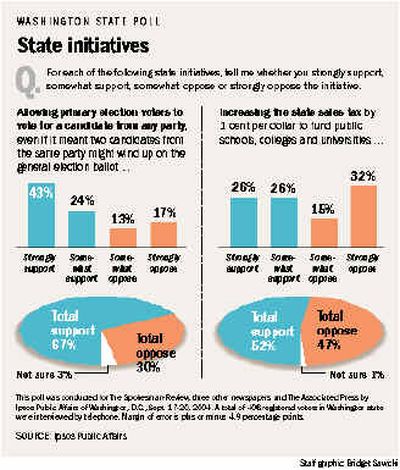
Two-thirds of the voters in the poll said they’d like to change the law so that they could vote for candidates of any party in a primary – something an initiative on the November ballot would let them do.
Other initiatives – to raise the sales tax to help pay for schools, expand casino gambling or approve charter schools – are closer calls, the poll suggests.
A description of each of those initiatives has a slim majority among voters surveyed. And as Robert Riehli, an analyst for the polling firm noted, initiatives tend to lose support as Election Day approaches.
“People have opinions but have not made up their minds,” Riehli said. “They’re going to hear a lot more before Election Day, and the numbers are going to shift around.”
The poll was conducted by Ipsos Public Affairs of Washington, D.C., for The Spokesman-Review, the Tacoma News Tribune, the Everett Herald and the Vancouver Columbian, and the Associated Press. The company contacted 500 state residents by phone between Sept. 17 and 20, and asked the 406 who said they were registered voters about issues that will help them pick candidates for key races in November.
As reported Sunday, voters rated the economy and the war as the top issues in the presidential race, and the economy the key to the gubernatorial race.
Ipsos also asked about the four statewide initiatives that give voters the chance to change the law at the ballot box in November. Just a few days after voters had been to the polls for the primary election, respondents were clear that they were not happy with the new system.
Federal courts had ruled the state had to restrict primary balloting so that voters can only mark one party’s ballot.
“People were very mad about the so-called Montana ballot,” Riehli said.
The survey shows the initiative is “enormously popular,” with independents and women among the most likely to want a choice on the primary ballot, he said.
Dee Ingle of Wenatchee said she didn’t like being restricted in the primary, although she’s “relatively happy” with the results. She describes herself as leaning Democratic, “but I have voted for both over the years. I don’t like to vote for just one party.”
She’ll vote for the change in November.
Mark Martin of Yakima thought the old system was fine, even if it sometimes meant he was picking “the lesser of two evils.” But he’s not sure that he’ll swap the new system for the initiative.
Under that proposal, the top two vote getters would advance to the general election, even if both are from the same party. That means you could get two bad candidates from the same party, he said.
Another initiative would raise the state sales tax by 1 cent for each $1 spent to pay for public schools and colleges.
In the survey, 52 percent of voters said they’d either definitely or probably vote yes, while 47 percent said they would definitely or probably vote no.
But the electorate is sharply divided along party lines, Riehli noted.
The sales tax hike has strong support among Democrats and those who say they plan to vote for Christine Gregoire, the Democratic candidate for governor. Republicans, and those who say they plan to vote for GOP gubernatorial candidate Dino Rossi, are strongly opposed.
Support for an initiative that would allow for the establishment of charter schools also splits along party lines, but in the opposite way, the poll suggests.
Republicans and Rossi voters support that proposal, while Democrats and Gregoire backers are likely to be against it. Overall, 53 percent said they’d support such a plan and 36 percent said they’d oppose it.
Although that’s roughly the same level of support as the education funding initiative, Riehli said, the charter school proposal is in slightly better shape at this point. It shows one voter in 10 undecided on the issue; the sales tax proposal is already opposed by nearly half of voters surveyed, with only 1 percent undecided.
A proposal to expand slot machine gambling off of Indian reservations as a way of providing property tax relief reveals some interesting cross currents in state politics, he added.
There’s no real difference on the issue between Democrats and Republicans, according to the survey.
The proposal has strong support among those who are so concerned about the economy that they say it’s the key issue in the governor’s race, the results showed. It’s also more popular with younger voters than older ones.
It faces its strongest opposition among people who said they attend church at least once a week, and those who have a college degree. The latter may have the opinion that the tax relief is “not worth the trouble” additional gambling could bring, Riehli suggested.
“It’s not a very well-developed issue, politically,” he said.